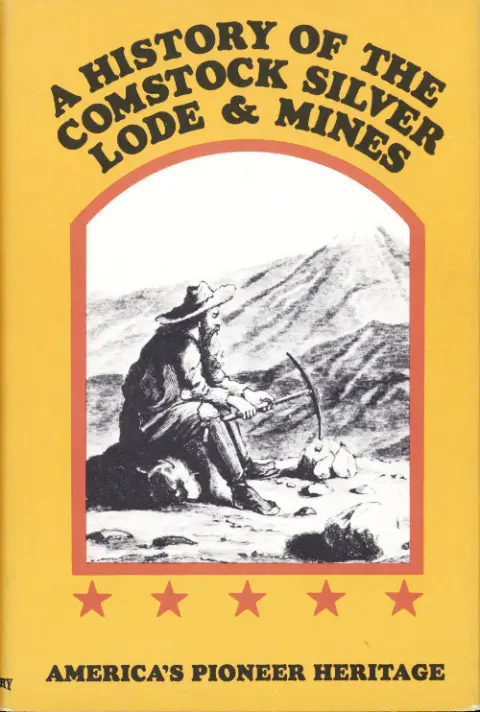
A History of the Comstock Silver Lode & Mines Nevada and the Great Basin Region; Lake Tahoe and the High Sierras
Dan De Quille
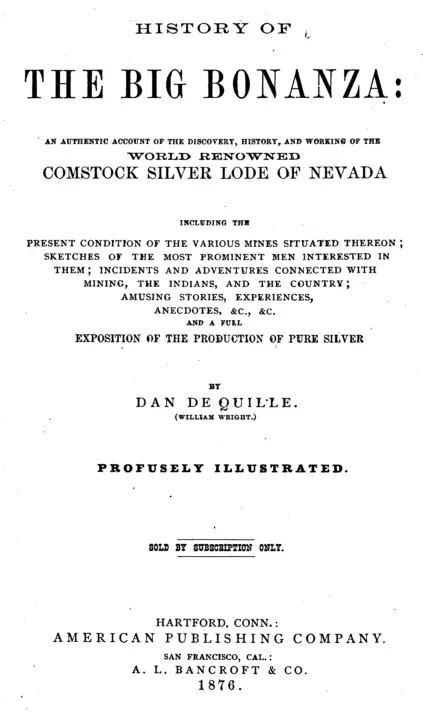
THE CLASSIC COLLECTION · 1876
"History of the Big Bonanza: An Authentic Account of the Discovery, History, and Working of the World Renowned Comstock Silver Lode of Nevada" by Dan De Quille is a historical account written in the latter part of the 19th century. This volume chronicles the significant discovery and development of the Comstock Lode, detailing the mining operations, the settlers, and the individuals who played key roles in this transformative era. The narrative not only covers the events surrounding the silver mining boom but also delves into the colorful lives and stories of those involved. The opening of this book sets the stage by examining the early days of settlement in Nevada and the legends that surrounded silver mining. It describes how the land transitioned from little known to being pivotal during the silver rush, emphasizing the contributions of early settlers. The author discusses the challenging environment, the conflict with Native Americans, and the emerging mining culture. Notably, it reveals the misconceptions early miners held about silver mining and introduces characters like "Old Virginia" and others who became significant figures as mining operations escalated. The narrative combines factual history with entertaining anecdotes, highlighting the intrigue and adventure of mining life during that transformative period.
Introduction adapted from the source catalogue; source summaries may be automatically generated.
Free to read · English · 180,009 words · No account needed
MAKE TIME FOR A GOOD BOOK
On by default. Untick to stop anonymous reading totals. Each page counts after 10 seconds in view. How this works.
Anonymous counting is on unless you have switched it off.
In 1861, Mr. Deidesheimer prevailed upon the Ophir Company to put up a forty-five horse-power engine, an eight-inch pump and improved hoisting machinery for the incline of the mine. The company thought this a fearfully extravagant move, and were almost frightened out of their wits when this “tremendous” machinery was first mentioned. Now there is hardly anything in the shape of a mine anywhere along the Comstock range on which there is not in operation more powerful and costly machinery.
At the depth of 180 feet, at what was called the third gallery, the width of the ore was, as I have said, 45 feet; at the fourth gallery it became 66 feet in width, and the miners were delighted to find that the new timbers supported the ground in the most perfect manner. At this time the ore extracted from this first bonanza was assorted as it was extracted. That which would average $1,000 per ton was sacked up and shipped to England for reduction, while the remainder was piled up as second and third-class ore, to await the erection of proper mills for working it at home. At the Mexican and other mines in the neighborhood, about the same disposition was at this time being made of the ores taken out, while at Gold Hill they had not yet attained a sufficient depth to reach the silver, and were working their ores for gold alone; though much silver was obtained with the gold.
The first mill started up for the reduction of silver ores was that known as the “Pioneer,” located at the Devil’s Gate, just where the warlike “Silverites” built their fort at the time of the Indian troubles. Other mills started up within a few days after this first one went into operation and soon there were many at work in all directions. The early millmen knew but little about working silver ores, and all manner of experiments were tried with a view to the thorough amalgamation of the silver contained in the rock that was crushed. This, in the opinion of most superintendents of mills, was to be accomplished by the use of chemicals. A more promiscuous collection of strange drugs and vegetable decoctions never before was used for any purpose. The amalgamating pans in the mills surpassed the caldron of Macbeth’s witches in the variety and villainousness of their contents. Not content with blue-stone (sulphate of copper), salt, and one or two other simple articles of known efficacy, they poured into their pans all manner of acids; dumped in potash, borax, saltpetre, alum, and all else that could be found at the drug-stores, then went to the hills and started in on the vegetable kingdom. They peeled bark off the cedar-trees, boiled it down till they had obtained a strong tea, and then poured it into the pans where it would have an opportunity of attacking the silver stubbornly remaining in the rocky parts of the ore. The native sage-brush, which everywhere covered the hills, being the bitterest, most unsavory, and nauseating shrub to be found in any part of the world, it was not long before a genius in charge of a mill conceived the idea of making a tea of this and putting it into his pans. Soon, the wonders performed by the “sage-brush process,” as it was called, were being heralded through the land. The superintendent of every mill had his secret process of working the silver ore. Often, when it was supposed that one of the superintendents had made a grand discovery, the workmen of the mill were bribed to make known the secret. To guard as much as possible against this, the superintendent generally had a private room in which he made his vile compounds. “Process-peddlers,” with little vials of chemicals in their vest pockets, went from mill to mill to show what they could do and would do, provided they received from $5,000 to $20,000 for their secret. The object with many inventors of “processes” appeared to be to physic the silver out of the rock, or at least to make it so sick that it would be obliged to loose its hold upon its matrix and come out and be caught by the quicksilver lying in wait for it in the bottom of the pans. Had it been in the dark ages that these experiments were in progress, the efficacy of the blood of human victims would doubtless have been tried; they would occasionally have hoisted an honest miner up from the subterranean depths and cut his throat over a pan. The “process-peddlers” finally became a worse nuisance than ever lightning-rod men have been—the limited space of country to which they were confined being considered—and the millmen became disgusted with all the patent processes—-their own as well as those of others—and soon little, save salt and blue-stone, was used in the pans. It was found that thorough grinding and careful working of the ore was what was required.
Your reading position is saved on this browser. Take it to another device with a library code. Reading pages adapt to text, rather than matching a printed edition.
BEHIND THE BOOK
This eBook is for the use of anyone anywhere in the United States and most other parts of the world at no cost and with almost no restrictions whatsoever. You may copy it, give it away or re-use it under the terms of the Project Gutenberg License included with this eBook or online at www.gutenberg.org. If you are not located in the United States, you will have to check the laws of the country where you are located before using this eBook. Read the source licence.
The original source file, including credits and licence, is retained by this library. Request an original-format copy at no charge. Please include the book title and Project Gutenberg identifier #74667.
KEEP YOUR CURIOSITY GOING
Wilfrid Scawen Blunt
Wilfrid Scawen Blunt

E. W. (Edgar Watson) Howe
Cécile Tormay

Moritz Busch
John L. Ransom