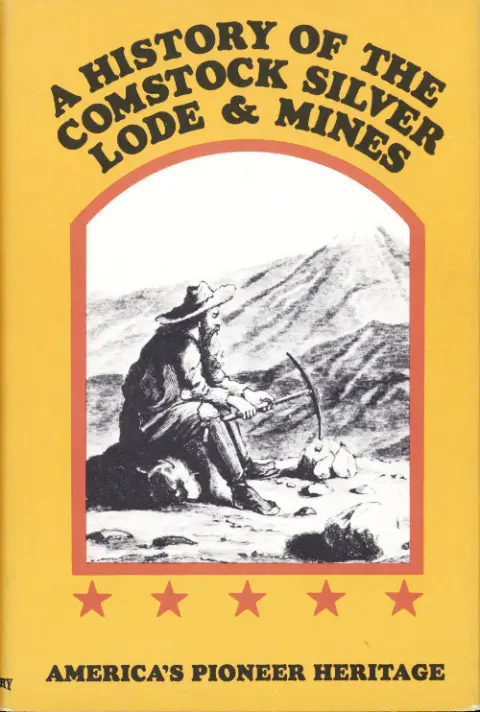
A History of the Comstock Silver Lode & Mines Nevada and the Great Basin Region; Lake Tahoe and the High Sierras
Dan De Quille
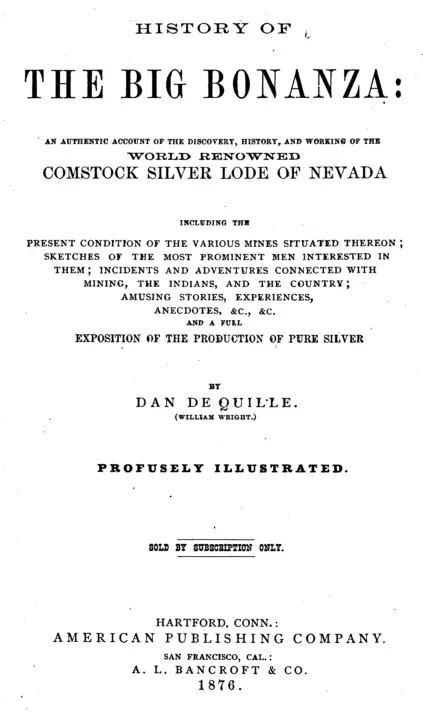
THE CLASSIC COLLECTION · 1876
"History of the Big Bonanza: An Authentic Account of the Discovery, History, and Working of the World Renowned Comstock Silver Lode of Nevada" by Dan De Quille is a historical account written in the latter part of the 19th century. This volume chronicles the significant discovery and development of the Comstock Lode, detailing the mining operations, the settlers, and the individuals who played key roles in this transformative era. The narrative not only covers the events surrounding the silver mining boom but also delves into the colorful lives and stories of those involved. The opening of this book sets the stage by examining the early days of settlement in Nevada and the legends that surrounded silver mining. It describes how the land transitioned from little known to being pivotal during the silver rush, emphasizing the contributions of early settlers. The author discusses the challenging environment, the conflict with Native Americans, and the emerging mining culture. Notably, it reveals the misconceptions early miners held about silver mining and introduces characters like "Old Virginia" and others who became significant figures as mining operations escalated. The narrative combines factual history with entertaining anecdotes, highlighting the intrigue and adventure of mining life during that transformative period.
Introduction adapted from the source catalogue; source summaries may be automatically generated.
Free to read · English · 180,009 words · No account needed
MAKE TIME FOR A GOOD BOOK
On by default. Untick to stop anonymous reading totals. Each page counts after 10 seconds in view. How this works.
Anonymous counting is on unless you have switched it off.
If Comstock had a ranche recorded which covered the site of Virginia City, the page containing such record must have been one in the old book of records of Gold Hill district. At first all claims located in Virginia district were recorded at Gold Hill.
September 23, 1859, Pat M^cLaughlin, one of the discoverers of the silver, sold his interest, one-sixth, in the Ophir mine for $3,500. Peter O’Riley, the other original discoverer, held on to his interest in the mine longer than any of the original locators, and received for it about $40,000, with back dividends amounting to four or five thousand dollars. Osborne received $7,000 for his ground.
V. A. Houseworth, the recorder at Gold Hill, who had trade for one-fourth of one-sixth interest in the mine, sold that interest to Judge Walsh, in September, 1859, for $3,000. All of these men supposed at the time that they were obtaining a big price for their interests in the mine. They knew nothing about silver-mines and feared that the deposit discovered might suddenly “peter” out.
November 30, 1859, E. Penrod sold to Gabriel Maldarnardo, a Mexican miner, his interest in the 100 feet of ground segregated to himself and Comstock, at the time the Ophir mine was located. The deed given on this occasion is quite a curiosity. It shows that the legal genius who drew it up was determined to corral all that was in sight in the way of “tenements, hereditaments” and “appurtenances.” It reads:
“For and in consideration of $3,000, to him in hand paid, this day, E. Penrod has remised, released, and quit-claimed, and by these presents do remise, release and quitclaim unto said party of the second part and his heirs and assigns forever, all his right, title, and interest in and to the undivided one-half of one hundred feet of a certain Quartz Lead known as the reserved claim of Comstock, Penrod, & Co., on the original location of the said company at Virginia City, near the head of Six-mile Cañon, in Virginia Mining District, said Territory of Utah, said claim known as the Spanish claim, together with all and singular the tenements, hereditaments and appurtenances thereunto belonging, or in anywise appertaining, and the reversion and reversions, remainder and remainders, rents, dues, and profits thereof. And, also, all the estate, right, title, interest, property, possession, claim, and demand whatsoever, as well in law as in equity, of said party of the first part, of, in, or to the above-described premises, and every part and parcel thereof, with the appurtences, to have and to hold, all and singular the above-mentioned and described premises, together with the appurtenances, unto the said party of the second part, to his heirs and assigns forever.”
Your reading position is saved on this browser. Take it to another device with a library code. Reading pages adapt to text, rather than matching a printed edition.
BEHIND THE BOOK
This eBook is for the use of anyone anywhere in the United States and most other parts of the world at no cost and with almost no restrictions whatsoever. You may copy it, give it away or re-use it under the terms of the Project Gutenberg License included with this eBook or online at www.gutenberg.org. If you are not located in the United States, you will have to check the laws of the country where you are located before using this eBook. Read the source licence.
The original source file, including credits and licence, is retained by this library. Request an original-format copy at no charge. Please include the book title and Project Gutenberg identifier #74667.
KEEP YOUR CURIOSITY GOING
Wilfrid Scawen Blunt
Wilfrid Scawen Blunt

E. W. (Edgar Watson) Howe
Cécile Tormay

Moritz Busch
John L. Ransom