THE CLASSIC COLLECTION✦Summer Morning: A poemCLASSIC FREE BOOKS
Summer Morning: A poem
Thomas Miller
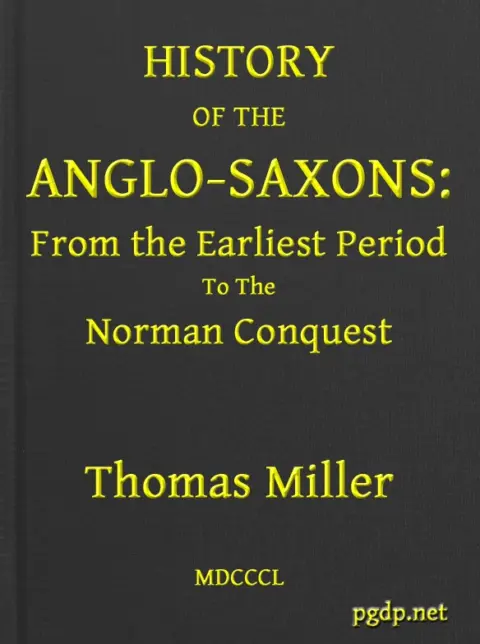
THE CLASSIC COLLECTION · 1850
"History of the Anglo-Saxons, from the Earliest Period to the Norman Conquest" by Thomas Miller is a historical account written in the mid-19th century. This work delves into the history of the Anglo-Saxon people, tracing their origins and conflicts from the pre-Roman era through to the Norman Conquest. It aims to document the cultural and political evolution of Britain during a time of significant transformation. The opening of the book sets a reflective tone, lamenting the obscurity surrounding Britain's early history. It highlights the scarce records we possess about the ancient Britons and their customs, depicting them as a rudimentary society struggling against formidable beasts and other tribes. The narrative evokes a sense of mystery regarding the origins of civilization in Britain, pondering the depths of prehistoric life while establishing the ancient Britons' connection to the broader Celtic heritage. Miller also introduces the looming presence of Roman invaders, setting the stage for the dramatic historical conflicts that will shape the future of England.
Introduction adapted from the source catalogue; source summaries may be automatically generated.
Free to read · English · 157,382 words · No account needed
MAKE TIME FOR A GOOD BOOK
On by default. Untick to stop anonymous reading totals. Each page counts after 10 seconds in view. How this works.
Anonymous counting is on unless you have switched it off.
"He that hath ability may raise a church to the praise of God, and if he has wherewithal, let him give land to it, and allow ten young men, so that they may serve in it, and minister the daily service. He may repair churches where he can, and make folk-ways, with bridges over deep waters, and over miry places; assist poor men's widows, step-children, and foreigners. He may free his own slaves, and redeem the liberty of those who belong to other masters, and especially the poor captives of war. He may feed the needy, house them, clothe and warm them, and give them baths and beds."
Thus did our pious ancestors make crime administer to the wants of the poor; they filtered the pure waters of charity from these corrupt sources, and displayed a wisdom which our modern legislators have yet to be taught.
When the Saxons first landed in England they could have had no previous knowledge of the Roman laws, which were then in existence in our island; for the government of the conquerors had long overthrown the primitive customs which were in use among the ancient Britons before the landing of Julius Cæsar. We have already shown that the earliest of our Saxon invaders were led on by some military chief, who claimed his descent from Odin, and was acknowledged as leader by the consent of his followers, also allowed the largest share of the plunder or captives which were taken in war. Thus it would naturally follow, that when they came to settle down upon the soil which they had conquered, the power of the military chief would soon be acknowledged, and that to him would be given the greatest portion of the land; while amongst his followers such shares would be distributed as were considered proportionate to their rank. After having conquered and divided the land, they would naturally unite together to defend the possessions they had won, and the chief, or his descendant,--if found worthy of being still retained at their head, by his wisdom or valour--would, either in peace or war, continue to hold the title and power of ruler; and thus would governments be formed, thrones established, and laws made by the wealthy and powerful, to keep their followers and captives in subjection. Nor would it be probable in all instances that the conquered were made captives. Many by their valour and opposition would still present a formidable front to the invaders; and as both parties would in time grow weary of a continued system of attack or defence, concessions would be made, peace agreed upon, the land divided, vows sworn, and penalties fixed, to be paid by those who first broke the treaty. In such cases, war would not be entered into by either party without their first stating the grievances. This, again, would lead to discussions, assemblies, accusations, defences; times and places would be allotted for meeting; and so courts and tribunals were formed; and thus in all countries did law and civilization commence. We have shown how England was at first divided into separate kingdoms; how chief after chief came over, fought, conquered, and established a separate state, until the Octarchy was formed; and that when the whole island was occupied, the Saxon kings began to make war upon each other, until state after state was subdued, and one king at last reigned over all. That governors had to be placed over different divisions of this vast extent of territory; that these, again, placed officers over the sub-divisions: thus there were earls or aldermen, sheriffs, or shrieves, officers to each hundred or tithing; headboroughs, frankpledges, who attended the court-leet which was held at given periods, and accounted for all grievances or violations of the law. The first laws made would naturally be those which protected persons and property,--to punish acts of violence and theft, and to prevent personal vengeance being inflicted. Thus, murder might be compounded for, under certain circumstances, at a fixed penalty, and every portion of the body injured had its price, from the leg to the little finger, even down to the hair, tooth, or nail. The loss of an eye and a leg appears to have been considered the most important, and was punished by a fine of fifty shillings. To lame a person only, the sum exacted was thirty shillings. To wound, or strike such a blow as caused deafness, twenty-five shillings; for fracturing the skull, twenty shillings; for cutting off the little finger, eleven shillings; tearing off the hair, ten shillings. For tearing off a nail, or driving out a tooth, the penalty was one shilling; but if a front tooth, the charge was six shillings. Robbery was punished according to the rank of the party plundered. If a freeman committed robbery, he forfeited all his goods and his freedom; if he was taken in the fact, and the stolen property found in his hand, the king had the option of killing him, of selling him, or receiving the value of his Were, which was the sum at which his life would have been rated had he been murdered. Even the life of the king had its Were or value. One hundred and twenty pounds was the price fixed to be paid as the penalty for the murder of a king. A noble's, a bishop's, an alderman's, a thane's, a servant's, had each its fixed penalty, according to the rank of the deceased,--from that of the king, as above named, to the humblest hind, whose life was rated at thirty shillings. Besides the Were, there was another protection, called the Mund. This seems to have been a penalty paid for disturbing the peace of a man's household; or, as Sharon Turner has observed, "it was a privilege which made every man's house his castle." The Saxons had also their bail or sureties. Thus, when a man had committed homicide, he had to find borh, or sureties for the payment of the penalty. The time allowed for payment is not mentioned, excepting in one case, where it appears to have been limited to forty days. The head of every tithing, or ten families, also appears to have been responsible for those under his jurisdiction or keeping, as we have previously shown in the reign of Alfred. He who had no surety, or borh, or could not pay the penalty for the crime committed, or had no kinsman to redeem him, either became a slave, or might be slain, according to the nature of the offence.
Your reading position is saved on this browser. Take it to another device with a library code. Reading pages adapt to text, rather than matching a printed edition.
Thomas Miller
Thomas Miller
Thomas Miller
BEHIND THE BOOK
This eBook is for the use of anyone anywhere in the United States and most other parts of the world at no cost and with almost no restrictions whatsoever. You may copy it, give it away or re-use it under the terms of the Project Gutenberg License included with this eBook or online at www.gutenberg.org. If you are not located in the United States, you will have to check the laws of the country where you are located before using this eBook. Read the source licence.
The original source file, including credits and licence, is retained by this library. Request an original-format copy at no charge. Please include the book title and Project Gutenberg identifier #45366.
KEEP YOUR CURIOSITY GOING
Cécile Tormay

Moritz Busch
John L. Ransom
Frances Wright
Cécile Tormay

Mabel Potter Daggett