THE CLASSIC COLLECTION✦Stories of Many LandsCLASSIC FREE BOOKS
Stories of Many Lands
Grace Greenwood
THE CLASSIC COLLECTION · 1851
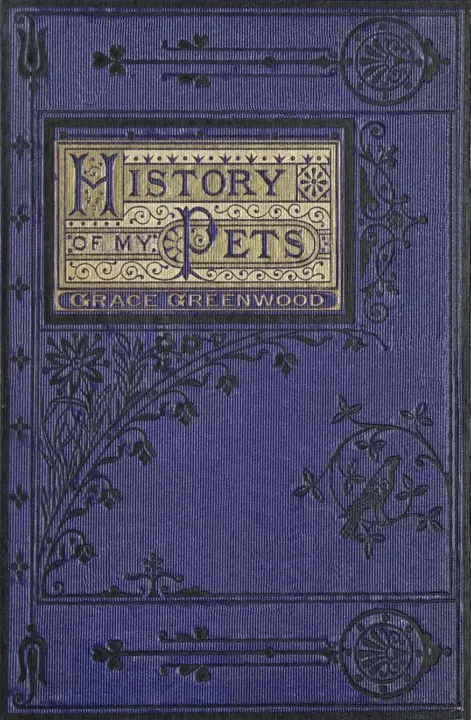
"History of My Pets" by Grace Greenwood is a collection of nostalgic narratives written in the mid-19th century. The book chronicles the author’s affectionate experiences with her beloved pets, including a kitten named Keturah, a cockerel named Sam, and a hawk named Toby, among others. Through these stories, readers can expect an exploration of childhood emotions, the bonds formed with animals, and the heartache that sometimes accompanies those relationships. The opening of the book introduces Keturah, a white kitten gifted to the young narrator after a difficult day at school. With vivid detail, Greenwood recounts the joy and challenges of caring for Keturah, including a memorable experience of accidentally falling asleep in church with the kitten hidden in her shawl, leading to an unexpected overnight adventure. The young girl's close bond with Keturah is evident, showcasing the innocence and warmth of childhood as well as the deeper emotional ties to animals that accompany both joy and grief. This heartfelt beginning sets a charming tone for the anecdotes that follow, inviting readers to join in the ups and downs of pet ownership through a child’s eyes.
Introduction adapted from the source catalogue; source summaries may be automatically generated.
Free to read · English · 27,306 words · No account needed
MAKE TIME FOR A GOOD BOOK
On by default. Untick to stop anonymous reading totals. Each page counts after 10 seconds in view. How this works.
Anonymous counting is on unless you have switched it off.
When Toby had finished his meal, he would wipe his beak with his wing, mount on my shoulder, and ride home again; sometimes, when it was a very warm day and he had dined more heartily than usual, he would fall asleep during the ride, still holding on to his place with his long, sharp claws. Sometimes I would come home with my pinafore torn and bloody on the shoulder, and then my mother would scold me a little and laugh at me a great deal. I would blush and hang my head and cry, but still cling to my strange pet; and when he got full-grown and had wide, strong wings, and a great, crooked beak that every body else was afraid of, I was still his warm friend and his humble servant, still carried him to his meals three times a day, shut him into his house every night, and let him out every morning. Such a life as that bird led me!
Toby was perfectly tame, and never attempted to fly beyond the yard. I thought this was because he loved me too well to leave me; but my brothers, to whom he was rather cross, said it was because he was a stupid fowl. Of course they only wanted to tease me. I said that Toby was rough, but honest; that it was true he did not make a display of his talents like some folks, but that I had faith to believe that, some time before he died, he would prove himself to them all to be a bird of good feelings and great intelligence.
Finally the time came for Toby to be respected as he deserved. One autumn night I had him with me in the sitting-room, where I played with him and let him perch on my arm till it was quite late. Some of the neighbours were in, and the whole circle told ghost-stories, and talked about dreams, and warnings, and awful murders, till I was half frightened out of my wits; so that, when I went to put my sleepy hawk into his little house, I really dared not go into the dark, but stopped in the entry, and left him to roost for one night on the hat-rack, saying nothing to any one. Now it happened that my brother William, who was then about fourteen years of age, was a somnambulist,--that is, a person who walks in sleep. He would often rise in the middle of the night, and ramble off for miles, always returning unwaked. Sometimes he would take the horse from the stable, saddle and bridle him, and have a wild gallop in the moonlight. Sometimes he would drive the cows home from pasture, or let the sheep out of the pen. Sometimes he would wrap himself in a sheet, glide about the house, and appear at our bedside like a ghost. But in the morning he had no recollection of these things. Of course, we were very anxious about him, and tried to keep a constant watch over him, but he would sometimes manage to escape from all our care. Well, that night there was suddenly a violent outcry set up in the entry. It was Toby, who shrieked and flapped his wings till he woke my father, who dressed and went down stairs to see what was the matter. He found the door wide open, and the hawk sitting uneasily on his perch, looking frightened and indignant, with all his feathers raised. My father, at once suspecting what had happened, ran up to William’s chamber and found his bed empty; he then roused my elder brothers, and, having lit a lantern, they all started off in pursuit of the poor boy. They searched through the yard, garden, and orchard, but all in vain. Suddenly they heard the saw-mill, which stood near, going. They knew that the owner never worked there at night, and supposed that it must be my brother, who had set the machinery in motion. So down they ran as fast as possible, and, sure enough, they found him there, all by himself. A large log had the night before been laid in its place ready for the morning, and on that log sat my brother, his large black eyes staring wide open, yet seeming to be fixed on nothing, and his face as pale as death. He seemed to have quite lost himself, for the end of the log on which he sat was fast approaching the saw. My father, with great presence of mind, stopped the machinery, while one of my brothers caught William and pulled him from his perilous place. Another moment, and he would have been killed or horribly mangled by the cruel saw. With a terrible scream, that was heard to a great distance, poor William awoke. He cried bitterly when he found where he was and how he came there. He was much distressed by it for some time; but it was a very good thing for all that, for he never walked in his sleep again.
Your reading position is saved on this browser. Take it to another device with a library code. Reading pages adapt to text, rather than matching a printed edition.
BEHIND THE BOOK
This eBook is for the use of anyone anywhere in the United States and most other parts of the world at no cost and with almost no restrictions whatsoever. You may copy it, give it away or re-use it under the terms of the Project Gutenberg License included with this eBook or online at www.gutenberg.org. If you are not located in the United States, you will have to check the laws of the country where you are located before using this eBook. Read the source licence.
The original source file, including credits and licence, is retained by this library. Request an original-format copy at no charge. Please include the book title and Project Gutenberg identifier #71523.
KEEP YOUR CURIOSITY GOING
Coulson Kernahan

Maurice Baring
Frances Wright
Cécile Tormay

Frederic Jesup Stimson

W. H. P. (William Henry Pope) Jarvis