THE CLASSIC COLLECTION✦An outlaw’s diary: the CommuneCLASSIC FREE BOOKS
An outlaw’s diary: the Commune
Cécile Tormay
THE CLASSIC COLLECTION · 1871
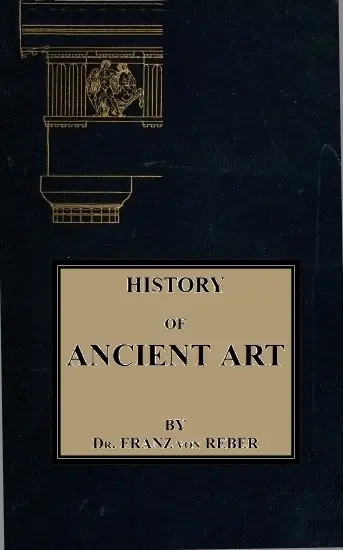
"History of Ancient Art" by Franz von Reber is a scholarly historical account written in the late 19th century. It explores the development, significance, and various manifestations of ancient art across different cultures, including Egypt, Mesopotamia, and Greece, shedding light on their artistic achievements and relevance to civilization. The opening of the text sets the stage for a comprehensive examination of ancient art, beginning with the significance of Egypt's monumental achievements such as the pyramids, and discussing their enduring influence on architectural design. Reber emphasizes the importance of methodical historical study in understanding the evolution and context of art forms, arguing that art functions as a vital record of civilization that conveys cultural values, emotions, and societal structures across time. He highlights the need for clarity in the study of ancient arts, aiming to provide a judicious and well-informed overview that is accessible to students and advanced scholars alike.
Introduction adapted from the source catalogue; source summaries may be automatically generated.
Free to read · English · 149,331 words · No account needed
MAKE TIME FOR A GOOD BOOK
On by default. Untick to stop anonymous reading totals. Each page counts after 10 seconds in view. How this works.
Anonymous counting is on unless you have switched it off.
The Heracles may be regarded as a study. Charis and Tyche were allegories, the latter having been represented sitting “because happiness does not stand fast.” The most celebrated of them all, Calumny, is minutely described by Lucian. It portrayed a man, whose inclination to credit evil reports was characterized by large ears, sitting between two women, Ignorance and Mistrust, and receiving Calumny, a magnificent woman excited with passion, preceded by Envy; she drags in a youth by the hair, who vainly, with hands uplifted, calls the gods to witness. Behind the train advances Repentance, a mourning female figure in black, looking back with pain and shame upon the tardy appearance of Truth. Similar in character is the picture of the chained war demon, belonging partly to the group of portraits. A third allegory, of little intrinsic worth, is set forth with great artistic ability--Bronte, Astrape, and Keraunobolia--thunder, with the flash and stroke of lightning.
Among the portraits, allegorical in nature, was the famous picture in which Alexander, with lightning in his right hand, was represented as Jupiter. The monarch himself was so well pleased with this that he said there were two Alexanders--one the unconquered son of Philip, the other the inimitable creation of Apelles. But little is known of the king’s portraits, whether equestrian, in triumphal chariots, or surrounded by deities and allegorical figures; nor of those of Philip and his generals, of the tragic actor Gorgosthenes of Habron, nor of that of the artist himself.
If Apelles be scrutinized more closely in order to make clear the chief characteristics by which he won such brilliant renown, it will be found that it was not in composition. In this, as in treatment of perspective, he gave precedence to his fellow-pupils Melanthios and Asclepiodoros. That he was aware of this weakness, and avoided occasion for manifesting it, is shown by the fact that most of his paintings contained few figures. When more appeared, instead of being picturesquely grouped and treated, they were ranged in rows, almost like reliefs, better suited to the allegorical subjects so prevalent with Apelles, and so common in his time, than to mythological and historical representations. Though allegory may, in great measure, be unfavorable to true art, because, as Winckelmann says, it forces the painter “to tint his brush with reason,” still that of Apelles has lately been too much depreciated. The Calumny has been pronounced an error of fancy, rough symbolism, and an inharmonious assemblage of persons and personifications. But these were the legitimate materials of the artist, and he succeeded, at least, in the representation of character and in truthfulness of drawing. The lightning group was something more than a piece of technical bravura. Who would prize the picture less because thunder and lightning were represented instead of Zeus, a deity who would have been attempted by no painter of antiquity, or, indeed, of later times? Though his motive may have been purely intellectual, the painter remained the same, whether he portrayed a Cassandra or a Diabole--whether he more or less displayed his astounding mastery. Apelles will be more rightly judged if he be treated as a painter rather than an artist; as such we recognize in him a technical and many-sided perfection. Different accounts speak of him as rapid and sure in drawing, his lines being not only correct, but in the highest degree characteristic. The maxim of Apelles “No day without a line”--that is, without exercise in drawing--has become a proverb, if not quite in its original sense. Through this incessant practice his hand acquired such sureness that it followed the will implicitly, and made possible even the hair-splitting execution related in an anecdote which has been unjustly discredited by critics. Apelles entered one day the workshop of Protogenes, in the absence of the latter, and made known his visit by drawing a line upon a tablet at hand with such swing and surety, such purity and smoothness, that the Rhodian master, upon his return, recognized the hand of Apelles. In order to show himself equal, Protogenes split the line by a second one in a different color, but acknowledged himself defeated when Apelles divided this through its entire length by a third. An evidence of the sharpness and certainty of his characterization with simple lines is given in the story of a servant who had injured him, and whom Apelles, though he had seen him only once, so sketched with charcoal upon the wall that the likeness was recognized by King Ptolemy after the first strokes. It will readily be understood that such capacity must have fitted the artist especially for portraiture; and his portraits attained such striking likeness and truthfulness that a physiognomist assumed to be able, by them, to discern not only the exact age of the subject, but even the time of his future death. No further testimony is needed than the Anadyomene to prove that his works were perfect in correctness and expression as well as in beauty.
Your reading position is saved on this browser. Take it to another device with a library code. Reading pages adapt to text, rather than matching a printed edition.
BEHIND THE BOOK
This eBook is for the use of anyone anywhere in the United States and most other parts of the world at no cost and with almost no restrictions whatsoever. You may copy it, give it away or re-use it under the terms of the Project Gutenberg License included with this eBook or online at www.gutenberg.org. If you are not located in the United States, you will have to check the laws of the country where you are located before using this eBook. Read the source licence.
The original source file, including credits and licence, is retained by this library. Request an original-format copy at no charge. Please include the book title and Project Gutenberg identifier #42082.
KEEP YOUR CURIOSITY GOING
Cécile Tormay

Moritz Busch
John L. Ransom
Frances Wright
Cécile Tormay

Mabel Potter Daggett