
Historical record of the Ninety-second Regiment, originally termed “The Gordon Highlanders” and numbered the Hundredth Regiment
Richard Cannon
THE CLASSIC COLLECTION · 1849
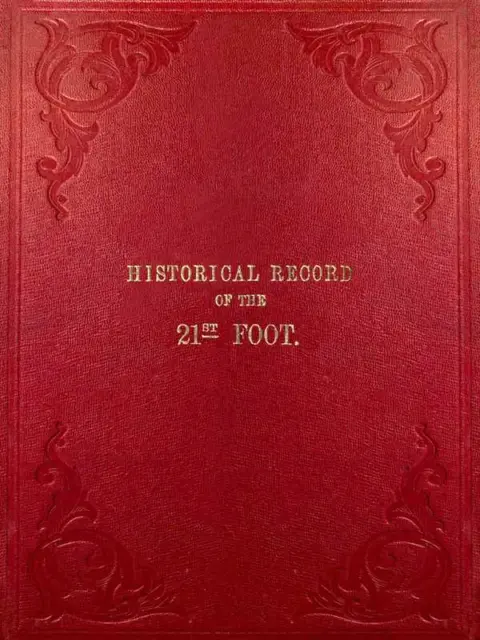
"Historical Record of the Twenty-first Regiment, or the Royal North British Fusiliers" by Richard Cannon is a historical account written in the mid-19th century. The work provides a detailed chronicle of the formation and military history of the Twenty-first Regiment from its inception in 1678 through its actions up to 1849. The focus is on the regiment's contributions and achievements in various significant conflicts, emphasizing the valor and dedication of the British soldiers. The opening of the historical record outlines the establishment of the Twenty-first Regiment during a tumultuous period in Scotland, where political and religious conflicts prevailed. It discusses the regiment's origins under the command of Charles, Earl of Mar, and its initial armament with light muskets as "Fusiliers." The narrative provides context about the political landscape of the time, mentioning key events such as the murder of Archbishop Sharp and the subsequent battle at Bothwell Bridge, setting the stage for the regiment's evolving role in military campaigns over the centuries. The text establishes a foundation for understanding the regiment’s storied history, detailing both significant battles and changes in military tactics as they relate to the regiment's experiences.
Introduction adapted from the source catalogue; source summaries may be automatically generated.
Free to read · English · 24,201 words · No account needed
MAKE TIME FOR A GOOD BOOK
On by default. Untick to stop anonymous reading totals. Each page counts after 10 seconds in view. How this works.
Anonymous counting is on unless you have switched it off.
In September, 1831, the regiment marched for Dublin, where it embarked for England in October, and landing at Liverpool, afterwards proceeded to Weedon. In 1832 it was removed to Chatham.
[Sidenote: 1833]
During the years 1832 and 1833, the regiment embarked, by detachments, in charge of convicts, for New South Wales, and it was stationed in Australia and Van Diemen's Land until the year 1839.
[Sidenote: 1839]
Five companies and head-quarters embarked from Hobart Town, in February, 1839, for the East Indies, and arriving at Calcutta in May, afterwards proceeded to Chinsurah. They were followed by two companies from Hobart Town in March, 1840; and two from the Swan River settlement in July.
[Sidenote: 1840]
In April, 1840, the head-quarters were removed to Calcutta; and in
August, the regiment embarked for Dinapore, where it arrived in
September.
[Sidenote: 1841]
The regiment was stationed at Dinapore during the year 1841.
[Sidenote: 1842]
[Sidenote: 1843]
Leaving Dinapore in November, 1842, the regiment commenced its march for Agra: but on arriving at Mirzapoor, its destination was changed to Kamptee, at which place it arrived on the 6th of February, 1843.
[Sidenote: 1844]
During the year 1844, the regiment remained at Kamptee.
[Sidenote: 1845]
The regiment commenced its march from Kamptee en route to the north-western provinces of Bengal on the 6th of December, 1845, and arrived at Jubbulpore on the 30th of that month.
[Sidenote: 1846]
The regiment resumed its march on the 1st of January, 1846, and arrived at Agra on the 7th of February, where it was stationed during the remainder of the year.
[Sidenote: 1847]
Leaving Agra on the 15th of January, 1847, the regiment arrived at Cawnpore on the 1st of February. From Cawnpore the regiment proceeded, in November, to Calcutta, at which place it arrived on the 30th of December.
Orders were at this period given for the return to England of the TWENTY-FIRST, ROYAL NORTH BRITISH FUSILIERS, and three hundred and ninety-three soldiers transferred their services to other regiments remaining in India.
In January, 1848, the regiment, under the command of Lieutenant-Colonel John Thomas Hill, embarked at Calcutta, and arrived at Gravesend on the 11th of May.
The regiment was, in the first instance, stationed at Canterbury, from which city it proceeded to Edinburgh in July, 1848.
On the 1st of June, 1849, the period to which this Record has been continued, the regiment continued to be stationed at Edinburgh Castle, under the command of Lieutenant-Colonel Thomas Gore Browne.
Your reading position is saved on this browser. Take it to another device with a library code. Reading pages adapt to text, rather than matching a printed edition.
Richard Cannon
Richard Cannon

Richard Cannon
Richard Cannon
BEHIND THE BOOK
This eBook is for the use of anyone anywhere in the United States and most other parts of the world at no cost and with almost no restrictions whatsoever. You may copy it, give it away or re-use it under the terms of the Project Gutenberg License included with this eBook or online at www.gutenberg.org. If you are not located in the United States, you will have to check the laws of the country where you are located before using this eBook. Read the source licence.
The original source file, including credits and licence, is retained by this library. Request an original-format copy at no charge. Please include the book title and Project Gutenberg identifier #54029.
KEEP YOUR CURIOSITY GOING
Cécile Tormay

Moritz Busch
John L. Ransom
Frances Wright
Cécile Tormay

Mabel Potter Daggett