
Historical record of the Ninety-second Regiment, originally termed “The Gordon Highlanders” and numbered the Hundredth Regiment
Richard Cannon
THE CLASSIC COLLECTION · 1853
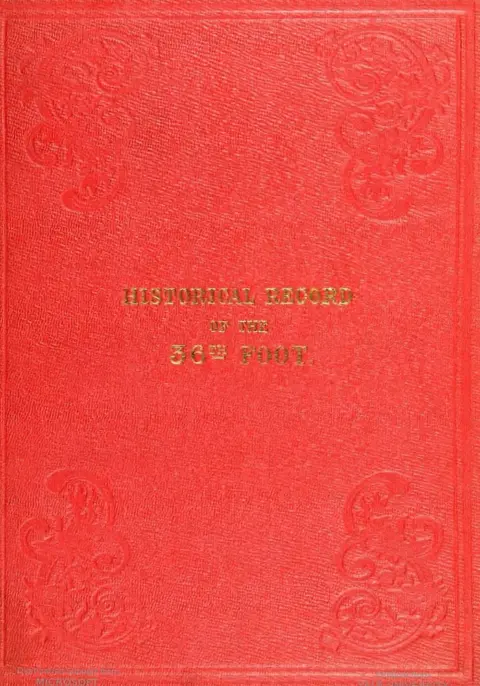
"Historical Record of the Thirty-sixth, or the Herefordshire Regiment of Foot" by Richard Cannon is a historical account written in the mid-19th century. This record details the formation and service history of the Thirty-sixth Regiment, highlighting its notable operations from its inception in the early 18th century to the mid-19th century. The book likely explores military campaigns, battles, and the evolution of the regiment over time, focusing on the valor and achievements of its soldiers." "The opening of the book begins with a transcriber's note indicating the formatting conventions used throughout the text. Following this, there’s a general order detailing the command by the British monarchy for comprehensive accounts of each regiment's service in the military, emphasizing the importance of recording bravery and achievements for historical reference. The preface articulates the rationale for chronicling the regiment's history, which serves to inspire future soldiers by showcasing their predecessors' valor and dedication. The introduction sets the stage for the regiment’s history, referencing significant historical contexts such as the War of the Spanish Succession and the intrinsic military values of British infantry, thereby framing the subsequent detailed accounts of the Thirty-sixth's engagements in various military operations."
Introduction adapted from the source catalogue; source summaries may be automatically generated.
Free to read · English · 45,807 words · No account needed
MAKE TIME FOR A GOOD BOOK
On by default. Untick to stop anonymous reading totals. Each page counts after 10 seconds in view. How this works.
Anonymous counting is on unless you have switched it off.
Thus ended a battle in which the THIRTY-SIXTH regiment behaved with great gallantry, but was nearly annihilated. Captains Musgrave and Parsons, Lieutenants Ayriss and Ballance, and Ensign Wells were killed; the following officers of the regiment were taken prisoners:--
Colonel Alnutt (wounded).
Lieut.-Colonel Frankland.
Lieut.-Colonel Barry (wounded).
Lieutenant Hicks.
Lieutenant Duckinfeild (wounded).
Lieutenant Wants.
Lieutenant Dancer (wounded).
Lieutenant Bishop.
Ensign Bennet (wounded).
Ensign Erwine.
Ensign Sheen (wounded).
Ensign Pascal.
Ensign Money.
The number of non-commissioned officers and soldiers killed, wounded, and taken prisoners at the battle of Almanza has not been ascertained; those who escaped, and were found serviceable, were afterwards transferred to other corps in Spain, and certain of the officers returned to England to recruit the regiment.
On the 15th of September 1707, orders were addressed to Colonel Alnutt to recruit and fill up the respective companies of the regiment; and the recruits were to assemble at Chester and Namptwich, which places were appointed for the rendezvous of the corps.
[Sidenote: 1708.]
In the Annals of Queen Anne for the year 1708, it is stated, “Some time before, orders and commissions were delivered for new raising the regiments of--
Mordaunt’s, afterwards Twenty-eighth regiment,
Wade’s, afterwards Thirty-third regiment,
Gorges’s, afterwards Thirty-fifth regiment,
Alnutt’s, afterwards Thirty-sixth regiment,
Montjoy’s, afterwards disbanded,
Mackartney’s, afterwards disbanded,
Lord Mark Kerr’s, afterwards disbanded,
which suffered most at the battle of Almanza, and the officers whereof, who were prisoners in France, were supplied by others.”
[Sidenote: 1709.]
Colonel Archibald Earl of Ilay, afterwards Duke of Argyle, was appointed to the colonelcy of the THIRTY-SIXTH regiment on the 23d of March 1709, in succession to Colonel Thomas Alnutt, deceased.
[Sidenote: 1710.]
On the 23d of October 1710, Colonel Henry Desaulnais (afterwards spelt Desney) from the Coldstream foot guards, was appointed to the colonelcy of the THIRTY-SIXTH regiment, in succession to Colonel the Earl of Ilay, resigned.
During the nine years which this war had been raging in Europe, British blood and treasure had been expended in making conquests for the house of Austria. The only advantage which had accrued to Great Britain was, that the power of the House of Bourbon had been diminished, and that of Austria augmented; the new Ministry chosen by Queen Anne, in 1710, resolved to act upon a different principle. Colonel Nicholson having made a successful attack on Port Royal, in Nova Scotia, on his return to England he submitted to the Government a plan for the reduction of Placentia and Quebec, as a preparatory measure for acquiring Canada for the British crown, and for expelling the French from Newfoundland, in order to regain the fishery.
Your reading position is saved on this browser. Take it to another device with a library code. Reading pages adapt to text, rather than matching a printed edition.
Richard Cannon
Richard Cannon

Richard Cannon
Richard Cannon
BEHIND THE BOOK
This eBook is for the use of anyone anywhere in the United States and most other parts of the world at no cost and with almost no restrictions whatsoever. You may copy it, give it away or re-use it under the terms of the Project Gutenberg License included with this eBook or online at www.gutenberg.org. If you are not located in the United States, you will have to check the laws of the country where you are located before using this eBook. Read the source licence.
The original source file, including credits and licence, is retained by this library. Request an original-format copy at no charge. Please include the book title and Project Gutenberg identifier #66598.
KEEP YOUR CURIOSITY GOING
Cécile Tormay

Moritz Busch
John L. Ransom
Frances Wright
Cécile Tormay

Mabel Potter Daggett