
Historical record of the Ninety-second Regiment, originally termed “The Gordon Highlanders” and numbered the Hundredth Regiment
Richard Cannon
THE CLASSIC COLLECTION · 1844
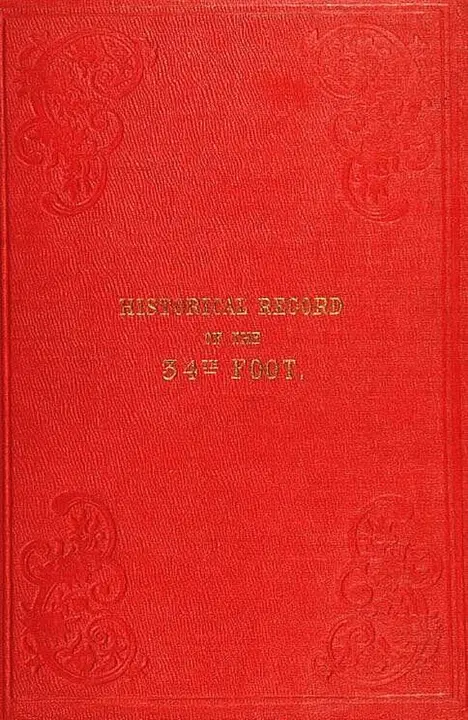
"Historical Record of the Thirty-fourth, or the Cumberland Regiment of Foot" by Richard Cannon is a historical account written in the mid-19th century. The book provides a detailed history of the Thirty-fourth Regiment of Foot, tracing its formation in 1702 through its military engagements up until 1844. The text focuses on the regiment's various campaigns, notable battles, and significant contributions to military history. The opening of this historical record outlines the rationale for documenting the military achievements of British regiments, emphasizing the importance of inspiring future soldiers through the stories of past bravery and sacrifice. It describes the establishment and early years of the Thirty-fourth Regiment, detailing its formation under Colonel Robert Lord Lucas and subsequent deployments in various military expeditions. A narrative of valor, challenges, and growth is set, showcasing how the regiment served in key battles and operations across Europe and beyond, reflecting the broader context of British military history.
Introduction adapted from the source catalogue; source summaries may be automatically generated.
Free to read · English · 31,371 words · No account needed
MAKE TIME FOR A GOOD BOOK
On by default. Untick to stop anonymous reading totals. Each page counts after 10 seconds in view. How this works.
Anonymous counting is on unless you have switched it off.
Lieutenant-General the Honorable Sir G. Lowry Cole, G.C.B., was removed to the Twenty-seventh, or the Inniskilling Regiment, of Foot, and was succeeded in the colonelcy of the THIRTY-FOURTH, by Lieutenant-General Sir Thomas Makdougall Brisbane, Bart, G.C.B., G.C.H., by commission, dated the 16th of December, 1826.
[Sidenote: 1827]
[Sidenote: 1828]
After remaining twelve months at Dublin, the head-quarters were removed to Templemore, in May, 1827, and in September to Galway, furnishing twelve detachments to military stations in that neighbourhood. In April, 1828, the regiment was removed to Buttevant; and in July to Cork.
[Sidenote: 1829]
During the six years which had elapsed from the date of the arrival of the regiment from India, it had recruited its ranks and attained a state of discipline and efficiency, and its turn to proceed abroad having arrived in August, 1829, the service companies embarked from Cork for North America; they sailed in two divisions, the first under Major the Honorable H. S. Fane, and the second under Captain Tew, and arriving at Nova Scotia in October, landed at Halifax, where they remained nine months.
[Sidenote: 1830]
In July, 1830, the head-quarters were removed from Halifax to Fort Charlotte, and detachments were sent to Prince Edward’s Island, Annapolis, Windsor, York Redoubt, Sydney, Cape Breton, and St. Andrews, New Brunswick.
[Sidenote: 1832]
The regiment remained detached until August, 1832, when the head-quarters, consisting of one field officer, two captains, five subalterns, two staff, twenty-three serjeants, nine drummers, and three hundred and sixty-seven rank and file, embarked on board His Majesty’s ship “Winchester” for New Brunswick, disembarked at St. John’s, and proceeded to Fredericton, having left at the former station one field officer, one captain, two subalterns, six serjeants, one drummer, and a hundred and seven rank and file, which followed them on the 1st of September, in His Majesty’s brig “Arachne,” and arrived at St. John’s, New Brunswick, on the 4th September, 1832.
[Sidenote: 1834]
In 1834, on retiring from the command of the regiment,
Lieutenant-Colonel Richard Kelly presented to the officers’ mess, a
handsome snuff-box.
Lieutenant-Colonel Kelly was succeeded in the command of the regiment by Lieutenant-Colonel the Honorable Henry Fane.
[Sidenote: 1835]
The regiment remained in New Brunswick until July, 1835, when it returned in two divisions to Halifax.
[Sidenote: 1836]
In May, 1836, detachments were sent to Cape Breton, Annapolis, York Redoubt, and Prince Edward’s Island.
In this year, the red and white tuft, which had been previously worn by the battalion companies, was allowed by the following letter to be resumed.
“Horse Guards, 23rd May, 1836.
Your reading position is saved on this browser. Take it to another device with a library code. Reading pages adapt to text, rather than matching a printed edition.
Richard Cannon
Richard Cannon

Richard Cannon
Richard Cannon
BEHIND THE BOOK
This eBook is for the use of anyone anywhere in the United States and most other parts of the world at no cost and with almost no restrictions whatsoever. You may copy it, give it away or re-use it under the terms of the Project Gutenberg License included with this eBook or online at www.gutenberg.org. If you are not located in the United States, you will have to check the laws of the country where you are located before using this eBook. Read the source licence.
The original source file, including credits and licence, is retained by this library. Request an original-format copy at no charge. Please include the book title and Project Gutenberg identifier #66459.
KEEP YOUR CURIOSITY GOING
Cécile Tormay

Moritz Busch
John L. Ransom
Frances Wright
Cécile Tormay

Mabel Potter Daggett