
Historical record of the Ninety-second Regiment, originally termed “The Gordon Highlanders” and numbered the Hundredth Regiment
Richard Cannon
THE CLASSIC COLLECTION · 1844
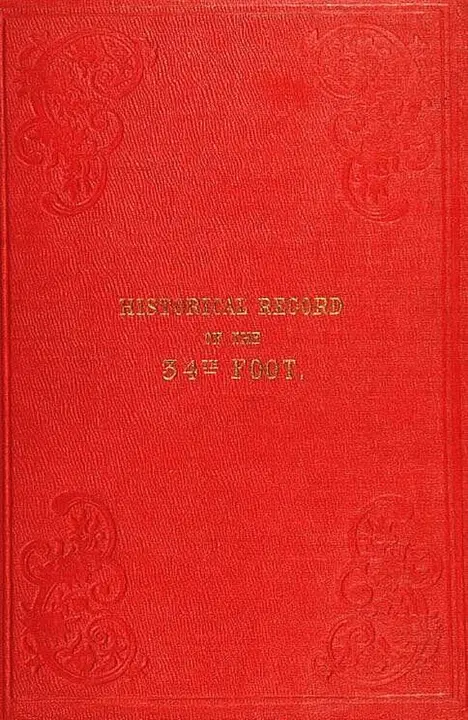
"Historical Record of the Thirty-fourth, or the Cumberland Regiment of Foot" by Richard Cannon is a historical account written in the mid-19th century. The book provides a detailed history of the Thirty-fourth Regiment of Foot, tracing its formation in 1702 through its military engagements up until 1844. The text focuses on the regiment's various campaigns, notable battles, and significant contributions to military history. The opening of this historical record outlines the rationale for documenting the military achievements of British regiments, emphasizing the importance of inspiring future soldiers through the stories of past bravery and sacrifice. It describes the establishment and early years of the Thirty-fourth Regiment, detailing its formation under Colonel Robert Lord Lucas and subsequent deployments in various military expeditions. A narrative of valor, challenges, and growth is set, showcasing how the regiment served in key battles and operations across Europe and beyond, reflecting the broader context of British military history.
Introduction adapted from the source catalogue; source summaries may be automatically generated.
Free to read · English · 31,371 words · No account needed
MAKE TIME FOR A GOOD BOOK
On by default. Untick to stop anonymous reading totals. Each page counts after 10 seconds in view. How this works.
Anonymous counting is on unless you have switched it off.
The first battalion remained at Secunderabad until the 19th of June, 1814, when it commenced its march for the island and fortress of Seringapatam, where it arrived on the 10th of August, and relieved the first battalion of the Sixty-ninth Regiment.
After reposing in quarters a short time at the city of Toulouse, the second battalion marched to Bordeaux, where it embarked for Ireland, on the 17th of July, and landing at Cork, was stationed at Middleton, Fermoy, &c., until November, when it proceeded to Dublin, under the command of Major Barlow.
[Sidenote: 1815]
The climate of the garrison of Seringapatam not proving favourable to the health of the soldiers of the first battalion, they were moved out of that fortress a short time, and in August, 1815, commenced their march for Vellore, where they arrived on the 9th of October.
The second battalion remained in garrison at Dublin, until September of this year, when it was suddenly ordered to march into Tipperary, in consequence of the insurrectionary proceedings of the inhabitants of that part of Ireland.
[Sidenote: 1816]
In February, 1816, thirteen officers, and three hundred and thirty non-commissioned officers and soldiers, of the first battalion, proceeded from Vellore to the sea-coast, and were stationed at Cuddalore six months, for the benefit of their health.
General Sir Eyre Coote was succeeded in the colonelcy of the regiment by Lieutenant-General the Honorable Sir Galbraith Lowry Cole, G.C.B., from the Seventieth Foot, by commission, dated the 21st of May, 1816.
[Sidenote: 1817]
The incursions of the barbarous people called Pindarees, who infested the British territory in India at this period, and committed dreadful ravages wherever they appeared, occasioned the first battalion to take the field early in 1817, when it left a detachment at Vellore, under Lieutenant-Colonel Worsley, and joined the division commanded by Major-General Browne, assembled to guard the passes near Naggerry. In February the battalion returned to Vellore.
In the mean time, the peace of Europe appearing to be established upon sound and durable principles, the second battalion was ordered to be reduced, which took place in April, 1817, when the following brigade order was issued:--
“Major-General Doyle having received the warrant for the disbandment of the second battalion of the THIRTY-FOURTH Regiment, and carried the orders of the commander of the forces into effect, it now only remains for the major-general to express, in the most unqualified manner, his perfect approbation of the sober, orderly, and soldier-like conduct of the corps in quarters, for a period of upwards of one year and a half, during which it has been under his immediate command.
Your reading position is saved on this browser. Take it to another device with a library code. Reading pages adapt to text, rather than matching a printed edition.
Richard Cannon
Richard Cannon

Richard Cannon
Richard Cannon
BEHIND THE BOOK
This eBook is for the use of anyone anywhere in the United States and most other parts of the world at no cost and with almost no restrictions whatsoever. You may copy it, give it away or re-use it under the terms of the Project Gutenberg License included with this eBook or online at www.gutenberg.org. If you are not located in the United States, you will have to check the laws of the country where you are located before using this eBook. Read the source licence.
The original source file, including credits and licence, is retained by this library. Request an original-format copy at no charge. Please include the book title and Project Gutenberg identifier #66459.
KEEP YOUR CURIOSITY GOING
Cécile Tormay

Moritz Busch
John L. Ransom
Frances Wright
Cécile Tormay

Mabel Potter Daggett