
Historical record of the Ninety-second Regiment, originally termed “The Gordon Highlanders” and numbered the Hundredth Regiment
Richard Cannon
THE CLASSIC COLLECTION · 1850
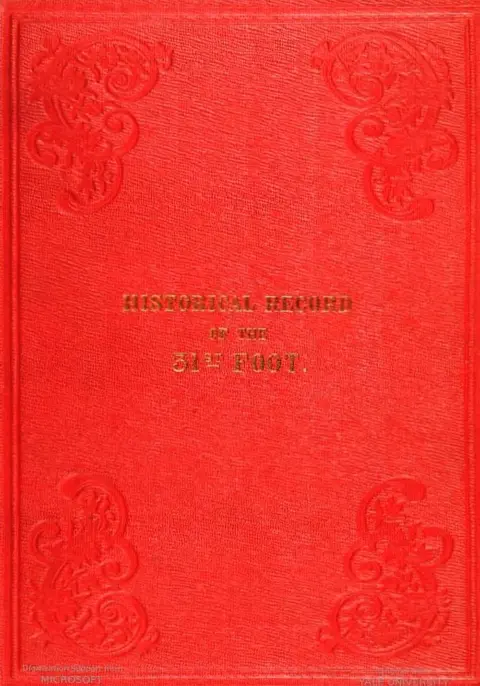
"Historical Record of the Thirty-first, or, the Huntingdonshire Regiment of Foot" by Richard Cannon is a historical account written in the mid-19th century. This work provides a detailed narrative of the formation and military service of the Thirty-first Regiment, tracing its history from its inception in the early 18th century through various key battles and engagements up to the mid-19th century. The book serves to honor the valor and achievements of the regiment within the broader context of British military history. At the start of this record, the transcriber outlines the formatting conventions used in the text, such as the notation of italicized text, footnotes, and superscripts, indicating a meticulous approach to historical documentation. The introduction includes a royal directive from 1836 aimed at encouraging a sense of pride and emulation among British soldiers by recording regiment-specific histories and individual acts of bravery. The opening chapters detail the regiment's formation as a Marine Corps and its early involvement in military operations during the War of the Spanish Succession, highlighting key figures and events that shaped its legacy.
Introduction adapted from the source catalogue; source summaries may be automatically generated.
Free to read · English · 88,227 words · No account needed
MAKE TIME FOR A GOOD BOOK
On by default. Untick to stop anonymous reading totals. Each page counts after 10 seconds in view. How this works.
Anonymous counting is on unless you have switched it off.
Lieut.-Colonel Bolton served in the Affghanistan campaign of 1842, and commanded the THIRTY-FIRST regiment in the action at Mazeena, in the Shinwaree valley, on the 26th of July 1842; at Tezeen on the 13th of September 1842, and at the occupation of Cabool by Major-General Pollock.
For his services in Affghanistan, Lieut.-Colonel Bolton received a medal, and was promoted to the rank of colonel on the 23rd of December 1842; he was also appointed aide-de-camp to Her Majesty, and was nominated a Companion of the Most Honorable Order of the Bath.
Colonel Bolton served with the army of the Sutlej in 1845, as Brigadier to the first brigade under the command of General Sir Hugh (now Viscount) Gough, Commander-in-Chief in India at that period. Colonel Bolton received a severe wound at the battle of Moodkee on the 18th of December 1845, from the effects of which he died on the 4th of January 1846.
Lieut.-Colonel Thomas Skinner, the eldest son of Lieut.-General John Skinner, while at Eton College, was on the 25th of January 1816, appointed to an ensigncy in the sixteenth regiment of foot, to which regiment his father had been attached for thirty-nine years, before he attained the rank of Major-General; Ensign Skinner joined the sixteenth regiment in Ireland in the year 1817, then commanded by the late Major-General (then Colonel) Tolley. Major-General Tolley, the best Greek scholar of his day at Westminster, amused his leisure with classical literature, and invited the young Etonian to share his studies; and thus making complete his education, fortunately imbued him with that taste for letters which secured to him through life a most agreeable resource. In 1819, the regiment being ordered to Ceylon, he obtained, by purchase, a lieutenancy on the 6th of August, and proceeded to that colony. While there he was employed to make the roads constructed by the late Lieut.-General Sir Edward Barnes, afterwards Colonel of the THIRTY-FIRST regiment. Lieutenant Skinner was appointed adjutant to the sixteenth regiment on the 20th of April 1820, and did duty in that capacity until 1822, when his Commanding Officer returned to England, and obtaining leave of absence for his young friend, they travelled home together through India and Egypt, visiting Malta and Sicily, and thence through Italy and France to England. Lieutenant Skinner was promoted to an unattached company on the 9th of October 1823, and on the 20th of March, 1824, was appointed Captain in the THIRTY-FIRST regiment. In February 1825, he sailed with the left wing of the THIRTY-FIRST in the Scaleby Castle for Calcutta, the regiment being ordered to reinforce the army at that time acting in Burmah; but owing to the burning of her consort, the Kent East Indiaman, in the Bay of Biscay, with the right wing, the regiment was inefficient, and remained in garrison at Calcutta. In 1829, Captain Skinner returned home on leave of absence in the Cartha, and nearly suffered shipwreck on the coast of Wales. The vessel being driven by storm when off Liverpool, was unable to weather Bardsea Island, and fortunately passed safely through the narrow channel between that rock, and the coast of Carnarvon into Pwelli Bay. He did not lose his time in India; for with his brother, Captain James Skinner, of the sixty-first regiment of Bengal Native Infantry, he travelled to the sources of the Ganges and the Jumna, an account of which was published in 1833, from letters written at the time, in two volumes, entitled “Excursions in India,” and the work passed through two editions. During his leave of absence he travelled over England and Scotland, and made himself as well acquainted with those parts of his native land, as, in the course of his professional duties, he had previously become with Ireland. In December 1833, by permission of General Lord Hill, Commanding in Chief, he travelled by the Holy Land and Bagdad to India to rejoin the THIRTY-FIRST regiment. An account of these travels, in two volumes, was published in 1836, under the title of “Adventures during a Journey overland to India” which also passed through two editions. On the 24th of November, 1835, he was promoted Major in the THIRTY-FIRST regiment. Emulous of his father’s skill as an officer of Light Infantry, he diligently cultivated that branch of the service, availing himself of the opportunity of practising manœuvres in the field afforded to those serving in India, by the collection of large bodies of men at the principal stations. In 1840, his health being affected by the climate, Lord Hill considerately forwarded to him, through the General commanding in India, leave of absence, of which he declined to avail himself, as he thought his services might be useful in the then state of India. On the 23rd of November 1840, he was entrusted to take from Chinsurah a large body of recruits, about twenty young officers, and about twenty-two young women and as many children, to their destinations where they arrived in health, and without complaint of any sort against them in the districts through which they passed. The Commander-in-Chief in India thus expressed his thanks for this unprecedented success in such duty.
Your reading position is saved on this browser. Take it to another device with a library code. Reading pages adapt to text, rather than matching a printed edition.
Richard Cannon
Richard Cannon

Richard Cannon
Richard Cannon
BEHIND THE BOOK
This eBook is for the use of anyone anywhere in the United States and most other parts of the world at no cost and with almost no restrictions whatsoever. You may copy it, give it away or re-use it under the terms of the Project Gutenberg License included with this eBook or online at www.gutenberg.org. If you are not located in the United States, you will have to check the laws of the country where you are located before using this eBook. Read the source licence.
The original source file, including credits and licence, is retained by this library. Request an original-format copy at no charge. Please include the book title and Project Gutenberg identifier #66796.
KEEP YOUR CURIOSITY GOING
Cécile Tormay

Moritz Busch
John L. Ransom
Frances Wright
Cécile Tormay

Mabel Potter Daggett