
Historical record of the Ninety-second Regiment, originally termed “The Gordon Highlanders” and numbered the Hundredth Regiment
Richard Cannon
THE CLASSIC COLLECTION · 1850
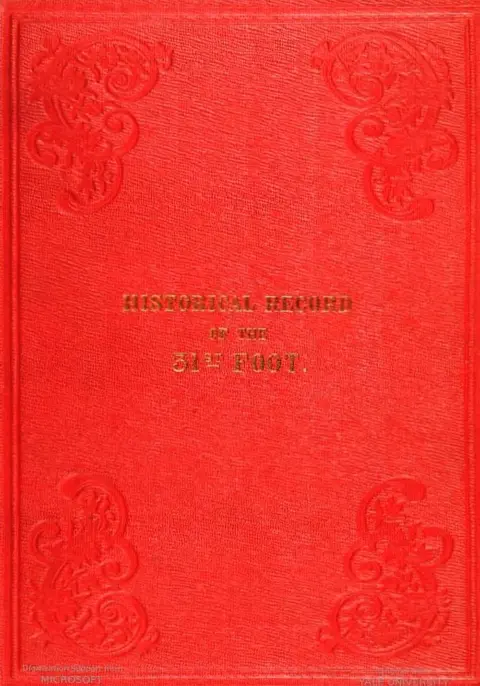
"Historical Record of the Thirty-first, or, the Huntingdonshire Regiment of Foot" by Richard Cannon is a historical account written in the mid-19th century. This work provides a detailed narrative of the formation and military service of the Thirty-first Regiment, tracing its history from its inception in the early 18th century through various key battles and engagements up to the mid-19th century. The book serves to honor the valor and achievements of the regiment within the broader context of British military history. At the start of this record, the transcriber outlines the formatting conventions used in the text, such as the notation of italicized text, footnotes, and superscripts, indicating a meticulous approach to historical documentation. The introduction includes a royal directive from 1836 aimed at encouraging a sense of pride and emulation among British soldiers by recording regiment-specific histories and individual acts of bravery. The opening chapters detail the regiment's formation as a Marine Corps and its early involvement in military operations during the War of the Spanish Succession, highlighting key figures and events that shaped its legacy.
Introduction adapted from the source catalogue; source summaries may be automatically generated.
Free to read · English · 88,227 words · No account needed
MAKE TIME FOR A GOOD BOOK
On by default. Untick to stop anonymous reading totals. Each page counts after 10 seconds in view. How this works.
Anonymous counting is on unless you have switched it off.
---- Return of the troops under Major-General Sir Henry Smith to the head-quarters of the Army 145
---- Advance of the Army on Lahore 156
---- Occupation of the City 158
1846 Orders received for the Regiment to return to Europe 159
---- Embarked for Calcutta 163
---- Review of the Punjaub Campaign 165
---- Honors conferred on the “Army of the Sutlej” 167
---- General Lord Gough’s farewell order to the Regiment 172
---- Embarked for England 174
---- Reception on arrival 175
---- Letter to Lieut.-Colonel Spence, from General Sir Colin Halkett, reviewing the services of the Regiment 177
---- Stationed at Walmer 182
1847 Authorized to bear on the Regimental Colour and Appointments the words “MOODKEE,” “FEROZESHAH,” “ALIWAL,” and “SOBRAON” 183
---- General Sir Colin Halkett G.C.B., removed to the forty-fifth Regiment --
---- Lieut.-General the Honorable Henry Otway Trevor appointed Colonel of the THIRTY-FIRST Regiment --
---- The Regiment removed to Manchester --
1848 Embarked for Ireland --
---- Presentation of New Colours by Major-General His Royal Highness the Prince George of Cambridge 184
1849 Stationed at Athlone 186
1850 Removed to Dublin --
---- Presentation of a Testimonial to Lieut.-Colonel Spence on his retirement --
[Sidenote: 1701]
In the commencement of the eighteenth century, the British Monarch, King William III., found that the conditions of the Treaty of Ryswick, concluded in 1697, were violated by the King of France, Louis XIV., who, on the decease of Charles II. of Spain on the 1st of November, 1700, pursued with unremitting assiduity his ambitious project of ultimately uniting the crowns of France and Spain, by procuring the accession of his grandson, Philip, Duke of Anjou, to the vacant throne; thus excluding the claims of the House of Austria, and disregarding the existing treaties between the principal nations of Europe. The seizure of the Spanish Netherlands by the troops of France,--the detention of the Dutch garrisons in the barrier towns,--the declaration of Louis XIV. in favour of the family of James II., and other acts of hostility, justified the British Government in making preparations for war.
King William had determined on active measures, by sea and land, against the powers of France and Spain, and had accordingly directed augmentations to be made in the navy and army. A division of the army had been appointed, under the command of Brigadier-General Ingoldsby, (twenty-third regiment,) to embark for Flanders, and another portion of the army was selected to embark for the coast of Spain, under the orders of the Duke of Ormond.
[Sidenote: 1702]
Your reading position is saved on this browser. Take it to another device with a library code. Reading pages adapt to text, rather than matching a printed edition.
Richard Cannon
Richard Cannon

Richard Cannon
Richard Cannon
BEHIND THE BOOK
This eBook is for the use of anyone anywhere in the United States and most other parts of the world at no cost and with almost no restrictions whatsoever. You may copy it, give it away or re-use it under the terms of the Project Gutenberg License included with this eBook or online at www.gutenberg.org. If you are not located in the United States, you will have to check the laws of the country where you are located before using this eBook. Read the source licence.
The original source file, including credits and licence, is retained by this library. Request an original-format copy at no charge. Please include the book title and Project Gutenberg identifier #66796.
KEEP YOUR CURIOSITY GOING
Cécile Tormay

Moritz Busch
John L. Ransom
Frances Wright
Cécile Tormay

Mabel Potter Daggett