
Historical record of the Ninety-second Regiment, originally termed “The Gordon Highlanders” and numbered the Hundredth Regiment
Richard Cannon
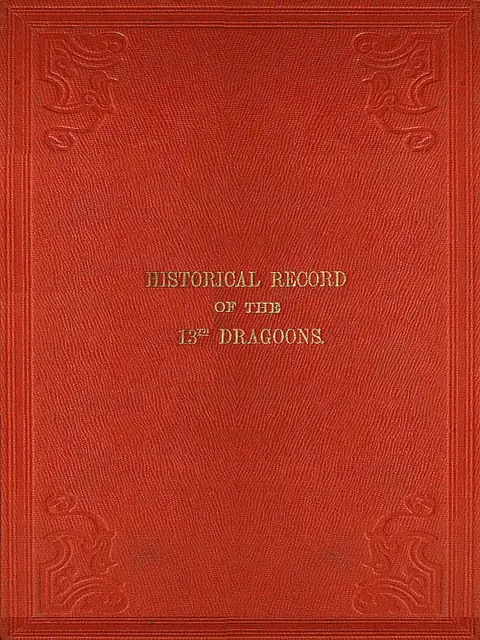
THE CLASSIC COLLECTION · 1842
"Historical Record of the Thirteenth Regiment of Light Dragoons" by Richard Cannon is a historical account written in the early 19th century. The text provides a detailed and chronological overview of the formation and subsequent military service of the Thirteenth Regiment of Light Dragoons from its inception in 1715 up until 1842. This work discusses various battles, campaigns, and notable figures, notably emphasizing the regiment's significant contributions during military conflicts such as the Napoleonic Wars. The opening of the account begins with a context-setting general order issued on January 1, 1836, which outlines the intention to document the achievements of British regiments to honor their bravery and inspire future soldiers. Following this introduction, a preface highlights the importance of preserving military history for the motivation of current and future soldiers, detailing how the Thirteenth Regiment was established amidst domestic threats to Great Britain and recounting its early operations, including engagements during the Jacobite risings. The narrative illustrates the regiment's evolution and its prominent role in significant historical events, paving the way for a comprehensive understanding of its storied legacy.
Introduction adapted from the source catalogue; source summaries may be automatically generated.
Free to read · English · 19,270 words · No account needed
MAKE TIME FOR A GOOD BOOK
On by default. Untick to stop anonymous reading totals. Each page counts after 10 seconds in view. How this works.
Anonymous counting is on unless you have switched it off.
The regiment marched to Romford, where it was reviewed by His Royal Highness the Commander-in-Chief. In June it was distributed in quarters at Newmarket, Bury St. Edmonds, Ely, Peterborough, and Cambridge; and in July it marched to York, sending, at different periods during the latter part of this and in the beginning of the following year, detachments to Carlisle, Newcastle-on-Tyne, Tadcaster, Stockton-on-Tees, Hull, Pontefract, Leeds, Halifax, and Wakefield, where they were occasionally employed in quelling riots. The establishment had been reduced in October, 1816.
[Sidenote: 1817]
The quarters were changed in July, 1817, to Brighton, with detachments at Chichester, Arundel, Hastings, and Eastbourne.
[Sidenote: 1818]
In the summer and autumn of 1818, the regiment was stationed at Manchester, Stockport, Blackburn, Bolton, and Preston, and was engaged in quelling riots.
[Sidenote: 1819]
Having received orders to prepare for embarkation for India, the regiment marched to Romford, where it was quartered a short time, and in February, 1819, eight troops, commanded by Lieutenant-Colonel Boyse, sailed from Gravesend; they were four months on the voyage, and landed at Madras on the 13th of June following. After a short halt, the regiment marched seventy-three miles up the country to Arcot, the capital of the Carnatic, where it was stationed during the remainder of the year.
[Sidenote: 1820]
[Sidenote: 1826]
From Arcot the regiment was removed, in the early part of 1820, to Bangalore, a military station in Mysore, about two hundred miles from Madras. At this station the regiment remained upwards of six years, and in 1826, it was removed to Arcot.
[Sidenote: 1828]
In February, 1828, the regiment was encamped at Arcot, from whence it was removed to Arnee, a town of the Carnatic, fourteen miles south of Arcot, and was stationed at that place during the remainder of the year.
[Sidenote: 1829]
The regiment left Arnee in March, 1829, and once more traversed the country to Bangalore, where it was quartered during the remainder of its stay in India.
[Sidenote: 1832]
In 1832, the regiment was again clothed in scarlet with buff
facings.
The Mahommedans of Mysore entered into a combination, in which some Sepoys of the force at Bangalore joined, for the destruction of the English officers and soldiers, and the subversion of the British government in October, 1832; but the discovery of this conspiracy on the day fixed upon for its execution, caused immediate precautions to be taken, which prevented the outbreak. Many of the mutineers were taken, tried, and sentenced,--some to death,--and the remainder to transportation. The Sepoys were executed in front of the assembled force.
[Sidenote: 1833]
Your reading position is saved on this browser. Take it to another device with a library code. Reading pages adapt to text, rather than matching a printed edition.
Richard Cannon
Richard Cannon

Richard Cannon
Richard Cannon
BEHIND THE BOOK
This eBook is for the use of anyone anywhere in the United States and most other parts of the world at no cost and with almost no restrictions whatsoever. You may copy it, give it away or re-use it under the terms of the Project Gutenberg License included with this eBook or online at www.gutenberg.org. If you are not located in the United States, you will have to check the laws of the country where you are located before using this eBook. Read the source licence.
The original source file, including credits and licence, is retained by this library. Request an original-format copy at no charge. Please include the book title and Project Gutenberg identifier #54908.
KEEP YOUR CURIOSITY GOING
Cécile Tormay

Moritz Busch
John L. Ransom
Frances Wright
Cécile Tormay

Mabel Potter Daggett