
Historical record of the Ninety-second Regiment, originally termed “The Gordon Highlanders” and numbered the Hundredth Regiment
Richard Cannon
THE CLASSIC COLLECTION · 1842
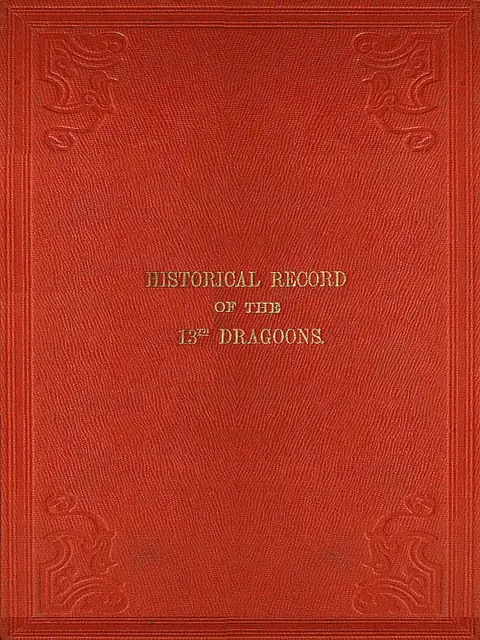
"Historical Record of the Thirteenth Regiment of Light Dragoons" by Richard Cannon is a historical account written in the early 19th century. The text provides a detailed and chronological overview of the formation and subsequent military service of the Thirteenth Regiment of Light Dragoons from its inception in 1715 up until 1842. This work discusses various battles, campaigns, and notable figures, notably emphasizing the regiment's significant contributions during military conflicts such as the Napoleonic Wars. The opening of the account begins with a context-setting general order issued on January 1, 1836, which outlines the intention to document the achievements of British regiments to honor their bravery and inspire future soldiers. Following this introduction, a preface highlights the importance of preserving military history for the motivation of current and future soldiers, detailing how the Thirteenth Regiment was established amidst domestic threats to Great Britain and recounting its early operations, including engagements during the Jacobite risings. The narrative illustrates the regiment's evolution and its prominent role in significant historical events, paving the way for a comprehensive understanding of its storied legacy.
Introduction adapted from the source catalogue; source summaries may be automatically generated.
Free to read · English · 19,270 words · No account needed
MAKE TIME FOR A GOOD BOOK
On by default. Untick to stop anonymous reading totals. Each page counts after 10 seconds in view. How this works.
Anonymous counting is on unless you have switched it off.
In 1781 the regiment marched to Charleville and Bruff, and was subsequently stationed at Cork, where it received orders to proceed, with some other regiments and artillery under the command of Colonel Ralph Abercromby, against George Robert Fitzgerald, who had fortified his family residence near Castlebar, in the county of Mayo, and was in open rebellion against the laws. On the arrival of the forces at Castlebar, they proceeded on the service assigned to them,--but Fitzgerald had fled and quitted the country: some ship guns, which he had mounted, were seized and brought into the barracks at Castlebar,--where the THIRTEENTH remained,--sending detachments to Ballinrobe and Sligo.
[Sidenote: 1782]
[Sidenote: 1783]
Soon after the termination of the American war, in 1782, the regiment underwent a change of clothing and equipment, and was constituted a corps of LIGHT CAVALRY. The cocked-hats were replaced by helmets, and appointments of a lighter description than formerly worn. These alterations were completed in 1783. In the spring of this year the regiment was stationed at Belturbet and Sligo; and, in consequence of the barracks at the former place falling down in the winter, a detachment was sent to Cavan.
[Sidenote: 1784]
In 1784 the colour of the clothing was changed from scarlet to blue, and the facings to light buff.
In May the regiment--then designated the "THIRTEENTH LIGHT DRAGOONS" in the Annual Army List--again assembled at Belturbet, and, after the usual inspection, marched into quarters at Athlone, Roscommon, and Cloghan, when the horses were turned out to grass for the first time since the commencement of the American war. After the peace the establishment had been reduced to one hundred and forty-four men, and one hundred and thirty-eight horses.
[Sidenote: 1785]
The THIRTEENTH were reviewed at Athlone, in June, 1785, and marched into quarters at Kilkenny, Ballyragget, and Carrick-on-Suir.
[Sidenote: 1786]
In June, 1786, the regiment assembled for inspection at Kilkenny, and marched to Mallow, Bandon, and Tallow.
During the winter of this year the troops were moved from Mallow to Cork, in consequence of disturbances; and they, as well as those at Bandon and Tallow, were constantly on duty, and greatly harassed; the gaols were filled with their prisoners of "White Boys," "Peep-o'day-Boys," &c., as the different bands of these misguided men called themselves.
[Sidenote: 1787]
In May, 1787, the regiment marched to Cashel, where it was
inspected, and in June it was quartered in Maryborough,
Mountmelick, and Thurles.
[Sidenote: 1788]
[Sidenote: 1789]
The regiment proceeded to Dublin in June, 1788, and subsequently moved into the Phœnix Park barrack, Navan and Man of War.
[Sidenote: 1790]
In June, 1790, the THIRTEENTH were stationed at Clonmel, Clogheen, Mallow, and Charleville, and at the end of this year a draught of men was sent to the Twentieth Dragoons at Jamaica.
[Sidenote: 1791]
Your reading position is saved on this browser. Take it to another device with a library code. Reading pages adapt to text, rather than matching a printed edition.
Richard Cannon
Richard Cannon

Richard Cannon
Richard Cannon
BEHIND THE BOOK
This eBook is for the use of anyone anywhere in the United States and most other parts of the world at no cost and with almost no restrictions whatsoever. You may copy it, give it away or re-use it under the terms of the Project Gutenberg License included with this eBook or online at www.gutenberg.org. If you are not located in the United States, you will have to check the laws of the country where you are located before using this eBook. Read the source licence.
The original source file, including credits and licence, is retained by this library. Request an original-format copy at no charge. Please include the book title and Project Gutenberg identifier #54908.
KEEP YOUR CURIOSITY GOING
Cécile Tormay

Moritz Busch
John L. Ransom
Frances Wright
Cécile Tormay

Mabel Potter Daggett