
Historical record of the Ninety-second Regiment, originally termed “The Gordon Highlanders” and numbered the Hundredth Regiment
Richard Cannon
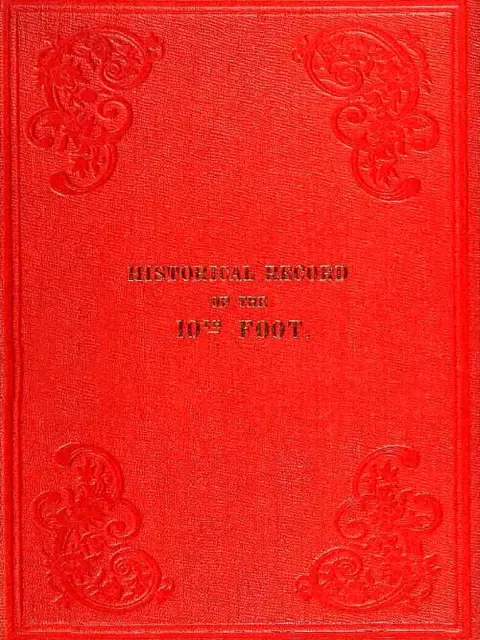
THE CLASSIC COLLECTION · 1847
"Historical Record of the Tenth, or the North Lincolnshire, Regiment of Foot" by Richard Cannon is a historical account written in the mid-19th century. The book chronicles the formation and extensive military history of the Tenth Regiment, detailing its engagement in numerous campaigns from its establishment in 1685 up until 1847. The narrative is likely to appeal to readers interested in military history, British regiments, and their contributions to various wars and battles over the centuries. The opening of the work establishes the foundation of the Tenth Regiment amid significant historical events, such as the rebellion of James, Duke of Monmouth, and the subsequent royal commissions that shaped the regiment's early leadership. It presents the original formation of the regiment, the context of its initial engagements, and sets the scene for its future endeavors. In elaborating on the regiment's inception and early service, it highlights key figures and their roles within the regiment, underlining the commitment to the British military tradition and the valor expected of its soldiers.
Introduction adapted from the source catalogue; source summaries may be automatically generated.
Free to read · English · 28,844 words · No account needed
MAKE TIME FOR A GOOD BOOK
On by default. Untick to stop anonymous reading totals. Each page counts after 10 seconds in view. How this works.
Anonymous counting is on unless you have switched it off.
The regiment left Nihalkee on the 11th February, crossed the Sutlej on the 13th, and on the 20th of the same month arrived before Lahore, where it was present at the occupation of that city, and at the signing of the treaty, which, while it convinced the world of the moderation and justice of the paramount power of India, is calculated to add to the stability of the Anglo-Indian empire, and also to provide for the future tranquillity of the Punjaub, by maintaining a Sikh government at Lahore, capable of controlling its army, protecting its subjects, and securing the British frontier against similar acts of aggression.
On the 23rd of March, 1846, the regiment marched from Lahore, recrossed the Sutlej on the 26th of that month, and arrived at Meerut on the 15th of April following. It marched again from Meerut, en route to Ferozepore, on the 27th of October, 1846, and arrived in cantonments on the 20th of November, where it remained encamped until the 28th of December, when it again proceeded to Lahore, under the charge of Lieutenant-Colonel Strickland, with a body of troops under the command of Lieutenant-Colonel Franks, and occupied quarters in the garrison of that city on the 2nd of January, 1847.
[Sidenote: 1847]
The TENTH regiment continued in the occupation of Lahore, as a part of the garrison of that city, to the end of the year 1847, at which period this record is concluded.
Page 45.--In 1783, the regular regiments of infantry were authorised to assume "County Titles," in order to promote the recruiting service, and the Tenth was directed to bear the title of North Lincolnshire Regiment in addition to the numerical title.
Page 59.--Lieutenant-General Lord William Bentinck returned to Sicily in October, 1813, and in February, 1814, he proceeded with a body of English and Sicilian troops, amounting to 6,500 men, from that island to Leghorn, from whence he published a Proclamation, inviting the Italians to shake off the French yoke: he subsequently landed his combined troops, and after a few slight actions made himself master of Genoa, on the 18th April, 1814. On the termination of the War in 1814 His Lordship retired for some time to Rome.
[6] Disembarkation Return, TENTH Foot, June, 1801--LANDED AT COSSEIR, 2 lieut.-colonels, 2 majors, 6 captains, 16 lieutenants, 5 ensigns, 5 staff, 46 serjeants, 18 drummers, and 854 rank and file.
Lieut.-Colonel Samuel Auchmuty of the TENTH performed the duty of adjutant-general to the expedition.
[7] Route from Cosseir on the Red Sea to Kenna on the Nile.
Miles.
From Cosseir to the New Wells 11 Water.
Half way to Moilah 17 No water.
Moilah 17 Water and provisions.
Advanced Wells 9 Water.
Half way to Legaitte 19 No water.
Legaitte 19 Water and provisions.
Baromba 18 Water.
Kenna 10 The Nile.
---
120
Your reading position is saved on this browser. Take it to another device with a library code. Reading pages adapt to text, rather than matching a printed edition.
Richard Cannon
Richard Cannon

Richard Cannon
Richard Cannon
BEHIND THE BOOK
This eBook is for the use of anyone anywhere in the United States and most other parts of the world at no cost and with almost no restrictions whatsoever. You may copy it, give it away or re-use it under the terms of the Project Gutenberg License included with this eBook or online at www.gutenberg.org. If you are not located in the United States, you will have to check the laws of the country where you are located before using this eBook. Read the source licence.
The original source file, including credits and licence, is retained by this library. Request an original-format copy at no charge. Please include the book title and Project Gutenberg identifier #56293.
KEEP YOUR CURIOSITY GOING
Cécile Tormay

Moritz Busch
John L. Ransom
Frances Wright
Cécile Tormay

Mabel Potter Daggett