
Historical record of the Ninety-second Regiment, originally termed “The Gordon Highlanders” and numbered the Hundredth Regiment
Richard Cannon
THE CLASSIC COLLECTION · 1847
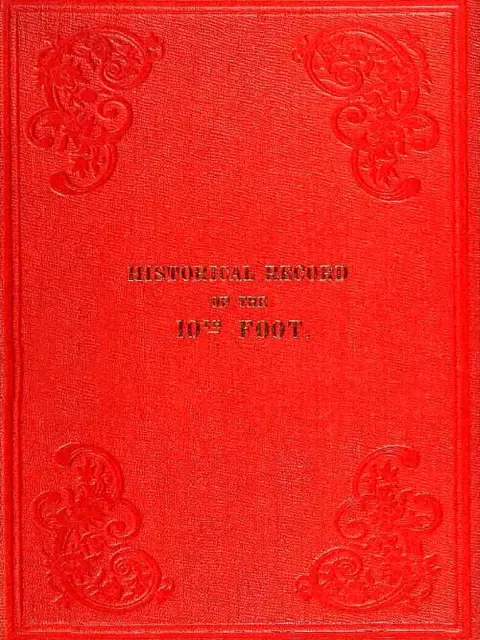
"Historical Record of the Tenth, or the North Lincolnshire, Regiment of Foot" by Richard Cannon is a historical account written in the mid-19th century. The book chronicles the formation and extensive military history of the Tenth Regiment, detailing its engagement in numerous campaigns from its establishment in 1685 up until 1847. The narrative is likely to appeal to readers interested in military history, British regiments, and their contributions to various wars and battles over the centuries. The opening of the work establishes the foundation of the Tenth Regiment amid significant historical events, such as the rebellion of James, Duke of Monmouth, and the subsequent royal commissions that shaped the regiment's early leadership. It presents the original formation of the regiment, the context of its initial engagements, and sets the scene for its future endeavors. In elaborating on the regiment's inception and early service, it highlights key figures and their roles within the regiment, underlining the commitment to the British military tradition and the valor expected of its soldiers.
Introduction adapted from the source catalogue; source summaries may be automatically generated.
Free to read · English · 28,844 words · No account needed
MAKE TIME FOR A GOOD BOOK
On by default. Untick to stop anonymous reading totals. Each page counts after 10 seconds in view. How this works.
Anonymous counting is on unless you have switched it off.
In March, 1819, the head-quarters embarked from Cephalonia, and the detachment from Zante, for Malta, where the regiment was assembled, and occupied the lower St. Elmo barracks at Valetta, under the command of Lieut.-Colonel Mathew Stewart, who was appointed from half-pay in succession to Colonel Travers, nominated an Inspecting Field-officer of Militia in the Ionian Islands.
[Sidenote: 1820]
During the year 1820, the regiment occupied the barracks in the Cottonera district, with detachments at Floriana, forts Manvel and Tigni, and the island of Giza.
[Sidenote: 1821]
From Malta, the regiment embarked, in April, 1821, for England, and landing at Portsmouth in June, was stationed at that fortress three months; it afterwards sailed to Plymouth, and occupied the citadel and Stonehouse barracks.
[Sidenote: 1822]
In April, 1822, the regiment embarked from Plymouth for Deptford, and after several changes of quarters it was stationed at Chatham and Sheerness.
[Sidenote: 1823]
On the 28th of May, 1823, the regiment embarked at Chatham, for Ireland; after landing at Cork, it proceeded to Fermoy, and in October it was removed to Rathkeale, with detachments at twelve other stations.
[Sidenote: 1824]
On the decease of Lieut.-General the Honorable Sir Thomas Maitland, G.C.B. and G.C.H., King George IV. conferred the colonelcy of the TENTH on Major-General Sir John Lambert, K.C.B. by commission dated the 18th of January, 1824. On the 8th January, 1824, Colonel Sir Robert Travers, was reappointed, in succession to Lieut.-Colonel Stewart, who retired from the service.
[Sidenote: 1825]
In April, the regiment was removed to Fermoy, and Lieut.-Colonel James Payler was appointed on the 2nd June, 1825, from the half-pay, unattached, in succession to Sir Robert Travers, promoted to the rank of Major-General. Lieut.-Colonel Payler assumed the command in June, 1825, and in September following the head-quarters were removed to Templemore.
[Sidenote: 1826]
From Templemore, the regiment was removed, in February, 1826, to Castlebar, where a pair of new colours, bearing a "SPHINX," with the words "EGYPT," and "PENINSULA," was presented to it by Lieut.-Colonel Payler, the commanding officer, on the 19th of May.
After several changes of quarters, in the autumn of this year the regiment was formed into six service and four depôt companies, at Buttevant, from whence the service companies marched to Cork, where they embarked, in December, for Portugal, the government of which country had solicited British aid, in consequence of an apprehended insurrection, and an invasion from Spain, which threatened to oppose the introduction of a constitution conferring more liberty on the Portuguese people than they had previously possessed.
[Sidenote: 1827]
Your reading position is saved on this browser. Take it to another device with a library code. Reading pages adapt to text, rather than matching a printed edition.
Richard Cannon
Richard Cannon

Richard Cannon
Richard Cannon
BEHIND THE BOOK
This eBook is for the use of anyone anywhere in the United States and most other parts of the world at no cost and with almost no restrictions whatsoever. You may copy it, give it away or re-use it under the terms of the Project Gutenberg License included with this eBook or online at www.gutenberg.org. If you are not located in the United States, you will have to check the laws of the country where you are located before using this eBook. Read the source licence.
The original source file, including credits and licence, is retained by this library. Request an original-format copy at no charge. Please include the book title and Project Gutenberg identifier #56293.
KEEP YOUR CURIOSITY GOING
Cécile Tormay

Moritz Busch
John L. Ransom
Frances Wright
Cécile Tormay

Mabel Potter Daggett