
Historical record of the Ninety-second Regiment, originally termed “The Gordon Highlanders” and numbered the Hundredth Regiment
Richard Cannon
THE CLASSIC COLLECTION · 1851
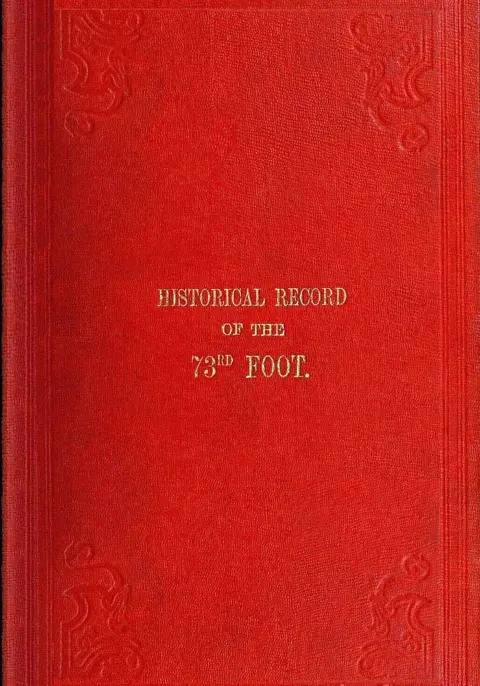
"Historical Record of the Seventy-Third Regiment" by Richard Cannon is a historical account written in the mid-19th century. The work documents the formation and military service of the Seventy-Third Regiment, originally raised as the Second Battalion of the Forty-Second Royal Highlanders, from 1780 until 1851. The book encompasses detailed accounts of the regiment's campaigns, battles, and significant events, aiming to provide a comprehensive narrative of its history and accomplishments. At the start of this record, the author outlines the intent and framework of the publication, emphasizing the importance of documenting the glorious deeds of British regiments to inspire future soldiers. The compilation begins with the creation of the Seventy-Third Regiment and highlights its early engagements, particularly against significant figures like Hyder Ali and Tippoo Saib in India during the late 18th century. The opening sets the stage for an in-depth exploration of the regiment's history, including its challenges and triumphs, as it served in various significant military operations over several decades.
Introduction adapted from the source catalogue; source summaries may be automatically generated.
Free to read · English · 24,701 words · No account needed
MAKE TIME FOR A GOOD BOOK
On by default. Untick to stop anonymous reading totals. Each page counts after 10 seconds in view. How this works.
Anonymous counting is on unless you have switched it off.
In July, the service companies were re-embarked for the Cape of Good Hope, and arrived at Cape Town in August. After landing their sick, they were ordered to proceed to Waterloo Bay, near to the Great Fish River, there to disembark, and join the troops employed in the field against the Kaffirs, on which arduous duty the regiment was subsequently employed.
From the 1st of January to the 3rd of February, 1847, and from the 10th of September to the end of the year, the service companies were engaged in active field operations against the Kaffirs. On this service the SEVENTY-THIRD had the following officers killed, namely, Captain William Baker, Lieutenants Clarevaulx Faunt, and the Honorable William John Granville Chetwynd, Ensign William Burnop, and Surgeon Neil Stewart Campbell.
[Sidenote: 1848]
In January, 1848, the service companies proceeded to Fort Grey, where the head-quarters were stationed until July following, and in October they were removed from Fort D’Urban to Cape Town.
[Sidenote: 1849]
Major-General Richard Goddard Hare Clarges, C.B., was appointed colonel of the SEVENTY-THIRD regiment on the 18th of May, 1849, in succession to Major-General Sir John Grey, K.C.B., who was removed to the fifth Fusiliers.
During the year 1849 the service companies were stationed at Cape Town. The depôt companies also remained in Ireland.
[Sidenote: 1850]
In December, 1850, the head-quarters and four companies, under the command of Lieut.-Colonel William Eyre, were removed from Cape Town to the Buffalo mouth for the frontier, in consequence of an outbreak of the Kaffirs.
[Sidenote: 1851]
At the date of the conclusion of the present record, namely, 1st of May 1851, the service companies were in camp at King William’s Town, under Lieut.-Colonel Eyre. The depôt companies, under Major George Hankey Smith, continued to be stationed in Ireland.
[6] Upon the representation of Major-General Gerard Lake, who was appointed Colonel of the Seventy-third Regiment, in November 1796, the Royal Authority was granted for the word “MANGALORE” being borne on the Regimental Colour and Appointments, in consideration of the gallant conduct displayed in the defence of that place.
[7] “A View of the Origin and Conduct of the War with Tippoo Sultan, by Lieut.-Colonel Alexander Beatson, late Aide-de-camp to the Marquis Wellesley, Governor-General of India.”
[8] Seringapatam derived its name from the god Serung, to whom one of the pagodas was dedicated.
[9] The history of the second battalion is resumed at page 43.
Horse Guards, 7th April, 1809.
Your reading position is saved on this browser. Take it to another device with a library code. Reading pages adapt to text, rather than matching a printed edition.
Richard Cannon
Richard Cannon

Richard Cannon
Richard Cannon
BEHIND THE BOOK
This eBook is for the use of anyone anywhere in the United States and most other parts of the world at no cost and with almost no restrictions whatsoever. You may copy it, give it away or re-use it under the terms of the Project Gutenberg License included with this eBook or online at www.gutenberg.org. If you are not located in the United States, you will have to check the laws of the country where you are located before using this eBook. Read the source licence.
The original source file, including credits and licence, is retained by this library. Request an original-format copy at no charge. Please include the book title and Project Gutenberg identifier #67001.
KEEP YOUR CURIOSITY GOING
Cécile Tormay

Moritz Busch
John L. Ransom
Frances Wright
Cécile Tormay

Mabel Potter Daggett