
Historical record of the Ninety-second Regiment, originally termed “The Gordon Highlanders” and numbered the Hundredth Regiment
Richard Cannon
THE CLASSIC COLLECTION · 1848
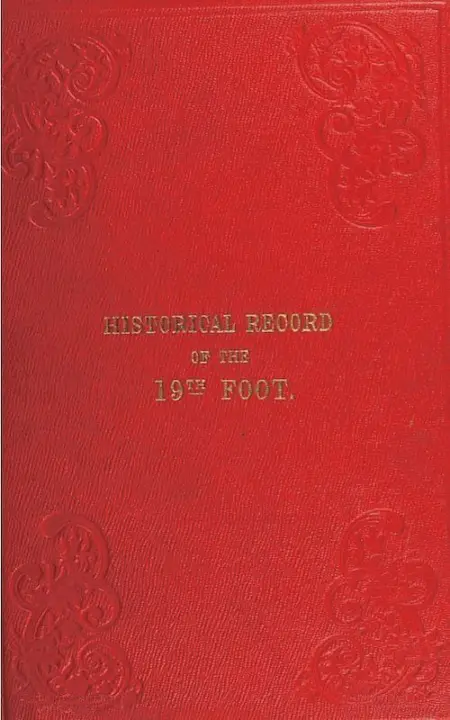
"Historical Record of the Nineteenth, or the First Yorkshire North Riding Regiment of Foot" by Richard Cannon is a historical account written in the mid-19th century. This comprehensive work documents the formation and military engagements of the Nineteenth Regiment from its inception in 1688 through its significant activities until 1848. The account includes details of battles, notable figures, and the regiment's evolution over time, reflecting the broader context of British military history. The opening of the work introduces the background of the Nineteenth Regiment, outlining the circumstances surrounding its formation during the political upheaval of 1688 when the Prince of Orange initiated a movement to secure the constitutional rights of England. The text details the initial enlistment of troops and the appointment of Colonel Francis Lutterell as their leader shortly after the regiment's establishment. Following the sequence of events in the years leading to the early engagements in Ireland and Flanders, the beginning provides a foundational understanding of the regiment's early operations and its early connection to pivotal military campaigns in British history.
Introduction adapted from the source catalogue; source summaries may be automatically generated.
Free to read · English · 15,488 words · No account needed
MAKE TIME FOR A GOOD BOOK
On by default. Untick to stop anonymous reading totals. Each page counts after 10 seconds in view. How this works.
Anonymous counting is on unless you have switched it off.
Five companies embarked in February, 1799, for the continent of India, to take part in the war with the ruler of the province of Mysore, the celebrated Tippoo Saib, whose adoption of French counsels, and hostility to the British interests, proved his ruin. The Mysore was invaded by the British troops, under Lieut.-General (afterwards Lord) Harris, in March, 1799, and the army advanced by triumphant marches to the capital, the strong and splendid city and fortress of Seringapatam, which was captured by storm on the 4th of May, when Tippoo fell, mortally wounded, in the defence of the place.
The capture of the capital having terminated the war in the Mysore, the five companies of the regiment afterwards returned to Ceylon.
[Sidenote: 1800]
From Columbo, the regiment marched, in October, 1800, to Point de Galle, where the head-quarters were stationed several months.
[Sidenote: 1801]
In April, 1801, the regiment embarked for the harbour, town, and fortress of Trincomalee, situate in a barren tract of country on the north-east side of the island of Ceylon, from whence detachments were sent to various posts in the interior. The centre of the island appeared to be defended against the approach of Europeans by the unhealthy climate of the district, through which it was necessary to pass to enter the inland provinces, which were governed by a native chief called the King of Candy.
[Sidenote: 1802]
In 1802 a treaty of peace was concluded between England and France and Holland; but the island of Ceylon was retained by the British.
[Sidenote: 1803]
War with France and Holland was resumed in 1803, and, at the same time, it was found necessary to commence hostilities with the Candians, inhabiting the interior of the island of Ceylon, with whom attempts had been made to establish a treaty of amity and commerce, but without success.
Some outrages having been committed by the Candians on British subjects, demand was made for reparation, which was evaded on various pretences, and a body of troops, of which a detachment of the NINETEENTH regiment formed part, penetrated through the unhealthy districts into the interior, to demand redress, and to exact security against the repetition of outrage. The troops experienced little opposition, and advanced to Candy, the capital, which was found abandoned by the inhabitants. A treaty was framed, and everything appeared in a train for a satisfactory arrangement; but after evincing unparalleled duplicity and treachery, the population of the surrounding districts suddenly attacked the town after hostilities had ceased, and the British troops, under Major Davey, being overpowered by numbers, agreed to capitulate, on condition of being allowed to march with their arms to the British settlements on the coast. These conditions were violated; the British soldiers were barbarously massacred, at Candy, on the 24th of June, excepting a few men who escaped, or were spared by the assassins; the Malays in the English service were required to enter the Candian service, and all who refused were destroyed. The NINETEENTH regiment had the following officers and soldiers massacred on this occasion,--Lieutenants M. H. Bynn, Peter Plenderleath, and Hector M'Lean, Ensign Robert Smith, Quarter-Master John Brown, Assistant-Surgeon William Hope, and one hundred and seventy-two non-commissioned officers and privates.
Your reading position is saved on this browser. Take it to another device with a library code. Reading pages adapt to text, rather than matching a printed edition.
Richard Cannon
Richard Cannon

Richard Cannon
Richard Cannon
BEHIND THE BOOK
This eBook is for the use of anyone anywhere in the United States and most other parts of the world at no cost and with almost no restrictions whatsoever. You may copy it, give it away or re-use it under the terms of the Project Gutenberg License included with this eBook or online at www.gutenberg.org. If you are not located in the United States, you will have to check the laws of the country where you are located before using this eBook. Read the source licence.
The original source file, including credits and licence, is retained by this library. Request an original-format copy at no charge. Please include the book title and Project Gutenberg identifier #61125.
KEEP YOUR CURIOSITY GOING
Cécile Tormay

Moritz Busch
John L. Ransom
Frances Wright
Cécile Tormay

Mabel Potter Daggett