
Historical record of the Ninety-second Regiment, originally termed “The Gordon Highlanders” and numbered the Hundredth Regiment
Richard Cannon
THE CLASSIC COLLECTION · 1839
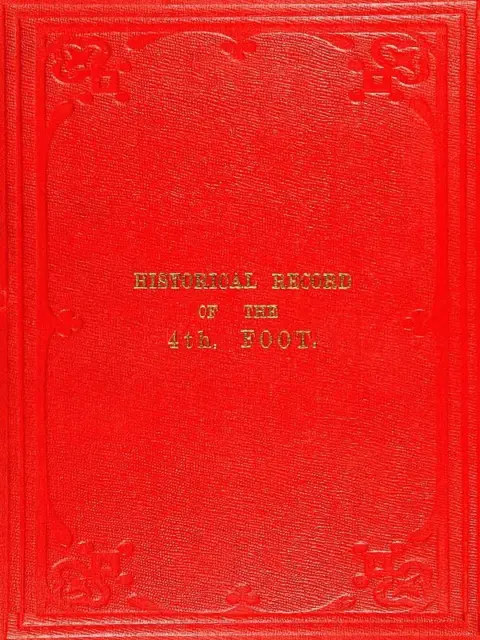
"Historical Record of the Fourth, or the King's Own, Regiment of Foot" by Richard Cannon is a historical account written in the early 19th century. This work chronicles the inception and subsequent military exploits of the Fourth Regiment, detailing its actions and engagements from its establishment in 1680 up to 1839. The book aims to preserve the legacies of bravery exhibited by the regiment over the years, highlighting its contributions to British military history and the valor of soldiers who served. The opening of this historical record introduces the context and background for the formation of the Fourth Regiment, initiated in response to military needs in Tangier following its cession to King Charles II. The text outlines the urgency felt by the British Crown due to threats from local forces and reflects on the aims of the regiment, including maintaining national honor and security in overseas territories. It describes the regiment’s initial deployment, the challenges faced in Tangier, and its evolution into a significant fighting unit within the British Army. Moreover, it underscores the commitment of its personnel to valor and discipline, setting the stage for the detailed accounts of battles and victories to come in subsequent sections of the historical record.
Introduction adapted from the source catalogue; source summaries may be automatically generated.
Free to read · English · 49,762 words · No account needed
MAKE TIME FOR A GOOD BOOK
On by default. Untick to stop anonymous reading totals. Each page counts after 10 seconds in view. How this works.
Anonymous counting is on unless you have switched it off.
JOHN BURGOYNE was a distinguished cavalry officer in the reign of George II. On the 10th of May, 1758, he was promoted from captain in the eleventh dragoons to captain-lieutenant and lieut.-colonel in the second foot guards; and his talents and experience occasioned him to be selected, in the following year, to form and discipline a corps of light cavalry, (now the sixteenth, or the Queen's lancers,) of which he was appointed lieut.-colonel commandant. Previous to this period light cavalry was little known in the British army, the value of that arme had, however, become appreciated; and the discipline, dexterity, and efficiency of BURGOYNE'S horsemen soon attracted admiration, and he received from his sovereign repeated and conspicuous testimonies of his royal approbation. In 1762 he was sent with his regiment to Portugal, where he served as brigadier-general, and he acquired distinction under the Count La Lippe and the Earl of Loudoun, whose despatches bore testimony of his gallantry and zeal for the service, in the warmest terms. He was appointed in 1763 colonel of his regiment, which was honoured with the title of the Queen's light dragoons; and in 1772 he was promoted to the rank of major-general; he was also appointed governor of Fort William. When the British colonies in North America revolted against the mother country, he was placed on the staff of the army in America, and he joined the troops at Boston a short time before the battle of Bunker's Hill. In 1776 he served under Lieut.-General Carlton in Canada, and in the autumn of that year he was promoted to the local rank of lieut.-general in America.
In 1777 he was appointed to the command of an army destined to proceed by Lakes Champlain and George to Hudson's River, with the view of forcing its way to Albany. An erroneous idea of the loyalty of the majority of the inhabitants of this part of North America appears to have been prevalent; and the difficulties to be encountered in this enterprise from the wooded and but partially inhabited country, through which the army had to march, with the state of the roads, and other causes, appear to have been overlooked. After a series of hard toil, incessant effort, and severe privation, the Indian warriors who formed part of the army, and whose predatory habits and disposition to use the tomahawk and scalping-knife had been restrained, all deserted; many of the Canadians and provincials followed this example, while others were deterred from performing their duties by fear; and after several stubborn engagements, in which the British regiments fought gallantly against an immense superiority of numbers, the lieut.-general found himself on the banks of the Hudson's River, with an army of three thousand five hundred men, reduced in physical power by incessant toil and want of provision, invested by an army of sixteen thousand Americans, disappointed of the hope of timely co-operation from other armies, without provisions; and under these dismal circumstances he concluded a convention with the American General Gates at Saratoga, in which he agreed that the troops should lay down their arms on condition of being sent to England, and not serving in America during the remainder of the war. These articles were, however, violated by the American government, on frivolous pretences, and the gallant men who had fought so bravely, and who did not submit until surrounded by five times their own number, were detained in America. Lieut.-General Burgoyne was exposed to the fate which usually attends unsuccessful commanders, and his conduct was censured; he defended himself in parliament with great warmth, and courted investigation; this was followed by altercation with the members of the government, which ended in his resigning, in 1779, the colonelcy of the Queen's light dragoons, also his appointment on the staff of the army in America, and the government of Fort William; but he retained his rank of lieut.-general in order to be amenable to a court martial. He was afterwards restored to royal favour; appointed commander-in-chief in Ireland; and in 1782 he was appointed colonel of the KING'S OWN regiment of foot; he was also a member of the privy council, and represented the town of Preston in parliament. He was an accomplished gentleman; also an able scholar, and author of a much celebrated comedy called "The Heiress;" and his character was further adorned with benevolence. He died on the 4th of August, 1792, and was buried in Westminster Abbey.
Your reading position is saved on this browser. Take it to another device with a library code. Reading pages adapt to text, rather than matching a printed edition.
Richard Cannon
Richard Cannon

Richard Cannon
Richard Cannon
BEHIND THE BOOK
This eBook is for the use of anyone anywhere in the United States and most other parts of the world at no cost and with almost no restrictions whatsoever. You may copy it, give it away or re-use it under the terms of the Project Gutenberg License included with this eBook or online at www.gutenberg.org. If you are not located in the United States, you will have to check the laws of the country where you are located before using this eBook. Read the source licence.
The original source file, including credits and licence, is retained by this library. Request an original-format copy at no charge. Please include the book title and Project Gutenberg identifier #55391.
KEEP YOUR CURIOSITY GOING
Cécile Tormay

Moritz Busch
John L. Ransom
Frances Wright
Cécile Tormay

Mabel Potter Daggett