
Historical record of the Ninety-second Regiment, originally termed “The Gordon Highlanders” and numbered the Hundredth Regiment
Richard Cannon
THE CLASSIC COLLECTION · 1845
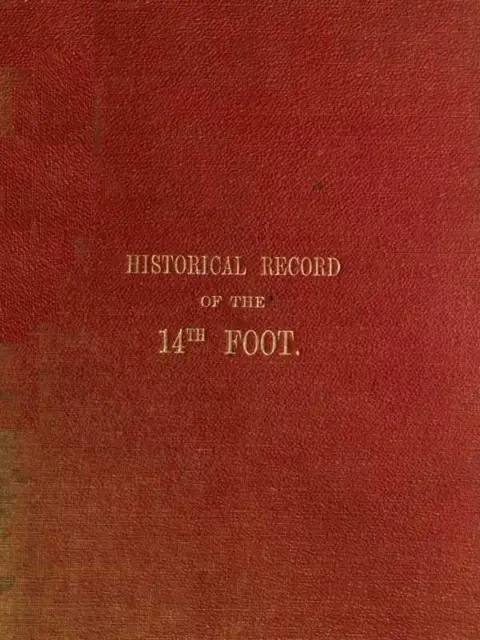
"Historical Record of the Fourteenth, or, the Buckinghamshire Regiment of Foot" by Richard Cannon is a historical account written in the mid-19th century. This work chronicles the formation and military engagements of the Fourteenth Regiment of Foot, starting from its establishment in 1685 up to 1845. The book serves as an in-depth record of the regiment’s distinguished services throughout various conflicts, detailing notable battles and significant moments in the history of British military operations. At the start of the account, the context is set within 1685, highlighting England's stability amid growing tensions related to King James II's reign. The opening focuses on the emergence of the Duke of Monmouth’s rebellion and the subsequent mobilization of troops, including the formation of the Fourteenth Regiment under Sir Edward Hales. The narrative illustrates the regiment's early actions, including its rapid deployment to combat the invaders and its subsequent retention in royal service after the suppression of the rebellion. The first chapter effectively establishes a framework for understanding the regiment's historical significance and sets the stage for further exploration of its military achievements throughout subsequent conflicts in Europe and the East Indies.
Introduction adapted from the source catalogue; source summaries may be automatically generated.
Free to read · English · 31,277 words · No account needed
MAKE TIME FOR A GOOD BOOK
On by default. Untick to stop anonymous reading totals. Each page counts after 10 seconds in view. How this works.
Anonymous counting is on unless you have switched it off.
On the 9th of January, 1799, His Majesty was pleased to appoint Colonel CALVERT to the important situation of ADJUTANT-GENERAL TO THE FORCES, in which capacity he was enabled to perform important and valuable services to the crown and to the country, during one of the most eventful periods in the history of Great Britain. In August, 1800 he was nominated to the colonelcy of the Fifth West India regiment; in 1803 he was promoted to the rank of major-general; in 1806 he was removed to the FOURTEENTH Foot, and in 1810 he was advanced to the rank of lieutenant-general.
At the period of his appointment to the high and important station of Adjutant-General of the Forces, the want of efficient regulations, and of an adherence to a system founded on principles calculated to promote the advantage of every branch of service, was felt by all persons called upon to take a part in the concerns of the army, and serious inconvenience was experienced from the absence of such a system by His Royal Highness the Duke of York, who, at two different periods, had to contend against powerful continental armies, with troops, though eminently brave, and endued with the true spirit of their profession, yet not formed upon sound general principles of discipline. His Royal Highness, being appointed Commander-in-Chief, applied himself with great diligence to the correction of abuses, and to the improvement of the condition of the army in every particular: and his efforts, which were honoured with the encouragement and approbation of His Majesty, were ably seconded by his staff officers, who were judiciously selected to carry his views into effect; the ultimate accomplishment of these objects reflected the highest credit on those who planned, and on those who executed measures which have conduced to the safety and glory of the United Kingdom and of its numerous colonial possessions. Among these officers, SIR HARRY CALVERT held a distinguished station. As Adjutant-General, the discipline, equipment, and efficiency of the army came under his superintendence, and to improve and perfect these, he devoted his best energies and unwearied attention. The general orders of the army, in the successive editions which were brought forward from the year 1799, afford abundant proofs of the value of his labours, in the numerous and excellent regulations made from time to time for the better government of the army. In the clothing, messing, equipment, and every other branch of the interior economy, improvements were introduced to promote the health and comfort of the soldier, and the efficiency of corps; and the establishment of confidential inspection reports facilitated the accomplishment of these objects, by furnishing the Commander-in-Chief, and the authorities under him, with the means of forming a correct judgment of the state of each corps in all its details,--of correcting what was wrong,--of supplying what was deficient, and of ascertaining the merits and capabilities of the officers. The energies of his mind were also directed to the improvement of the morale, as well as to ameliorate the materiel of the army. Being a man of high and sensitive honor himself, he wished to inspire all his brother officers with the same sentiments, by impressing them with a just idea of what they owed to themselves, both as individuals, and as members of the profession of arms. Conscious that no man can be truly respectable who does not respect himself, he was always anxious to uphold and encourage this principle; in accordance with which, he was particularly careful to afford every officer charged with misconduct the fullest opportunity of explanation, and, in conveying disapprobation or censure, he avoided the use of terms calculated to affect the officer's personal feelings, or to degrade him in his own estimation: his verbal intercourse was conducted on the same principle. Such was the kindness of his look and demeanour, and the courtesy of his language, that it was impossible to offer him any personal disrespect; and with whatever sentiments a gentleman might have approached him in his official capacity, he could retire with those only of respect and esteem. To the officers of his own department, who were in daily intercourse with him, his orders were conveyed in the form of requests; and the urbanity of his manners, tempered with self-respect, ensured prompt and cheerful co-operation. In so extensive a branch of the service, the preparation of many documents was necessarily confided to assistants, and the alterations which suggested themselves to his refined discrimination, were proposed with delicacy,--a trait of character grateful to the feelings of his subordinates, and remembered with emotions of respect constantly increased by continued intercourse. In 1807, when the recruiting of the army was placed under his superintendence, he applied himself successfully to the improvement of that branch of the service. He interested himself in the Royal Military Asylum, and in the establishment of regimental schools; the condition of general hospitals also engaged his attention,--he visited them all in 1814, and suggested many improvements in their conduct and management. The invalid and the pensioner found a friend and protector in him, and the representations of a discharged private soldier were received and considered with the same care as those of the higher grades of the service. In this, and in every other respect, he acted in accordance with the desires of the DUKE OF YORK, whose innate goodness of heart, and natural generosity and condescension, led him to promote and encourage every species of kindness to the humblest members of the profession to which he was so devotedly attached; and SIR HARRY CALVERT was the faithful organ of His Royal Highness's benevolent intentions, delighting in the good he was thus enabled to effect.
Your reading position is saved on this browser. Take it to another device with a library code. Reading pages adapt to text, rather than matching a printed edition.
Richard Cannon
Richard Cannon

Richard Cannon
Richard Cannon
BEHIND THE BOOK
This eBook is for the use of anyone anywhere in the United States and most other parts of the world at no cost and with almost no restrictions whatsoever. You may copy it, give it away or re-use it under the terms of the Project Gutenberg License included with this eBook or online at www.gutenberg.org. If you are not located in the United States, you will have to check the laws of the country where you are located before using this eBook. Read the source licence.
The original source file, including credits and licence, is retained by this library. Request an original-format copy at no charge. Please include the book title and Project Gutenberg identifier #54107.
KEEP YOUR CURIOSITY GOING
Cécile Tormay

Moritz Busch
John L. Ransom
Frances Wright
Cécile Tormay

Mabel Potter Daggett