
Historical record of the Ninety-second Regiment, originally termed “The Gordon Highlanders” and numbered the Hundredth Regiment
Richard Cannon
THE CLASSIC COLLECTION · 1845
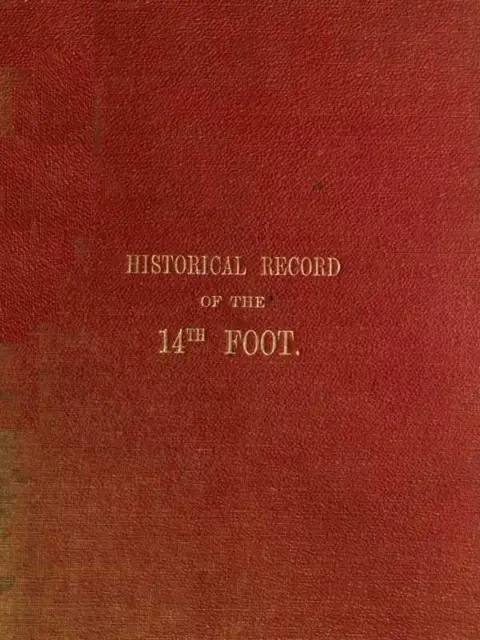
"Historical Record of the Fourteenth, or, the Buckinghamshire Regiment of Foot" by Richard Cannon is a historical account written in the mid-19th century. This work chronicles the formation and military engagements of the Fourteenth Regiment of Foot, starting from its establishment in 1685 up to 1845. The book serves as an in-depth record of the regiment’s distinguished services throughout various conflicts, detailing notable battles and significant moments in the history of British military operations. At the start of the account, the context is set within 1685, highlighting England's stability amid growing tensions related to King James II's reign. The opening focuses on the emergence of the Duke of Monmouth’s rebellion and the subsequent mobilization of troops, including the formation of the Fourteenth Regiment under Sir Edward Hales. The narrative illustrates the regiment's early actions, including its rapid deployment to combat the invaders and its subsequent retention in royal service after the suppression of the rebellion. The first chapter effectively establishes a framework for understanding the regiment's historical significance and sets the stage for further exploration of its military achievements throughout subsequent conflicts in Europe and the East Indies.
Introduction adapted from the source catalogue; source summaries may be automatically generated.
Free to read · English · 31,277 words · No account needed
MAKE TIME FOR A GOOD BOOK
On by default. Untick to stop anonymous reading totals. Each page counts after 10 seconds in view. How this works.
Anonymous counting is on unless you have switched it off.
At this period an armament was fitting out to complete the deliverance of the French West India islands from the power of republicanism, and to reduce to obedience the insurgents of St. Vincent and Grenada. The FOURTEENTH Regiment joined the expedition, and sailed with the immense fleet of Indiamen, transports, and merchant-vessels, under the convoy of a squadron of the royal navy commanded by Admiral Christian, which, on quitting the British shores, presented a magnificent spectacle calculated to impress the mind with a just idea of British power; but the voyage had been delayed until a very late period of the year, and the fleet encountered so severe a storm that several ships foundered at sea, others were wrecked on the western coast of England, and the greater part returned to port. The fleet was re-fitted and again put to sea, but, after encountering severe gales, it returned to Portsmouth a second time. The "Calypso" transport, having part of the FOURTEENTH Regiment on board, was nearly run down during a heavy gale, by the "Charon" of forty-four guns, and lost the main yard; but this transport continued the voyage and arrived at Barbadoes in eleven weeks.
[Sidenote: 1796]
Several of the regiments, which returned to port, had their destination changed; but the portion of the FOURTEENTH, which had put back, re-embarked in February, 1796, and arrived in April at Barbadoes, where four companies of the Twenty-eighth Foot were attached to the regiment.
The FOURTEENTH Foot constituted part of the expedition against St. Lucia, commanded by Lieutenant-General Sir Ralph Abercromby; and sailed from Carlisle-bay, Barbadoes, on the 22nd of April, for the rendezvous of the troops to be employed in the enterprise, at Martinique, from whence the expedition sailed, on the morning of the 26th of April, for St. Lucia, where the head quarters landed on the 27th, near Pigeon Island, and marched to Choque Bay, to cover the landing of the remainder of the troops. They continued in position there a short time, till the batteries against Morne Fortuné were completed, when they were ordered up to take part in the ulterior operations. Prior to landing, three companies were detached, with a force under Brigadier-General Perryn, on the side of the Grand Cul de Sac, to facilitate the investment of Morne Fortuné, and an attempt was made to drive the enemy from the batteries on the base of the mountain, on that side; and Major Donkin's battalion, consisting of three companies of the FOURTEENTH and four of the Twenty-eighth, formed part of the force employed on this service. This battalion supported the Forty-fourth Regiment, in the column commanded by Colonel Riddell. On advancing to the attack, the battalion was checked, at a sudden turn in a winding road cut on the side of a steep hill, by an abattis occupied by French troops, when Captain James Graves sprang up the bank by the aid of a branch, and being assisted by Captain Henry Cox, and Lieutenant George Morris, he helped a few soldiers to climb up the side of the hill, who fired down upon the flank of the troops in the abattis, who instantly abandoned it, and the FOURTEENTH continued their advance. On arriving on more open ground, the fire of the enemy's batteries was heavy; when Captain James Graves, of the FOURTEENTH, and Captain John Frederic Brown, of the Twenty-eighth, stormed the lower battery, called Chapuis, with a few men of the two regiments. Captain Brown, Lieutenants William F. Dalton and John Grady, with several private soldiers, fell wounded in the advance, but the battery was captured, and was held by Captain Graves, Lieutenant John Hutchinson, and about forty rank and file. The soldiers being fired upon from a house, it was forced by a few men under Lieutenant Owen, and all the defenders bayonetted. The firing on the right indicating a retrograde movement on the part of the British troops at that point, Serjeant Shaw of the FOURTEENTH was detached to reconnoitre; he returned wounded, and reported the retreat of the British, and the advance of a fresh column of the enemy. Under these circumstances the guns in the battery were spiked, and the soldiers retired, fighting their way through a woody country, until they joined the column under Brigadier-General Perryn. From the failure of part of the attacking force the operations were not successful.
Your reading position is saved on this browser. Take it to another device with a library code. Reading pages adapt to text, rather than matching a printed edition.
Richard Cannon
Richard Cannon

Richard Cannon
Richard Cannon
BEHIND THE BOOK
This eBook is for the use of anyone anywhere in the United States and most other parts of the world at no cost and with almost no restrictions whatsoever. You may copy it, give it away or re-use it under the terms of the Project Gutenberg License included with this eBook or online at www.gutenberg.org. If you are not located in the United States, you will have to check the laws of the country where you are located before using this eBook. Read the source licence.
The original source file, including credits and licence, is retained by this library. Request an original-format copy at no charge. Please include the book title and Project Gutenberg identifier #54107.
KEEP YOUR CURIOSITY GOING
Cécile Tormay

Moritz Busch
John L. Ransom
Frances Wright
Cécile Tormay

Mabel Potter Daggett