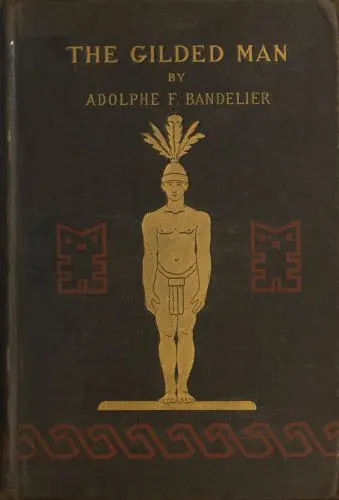
The Gilded Man (El Dorado) and other pictures of the Spanish occupancy of America
Adolph Francis Alphonse Bandelier
THE CLASSIC COLLECTION · 1881
"Historical Introduction to Studies Among the Sedentary Indians of New Mexico" by Ad. F. Bandelier is a scholarly historical account written in the late 19th century. The work delves into the early interactions and understandings of European explorers with the sedentary Native American tribes in New Mexico and Arizona. Bandelier focuses on various legends and historical narratives, examining their implications for interpreting the culture and societal structures of the indigenous peoples. The opening portion establishes the historical context by discussing the earliest knowledge of sedentary Indians as transmitted through Mexican narratives, particularly the tales of "Seven Cities" and the "Seven Caves.” Bandelier explores the influential roles these legends had in shaping European perceptions of the region, providing insights into the migration and cultural significance of the tribes. He references notable figures like Fray Marcos de Nizza and Coronado, situating their expeditions within the broader historical landscape while emphasizing the importance of understanding these narratives for studying indigenous ethnography and culture.
Introduction adapted from the source catalogue; source summaries may be automatically generated.
Free to read · English · 44,605 words · No account needed
MAKE TIME FOR A GOOD BOOK
On by default. Untick to stop anonymous reading totals. Each page counts after 10 seconds in view. How this works.
Anonymous counting is on unless you have switched it off.
[54] Obediencia y Vasallaje a Su Magestad por los Indios de Santo-Domingo. Id., p. 102. July 7, 1598. Obediencia, etc., de S. Joan Baptista, pp. 112, 115, "los Chiguas o Tiguas."
[55] Apuntamientos que sobre el Terreno hizo el Padre Jose Amando Niel, Documentos para la Historia de Mexico, 3a serie, vol. i. pp. 98, 99: "Estan pobladas junto a la sierra de Puruai que toma el nombre del principal pueblo que se llama asi, y orilla del gran rio." There were then three pueblos: San-Pedro, "rio abajo de Puruai;" Santiago, "rio arriba." Puaray was destroyed and in ruins in 1711. It was here that Father Augustin Ruiz was killed in 1581. Fray Geronimo de Zarate Salmeron, Relacion, etc., p. 10. Fray Agustin de Vetancurt, Menologio Franciscano, pp. 412, 413. Jean Blaeu, Douzieme livre de la Geographie Blaviane, Amsterdam, 1667, p. 62, calls the Tiguas "Tebas," and says they had "quinze bourgades." Vetancurt, Menologio, but principally Cronica de la provincia del Santo Evangelio de Mexico, gives the Tiguas, before 1680, the following stations and pueblos: Isleta, Alameda, Puray, and Sandia, pp. 310-313.
[56] Relacion, etc., p. 10.
[57] A. S. Gatschet, Zwoelf Sprachen aus dem Suedwesten Nord-Amerika's,
Weimar, 1876, p. 41.
[58] Castaneda, i. cap. xix. p. 116.
[59] Simpson, Coronado's March, pp. 336.
[60] Castaneda, i. cap. xiii. p. 76.
[61] Spanish Conquest, cap. xxiii. p. 180, note 5, p. 181, note 6.
[62] Castaneda, p. 76.
[63] Isleta is probably a modern pueblo, that is one erected since 1598 and previous to 1680, and I shall treat it as such till I am better informed. The description by Vetancurt ("Cronica," etc., trat. iii. cap. v. pp. 310 and 311, as in the year 1680) is characteristic: "Formase un rio de la nieve que se derrite, que con el rio Norte cercan un campo de cinco leguas ... Es el paso para las provincias de Acoma, Zunias, Moqui ..." In a straight line, the distance from Bernalillo is about twenty-five miles.
[64] p. 76. "Le general remonta ensuite la riviere, et visita toute la province jusqu'a ce qu'il fut arrive a Tiguex."
[65] p. 76. "Ils apprirent qu'en descendant la riviere ils trouveraient encore d'autres villages."
[66] Castaneda, ii. cap. iv. p. 168.
[67] Cap. vi. p. 182, part ii. In looking at the map, it will be seen that Bernalillo is, indeed, a central point. Along the Rio Grande it is almost at equal distances from Taos at the north, and Socorro at the south, whereas it is little further (in an east-westerly line) from Bernalillo to Zuni, than from Bernalillo to the plains. The accuracy of Castaneda becomes more and more wonderful, the closer his narrative is studied and compared with the country itself. His distance exceeds the bee-line regularly almost by one-third; a very natural fact, since he computes the lengths from the routes taken.
Your reading position is saved on this browser. Take it to another device with a library code. Reading pages adapt to text, rather than matching a printed edition.
Adolph Francis Alphonse Bandelier
Adolph Francis Alphonse Bandelier
Adolph Francis Alphonse Bandelier
Adolph Francis Alphonse Bandelier
BEHIND THE BOOK
This eBook is for the use of anyone anywhere in the United States and most other parts of the world at no cost and with almost no restrictions whatsoever. You may copy it, give it away or re-use it under the terms of the Project Gutenberg License included with this eBook or online at www.gutenberg.org. If you are not located in the United States, you will have to check the laws of the country where you are located before using this eBook. Read the source licence.
The original source file, including credits and licence, is retained by this library. Request an original-format copy at no charge. Please include the book title and Project Gutenberg identifier #23224.
KEEP YOUR CURIOSITY GOING
Cécile Tormay

Moritz Busch
John L. Ransom
Frances Wright
Cécile Tormay

Mabel Potter Daggett