THE CLASSIC COLLECTION✦An outlaw’s diary: the CommuneCLASSIC FREE BOOKS
An outlaw’s diary: the Commune
Cécile Tormay
THE CLASSIC COLLECTION · 1868
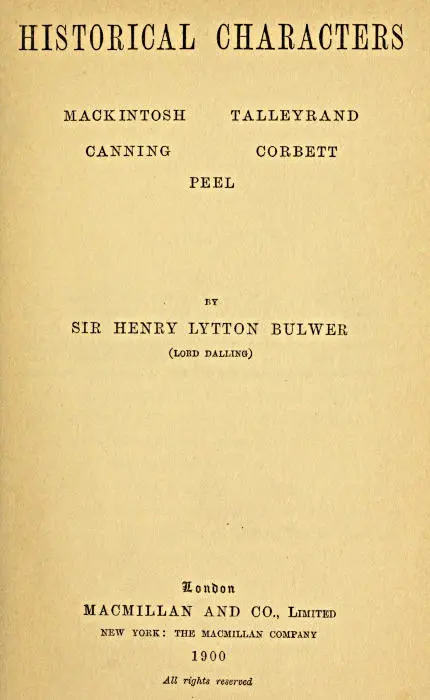
"Historical Characters: Mackintosh, Talleyrand, Canning, Cobbett, Peel" by Sir Henry Lytton Bulwer is a historical account written in the late 19th century. The book offers personal sketches of significant figures from modern history, particularly focusing on the era from the French Revolution of 1789 onwards. Through these portraits, the author seeks to illuminate the interplay between individual characters and the broader historical context in which they operated. The opening of the work sets the framework for exploring the lives and influences of key historical figures, starting with Charles Maurice de Talleyrand, a prominent diplomat and politician. The text discusses not just Talleyrand's background and rise within the ecclesiastical hierarchy but also his strategic thinking and adaptability during the tumultuous times of the French Revolution. It highlights both his early life and career, emphasizing his intelligence, social acuity, and the complexities of his character as he navigated the political landscape, showcasing how personal virtues and flaws shaped his historical role. This initial section provides a compelling introduction to the detailed character studies that are to follow.
Introduction adapted from the source catalogue; source summaries may be automatically generated.
Free to read · English · 212,298 words · No account needed
MAKE TIME FOR A GOOD BOOK
On by default. Untick to stop anonymous reading totals. Each page counts after 10 seconds in view. How this works.
Anonymous counting is on unless you have switched it off.
His recorded bon mots, of which I have given some, have become hackneyed, especially the best. But I will venture to mention a few that occur to me, as I am writing, and which are remarkable as expressing an opinion concerning an individual or a situation.
When the Comte d’Artois wished to be present at the councils of Louis XVIII., M. de Talleyrand opposed the project. The Comte d’Artois was offended, and reproached the minister. “Un jour,” said M. de Talleyrand, “Votre Majesté me remerciera pour ce qui déplaît a Votre Altesse Royale.”
M. de Châteaubriand was no favourite with M. de Talleyrand. He condemned him as an affected writer, and an impossible politician. When the “Martyrs” first appeared, and was run after by the public with an appetite that the booksellers could not satisfy, M. de Fontanes, after speaking of it with an exaggerated eulogium, finished his explanation of the narrative by saying that Eudore and Cymodocée were thrown into the circus and devoured “par les bêtes.” “Comme l’ouvrage,” said M. de Talleyrand.
Some person saying that Fouché had a great contempt for mankind, “C’est vrai,” said M. de Talleyrand, “cet homme s’est beaucoup étudié.”
There is a certain instinct which most persons have as to their successor; and when some one asked M. de Talleyrand a little before the Duc de Richelieu, governor of Odessa, was appointed prime minister in his own country, whether he, M. de Talleyrand, really thought that the Duc was fit to govern France, he replied, to the surprise of the questioner, “Most assuredly;” adding, after a slight pause, “No one knows the Crimea better.”
A lady, using the privilege of her sex, was speaking with violence of the defection of the Duc de Raguse. “Mon Dieu, madame,” said M. de Talleyrand, “tout cela ne prouve qu’une chose. C’est que sa montre avançait et tout le monde était à l’heure.”
A strong supporter of the chamber of peers, when there was much question as to its merits, said, “At least you there find consciences.” “Ah, oui,” said M. de Talleyrand, “beaucoup, beaucoup de consciences. Semonville, par exemple, en a au moins deux.”
Louis XVIII., speaking of M. de Blacas before M. de Talleyrand had expressed any opinion concerning him, said, “Ce pauvre Blacas, il aime la France, il m’aime, mais on dit qu’il est suffisant.” “Ah oui, Sire, suffisant et insuffisant.”
As Madame de Staël was praising the British Constitution, M. de Talleyrand, turning round, said in a low, explanatory tone, “Elle admire surtout l’habeas corpus.”
Your reading position is saved on this browser. Take it to another device with a library code. Reading pages adapt to text, rather than matching a printed edition.
BEHIND THE BOOK
This eBook is for the use of anyone anywhere in the United States and most other parts of the world at no cost and with almost no restrictions whatsoever. You may copy it, give it away or re-use it under the terms of the Project Gutenberg License included with this eBook or online at www.gutenberg.org. If you are not located in the United States, you will have to check the laws of the country where you are located before using this eBook. Read the source licence.
The original source file, including credits and licence, is retained by this library. Request an original-format copy at no charge. Please include the book title and Project Gutenberg identifier #53285.
KEEP YOUR CURIOSITY GOING
Cécile Tormay

Moritz Busch
John L. Ransom
Frances Wright
Cécile Tormay

Mabel Potter Daggett