
France and England in North America, Part VII, Vol 2: A Half-Century of Conflict
Francis Parkman
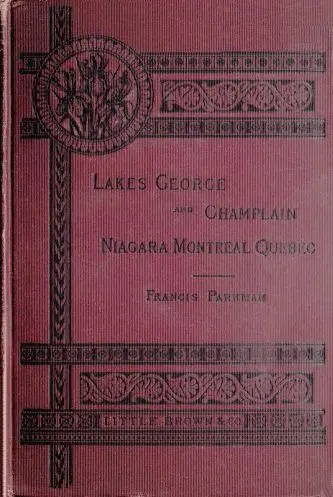
THE CLASSIC COLLECTION · 1885
"Historic Handbook of the Northern Tour" by Francis Parkman is a historical account written in the late 19th century. The work presents a collection of narratives detailing significant events from colonial history linked to tourist attractions in Canada and the northern United States, focusing on places such as Lakes George and Champlain, Niagara, Montreal, and Quebec. The opening of the book introduces readers to the region’s early exploration and battles, particularly revolving around Samuel de Champlain’s expedition against the Iroquois in 1609, marking the beginning of the French and Indian conflicts. It vividly describes their journey as they paddle through the uninhabited land filled with danger, recounting Champlain’s determination and the dream that forewarns them of impending battles. As the narrative unfolds, the text sets the stage for a historical account that blends adventure, exploration, and the complexities of colonial military engagements, enticing readers interested in the dramatic intersections of nature, history, and human conflict.
Introduction adapted from the source catalogue; source summaries may be automatically generated.
Free to read · English · 49,953 words · No account needed
MAKE TIME FOR A GOOD BOOK
On by default. Untick to stop anonymous reading totals. Each page counts after 10 seconds in view. How this works.
Anonymous counting is on unless you have switched it off.
She had found her destiny. The ocean, the wilderness, the solitude, the Iroquois,--nothing daunted her. She would go to Montreal with Maisonneuve and his forty men. Yet, when the vessel was about to sail, a new and sharp misgiving seized her. How could she, a woman, not yet bereft of youth or charms, live alone in the forest, among a troop of soldiers? Her scruples were relieved by two of the men, who, at the last moment, refused to embark without their wives,--and by a young woman, who, impelled by enthusiasm, escaped from her friends, and took passage, in spite of them, in one of the vessels.
All was ready; the ships set sail; but Olier, Dauversiere, and Fancamp remained at home, as did also the other Associates, with the exception of Maisonneuve and Mademoiselle Mance. In the following February, an impressive scene took place in the Church of Notre-Dame, at Paris. The Associates, at this time numbering about forty-five, with Olier at their head, assembled before the altar of the Virgin, and, by a solemn ceremonial, consecrated Montreal to the Holy Family. Henceforth it was to be called Villemarie de Montreal,--a sacred town, reared to the honor and under the patronage of Christ, St. Joseph, and the Virgin, to be typified by three persons on earth, founders respectively of the three destined communities,--Olier, Dauversiere, and a maiden of Troyes, Marguerite Bourgeoys: the seminary to be consecrated to Christ, the Hotel-Dieu to St. Joseph, and the college to the Virgin.
But we are anticipating a little; for it was several years as yet before Marguerite Bourgeoys took an active part in the work of Montreal. She was the daughter of a respectable tradesman, and was now twenty-two years of age. Her portrait has come down to us; and her face is a mirror of loyalty and womanly tenderness. Her qualities were those of good sense, conscientiousness, and a warm heart. She had known no miracles, ecstasies, or trances; and though afterwards, when her religious susceptibilities had reached a fuller development, a few such are recorded of her, yet even the Abbe Faillon, with the best intentions, can credit her with but a meagre allowance of these celestial favors. Though in the midst of visionaries, she distrusted the supernatural, and avowed her belief that, in His government of the world, God does not often set aside its ordinary laws. Her religion was of the affections, and was manifested in an absorbing devotion to duty. She had felt no vocation to the cloister, but had taken the vow of chastity, and was attached, as an externe, to the Sisters of the Congregation of Troyes, who were fevered with eagerness to go to Canada. Marguerite, however, was content to wait until there was a prospect that she could do good by going; and it was not till the year 1653, that, renouncing an inheritance, and giving all she had to the poor, she embarked for the savage scene of her labors. To this day, in crowded school-rooms of Montreal and Quebec, fit monuments of her unobtrusive virtue, her successors instruct the children of the poor, and embalm the pleasant memory of Marguerite Bourgeoys. In the martial figure of Maisonneuve, and the fair form of this gentle nun, we find the true heroes of Montreal.
Your reading position is saved on this browser. Take it to another device with a library code. Reading pages adapt to text, rather than matching a printed edition.
Francis Parkman
Francis Parkman
Francis Parkman
Francis Parkman
BEHIND THE BOOK
This eBook is for the use of anyone anywhere in the United States and most other parts of the world at no cost and with almost no restrictions whatsoever. You may copy it, give it away or re-use it under the terms of the Project Gutenberg License included with this eBook or online at www.gutenberg.org. If you are not located in the United States, you will have to check the laws of the country where you are located before using this eBook. Read the source licence.
The original source file, including credits and licence, is retained by this library. Request an original-format copy at no charge. Please include the book title and Project Gutenberg identifier #35216.
KEEP YOUR CURIOSITY GOING
Wilfrid Scawen Blunt
Wilfrid Scawen Blunt

E. W. (Edgar Watson) Howe
Cécile Tormay

Moritz Busch
John L. Ransom