
France and England in North America, Part VII, Vol 2: A Half-Century of Conflict
Francis Parkman
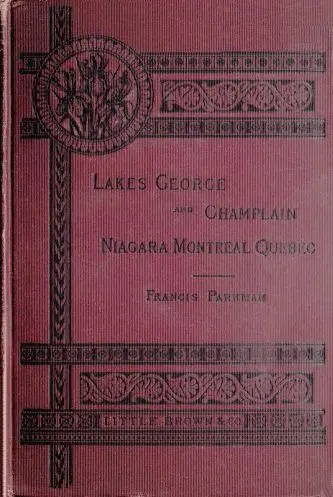
THE CLASSIC COLLECTION · 1885
"Historic Handbook of the Northern Tour" by Francis Parkman is a historical account written in the late 19th century. The work presents a collection of narratives detailing significant events from colonial history linked to tourist attractions in Canada and the northern United States, focusing on places such as Lakes George and Champlain, Niagara, Montreal, and Quebec. The opening of the book introduces readers to the region’s early exploration and battles, particularly revolving around Samuel de Champlain’s expedition against the Iroquois in 1609, marking the beginning of the French and Indian conflicts. It vividly describes their journey as they paddle through the uninhabited land filled with danger, recounting Champlain’s determination and the dream that forewarns them of impending battles. As the narrative unfolds, the text sets the stage for a historical account that blends adventure, exploration, and the complexities of colonial military engagements, enticing readers interested in the dramatic intersections of nature, history, and human conflict.
Introduction adapted from the source catalogue; source summaries may be automatically generated.
Free to read · English · 49,953 words · No account needed
MAKE TIME FOR A GOOD BOOK
On by default. Untick to stop anonymous reading totals. Each page counts after 10 seconds in view. How this works.
Anonymous counting is on unless you have switched it off.
While Johnson lay at Lake George, Dieskau prepared a surprise for him. The German Baron had reached Crown Point at the head of three thousand five hundred and seventy-three men, regulars, Canadians, and Indians. He had no thought of waiting there to be attacked. The troops were told to hold themselves ready to move at a moment's notice. Officers--so ran the order--will take nothing with them but one spare shirt, one spare pair of shoes, a blanket, a bearskin, and provisions for twelve days; Indians are not to amuse themselves by taking scalps till the enemy is entirely defeated, since they can kill ten men in the time required to scalp one. Then Dieskau moved on, with nearly all his force, to Carillon, or Ticonderoga, a promontory commanding both the routes by which alone Johnson could advance, that of Wood Creek and that of Lake George.
The Indian allies were commanded by Legardeur de Saint-Pierre. These unmanageable warriors were a constant annoyance to Dieskau, being a species of humanity quite new to him. "They drive us crazy," he says, "from morning till night. There is no end to their demands. They have already eaten five oxen and as many hogs, without counting the kegs of brandy they have drunk. In short, one needs the patience of an angel to get on with these devils; and yet one must always force himself to seem pleased with them."
They would scarcely even go out as scouts. At last, however, on the fourth of September, a reconnoitring party came in with a scalp and an English prisoner caught near Fort Lyman. He was questioned under the threat of being given to the Indians for torture if he did not tell the truth; but, nothing daunted, he invented a patriotic falsehood; and thinking to lure his captors into a trap, told them that the English army had fallen back to Albany, leaving five hundred men at Fort Lyman, which he represented as indefensible. Dieskau resolved on a rapid movement to seize the place. At noon of the same day, leaving a part of his force at Ticonderoga, he embarked the rest in canoes and advanced along the narrow prolongation of Lake Champlain that stretched southward through the wilderness to where the town of Whitehall now stands. He soon came to a point where the lake dwindled to a mere canal, while two mighty rocks, capped with stunted forests, faced each other from the opposing banks. Here he left an officer named Roquemaure with a detachment of troops, and again advanced along a belt of quiet water traced through the midst of a deep marsh, green at that season with sedge and water-weeds, and known to the English as the Drowned Lands. Beyond, on either hand, crags feathered with birch and fir, or hills mantled with woods, looked down on the long procession of canoes. As they neared the site of Whitehall, a passage opened on the right, the entrance to a sheet of lonely water slumbering in the shadow of woody mountains, and forming the lake then, as now, called South Bay. They advanced to its head, landed where a small stream enters it, left the canoes under a guard, and began their march through the forest. They counted in all two hundred and sixteen regulars of the battalions of Languedoc and La Reine, six hundred and eighty-four Canadians, and about six hundred Indians. Every officer and man carried provisions for eight days in his knapsack. They encamped at night by a brook, and in the morning, after hearing Mass, marched again. The evening of the next day brought them near the road that led to Lake George. Fort Lyman was but three miles distant. A man on horseback galloped by; it was Adams, Johnson's unfortunate messenger. The Indians shot him, and found the letter in his pocket. Soon after, ten or twelve wagons appeared in charge of mutinous drivers, who had left the English camp without orders. Several of them were shot, two were taken, and the rest ran off. The two captives declared that, contrary to the assertion of the prisoner at Ticonderoga, a large force lay encamped at the lake. The Indians now held a council, and presently gave out that they would not attack the fort, which they thought well supplied with cannon, but that they were willing to attack the camp at Lake George. Remonstrance was lost upon them. Dieskau was not young, but he was daring to rashness, and inflamed to emulation by the victory over Braddock. The enemy were reported greatly to outnumber him; but his Canadian advisers had assured him that the English colony militia were the worst troops on the face of the earth. "The more there are," he said to the Canadians and Indians, "the more we shall kill;" and in the morning the order was given to march for the lake.
Your reading position is saved on this browser. Take it to another device with a library code. Reading pages adapt to text, rather than matching a printed edition.
Francis Parkman
Francis Parkman
Francis Parkman
Francis Parkman
BEHIND THE BOOK
This eBook is for the use of anyone anywhere in the United States and most other parts of the world at no cost and with almost no restrictions whatsoever. You may copy it, give it away or re-use it under the terms of the Project Gutenberg License included with this eBook or online at www.gutenberg.org. If you are not located in the United States, you will have to check the laws of the country where you are located before using this eBook. Read the source licence.
The original source file, including credits and licence, is retained by this library. Request an original-format copy at no charge. Please include the book title and Project Gutenberg identifier #35216.
KEEP YOUR CURIOSITY GOING
Wilfrid Scawen Blunt
Wilfrid Scawen Blunt

E. W. (Edgar Watson) Howe
Cécile Tormay

Moritz Busch
John L. Ransom