THE CLASSIC COLLECTION✦Journal of a tour in Marocco and the Great AtlasCLASSIC FREE BOOKS
Journal of a tour in Marocco and the Great Atlas
Joseph Dalton Hooker & John Ball
THE CLASSIC COLLECTION · 1854
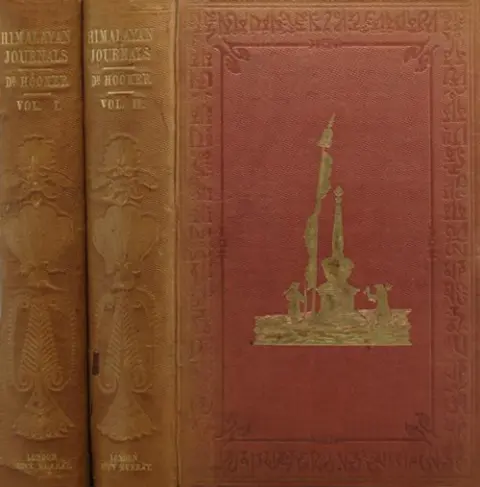
"Himalayan Journals — Volume 2" by Joseph Dalton Hooker is a scientific journal written in the mid-19th century. The book documents Hooker's extensive explorations and observations as a naturalist in the Sikkim and Nepal Himalayas, including insights into botany, geology, and the local cultures he encounters. The text serves as both a travelogue and a detailed account of the diverse flora and fauna, as well as the challenges faced during his journeys. The opening of the volume sets the stage for Hooker's second expedition into the Sikkim region, highlighting the political tensions he faces, particularly from the Dewan, who seeks to obstruct his progress. Hooker details the preparations for his journey, including the need to arrange supplies and deal with the uncooperative local authorities. As he traverses various terrains, he vividly describes the lush vegetation, local legends, and his encounters with the indigenous Lepcha people. His observations reflect both the beauty of the Himalayan landscape and the complexities of navigating the social and political landscape during his travels.
Introduction adapted from the source catalogue; source summaries may be automatically generated.
Free to read · English · 153,244 words · No account needed
MAKE TIME FOR A GOOD BOOK
On by default. Untick to stop anonymous reading totals. Each page counts after 10 seconds in view. How this works.
Anonymous counting is on unless you have switched it off.
B.-- JANUARY 1, 1851. Watch slow 3 minutes 45 seconds mean time. Tem. Act. Hour Act. Act. Reduced Barom. Air ------------------------------------------------------------------ a.m. 7.34 to 7.41 10.0 69.4 8.4200 29.948 55.4 8.38 to 8.45 16.0 70.0 13.3920 58.9 9.44 to 9.51 19.5 74.7 15.3660 29.891 63.2 10.46 to 10.53 21.0 78.2 15.8550 66.7 11.50 to 11.57 21.5 81.2 15.6950 69.8 p.m. 0.06 to 0.13 24.1 88.0 16.4603 29.850 70.3 0.58 to 1.02 23.9 87.2 16.4432 71.0 1.45 to 1.52 21.4 84.5 15.0870 71.3 3.15 to 3.22 18.1 82.5 13.0320 29.798 71.3 4.27 to 4.34 10.2 82.0 7.3746 70.0 4.36 to 4.43 9.8 84.0 6.9482 4.45 to 4.52 8.5 85.0 5.9670 4.56 to 5.09 5.6 85.0 3.9312 67.5 5.12 to 5.18 3.8 84.0 2.6942 29.778 68.7 ------------------------------------------------------------------
Black
Hour D.P. Diff. Sat. Bulb
------------------------------------------------------------------
a.m. 7.34 to 7.41 54.0 1.4 .953 Mist rises and
8.38 to 8.45 57.7 1.2 .970 104.5 drifts westward
9.44 to 9.51 61.7 1.5 .960 115.0 till 7.30 a.m.
10.46 to 10.53 62.4 4.3 .870 129.0
11.50 to 11.57 58.3 11.5 .688 117.0 Wind N.W., clouds
p.m. 0.06 to 0.13 56.0 14.3 .625 122.5 rise.
0.58 to 1.02 56.7 14.3 .625
1.45 to 1.52 57.5 13.8 .633 117.0
3.15 to 3.22 57.1 14.2 .625
4.27 to 4.34 59.5 10.5 .708
4.36 to 4.43
4.45 to 4.52
4.56 to 5.09 62.7 4.8 .855 Sunset cloudless.
5.12 to 5.18 62.2 6.5 .810
------------------------------------------------------------------
C.--JANUARY 2, 1851. Watch slow 3 minutes mean time. Tem. Act. Hour Act. Act. Reduced Barom. Air ------------------------------------------------------------------ a.m. 10.02 to 10.09 19.2 71.0 15.8592 64.5 10.20 to 10.24 22.6 79.0 16.9048 29.861 65.6 p.m. 0.03 to 0.10 24.7 89.2 16.6972 29.858 69.0 0.22 to 0.25 25.9 95.5 18.6796 70.7 2.04 to 2.08 23.3 91.5 15.4479 71.2 2.10 to 2.14 23.8 93.0 15.6128 ------------------------------------------------------------------
Black Hour D.P. Diff. Sat. Bulb ------------------------------------------------------------------ a.m. 10.02 to 10.09 60.6 3.9 .878 116.0 Low, dense fog at 10.20 to 10.24 61.4 4.2 .872 sunrise, clear at p.m. 0.03 to 0.10 59.3 9.7 .728 119.0 9 a.m. 0.22 to 0.25 57.5 3.2 .650 Hills hazy and 2.04 to 2.08 61.0 10.2 .718 112.0 horizon grey. 2.10 to 2.14 ------------------------------------------------------------------
In the following tables I have given the elevations of 300 places, chiefly computed from barometric data. For the computations such observations alone were selected as were comparable with contemporaneous ones taken at the Calcutta Observatory, or as could, by interpolation, be reduced to these, with considerable accuracy: the Calcutta temperatures have been assumed as those of the level of the sea, and eighteen feet have been added for the height of the Calcutta Observatory above the sea. I have introduced two standards of comparison where attainable; namely, 1. A few trigonometrical data, chiefly of positions around Dorjiling, measured by Lieutenant-Colonel Waugh, the Surveyor-General, also a few measured by Mr. Muller and myself, in which we can put full confidence: and, 2. A number of elevations in Sikkim and East Nepal, computed by simultaneous barometer observations, taken by Mr. Muller at Dorjiling. As the Dorjiling barometer was in bad repair, I do not place so much confidence in these comparisons as in those with Calcutta. The coincidence, however, between the mean of all the elevations computed by each method is very remarkable; the difference amounting to only thirty feet in ninety-three elevations; the excess being in favour of those worked by Dorjiling. As the Dorjiling observations were generally taken at night, or early in the morning, when the temperature is below the mean of the day, this excess in the resulting elevations would appear to prove, that the temperature correction derived from assuming the Calcutta observations to correspond with eighteen feet above the level of the sea at Sikkim, has not practically given rise to much error.
I have not added the boiling-point observations, which afford a further means of testing the accuracy of the barometric computations; and which will be found in section J of this Appendix.
Your reading position is saved on this browser. Take it to another device with a library code. Reading pages adapt to text, rather than matching a printed edition.
Joseph Dalton Hooker & John Ball
Joseph Dalton Hooker
Joseph Dalton Hooker
BEHIND THE BOOK
This eBook is for the use of anyone anywhere in the United States and most other parts of the world at no cost and with almost no restrictions whatsoever. You may copy it, give it away or re-use it under the terms of the Project Gutenberg License included with this eBook or online at www.gutenberg.org. If you are not located in the United States, you will have to check the laws of the country where you are located before using this eBook. Read the source licence.
The original source file, including credits and licence, is retained by this library. Request an original-format copy at no charge. Please include the book title and Project Gutenberg identifier #6477.
KEEP YOUR CURIOSITY GOING
Wilfrid Scawen Blunt
Wilfrid Scawen Blunt

E. W. (Edgar Watson) Howe
Cécile Tormay

Moritz Busch
John L. Ransom