THE CLASSIC COLLECTION✦Journal of a tour in Marocco and the Great AtlasCLASSIC FREE BOOKS
Journal of a tour in Marocco and the Great Atlas
Joseph Dalton Hooker & John Ball
THE CLASSIC COLLECTION · 1854
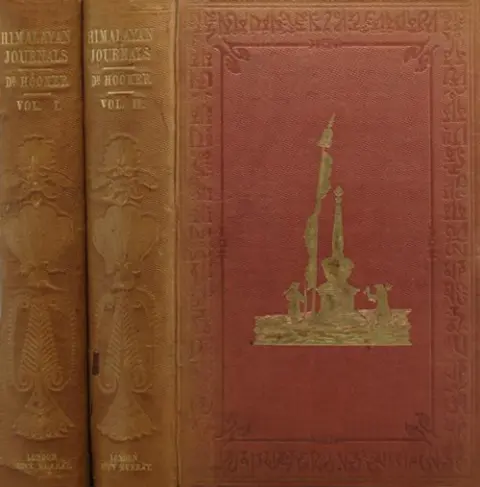
"Himalayan Journals — Volume 2" by Joseph Dalton Hooker is a scientific journal written in the mid-19th century. The book documents Hooker's extensive explorations and observations as a naturalist in the Sikkim and Nepal Himalayas, including insights into botany, geology, and the local cultures he encounters. The text serves as both a travelogue and a detailed account of the diverse flora and fauna, as well as the challenges faced during his journeys. The opening of the volume sets the stage for Hooker's second expedition into the Sikkim region, highlighting the political tensions he faces, particularly from the Dewan, who seeks to obstruct his progress. Hooker details the preparations for his journey, including the need to arrange supplies and deal with the uncooperative local authorities. As he traverses various terrains, he vividly describes the lush vegetation, local legends, and his encounters with the indigenous Lepcha people. His observations reflect both the beauty of the Himalayan landscape and the complexities of navigating the social and political landscape during his travels.
Introduction adapted from the source catalogue; source summaries may be automatically generated.
Free to read · English · 153,244 words · No account needed
MAKE TIME FOR A GOOD BOOK
On by default. Untick to stop anonymous reading totals. Each page counts after 10 seconds in view. How this works.
Anonymous counting is on unless you have switched it off.
The usual arrangement is a row of five, seven, or more erect oblong blocks with round heads (the highest being placed in the middle), on which are often wooden discs and cones: more rarely pyramids are built. Broad slabs for seats are also common by the wayside. Mr. Yule, who first drew attention to these monuments, mentions one thirty-two feet by fifteen, and two in thickness; and states that the sarcophagi (which, however, are rare) formed of four slabs, resemble a drawing in Bell's Circassia, and descriptions in Irby and Mangles' Travels in Syria. He adds that many villages derive their names from these stones, "mau" signifying "stone:" thus "Mausmai" is "the stone of oath," because, as his native informant said, "there was war between Churra and Mausmai, and when they made peace, they swore to it, and placed a stone as a witness;" forcibly recalling the stone Jacob set up for a pillar, and other passages in the old Testament: "Mamloo" is "the stone of salt," eating salt from a sword's point being the Khasia form of oath: "Mauflong" is "the grassy stone," etc.* [Notes on the Khasia mountains and people; by Lieutenant H. Yule, Bengal Engineers. Analogous combinations occur in the south of England and in Brittany, etc., where similar structures are found. Thus maen, man, or men is the so-called Druidical name for a stony, whence Pen-maen-mawr, for "the hill of the big stone," Maen-hayr, for the standing stones of Brittany, and Dol-men, °the table-stone," for a cromlech.] Returning from this grove, we crossed a stream by a single squared block, twenty-eight feet long, five broad, and two thick, of gray syenitic granite with large crystals of felspar.
We left Nurtiung on the 4th of October, and walked to Pomrang, a very long and fatiguing day's work. The route descends north-west of the village, and turns due east along bare grassy hills of mica-schist and slate (strike east and west, and dip north). Near the village of Lernai oak woods are passed, in which Vanda coerulea grows in profusion, waving its panicles of azure flowers in the wind. As this beautiful orchid is at present attracting great attention, from its high price, beauty, and difficulty of culture, I shall point out how totally at variance with its native habits, is the cultivation thought necessary for it in England.* [We collected seven men's loads of this superb plant for the Royal Gardens at Kew; but owing to unavoidable accidents and difficulties, few specimens reached England alive. A gentleman who sent his gardener with us to be shown the locality, was more successful: he sent one man's load to England on commission, and though it arrived in a very poor state, it sold for 300 pounds, the individual plants fetching prices varying from 3 pounds to 10 pounds. Had all arrived alive, they would have cleared 1000 pounds. An active collector, with the facilities I possessed, might easily clear from 2000 pounds to 3000 pounds, in one season, by the sale of Khasia orchids.] The dry grassy hills which it inhabits are elevated 3000 to 4000 feet: the trees are small, gnarled, and very sparingly leafy, so that the Vanda which grows on their limbs is fully exposed to sun, rain, and wind. There is no moss or lichen on the branches with the Vanda, whose roots sprawl over the dry rough bark. The atmosphere is on the whole humid, and extremely so during the rains; but there is no damp heat, or stagnation of the air, and at the flowering season the temperature ranges between 60 degrees and 80 degrees, there is much sunshine, and both air and bark are dry during the day: in July and August, during the rains, the temperature is a little higher than above, but in winter it falls much lower, and hoar-frost forms on the ground. Now this winter's cold, summer's heat, and autumn's drought, and above all, this constant free exposure to fresh air and the winds of heaven, are what of all things we avoid exposing our orchids to in England. It is under these conditions, however, that all the finer Indian Orchideae, grow, of which we found Dendrobium Farmeri, Dalhousianum, Devonianum, etc., with Vanda coerulea; whilst the most beautiful species of Coelogyne, Cymbidium, Bolbophyllum, and Cypripedium, inhabit cool climates at elevations above 4000 feet in Khasia, and as high as 6000 to 7000 in Sikkim.
Your reading position is saved on this browser. Take it to another device with a library code. Reading pages adapt to text, rather than matching a printed edition.
Joseph Dalton Hooker & John Ball
Joseph Dalton Hooker
Joseph Dalton Hooker
BEHIND THE BOOK
This eBook is for the use of anyone anywhere in the United States and most other parts of the world at no cost and with almost no restrictions whatsoever. You may copy it, give it away or re-use it under the terms of the Project Gutenberg License included with this eBook or online at www.gutenberg.org. If you are not located in the United States, you will have to check the laws of the country where you are located before using this eBook. Read the source licence.
The original source file, including credits and licence, is retained by this library. Request an original-format copy at no charge. Please include the book title and Project Gutenberg identifier #6477.
KEEP YOUR CURIOSITY GOING
Wilfrid Scawen Blunt
Wilfrid Scawen Blunt

E. W. (Edgar Watson) Howe
Cécile Tormay

Moritz Busch
John L. Ransom