THE CLASSIC COLLECTION✦Journal of a tour in Marocco and the Great AtlasCLASSIC FREE BOOKS
Journal of a tour in Marocco and the Great Atlas
Joseph Dalton Hooker & John Ball
THE CLASSIC COLLECTION · 1854
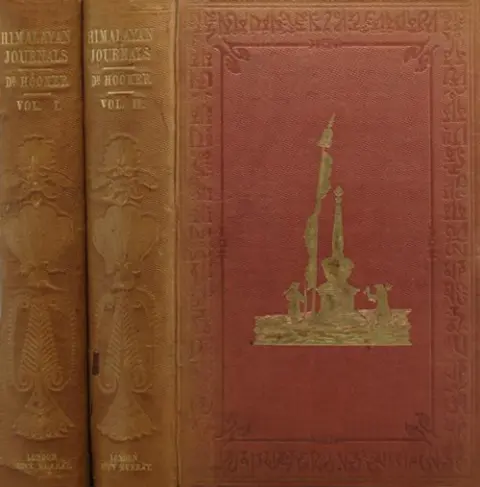
"Himalayan Journals — Volume 2" by Joseph Dalton Hooker is a scientific journal written in the mid-19th century. The book documents Hooker's extensive explorations and observations as a naturalist in the Sikkim and Nepal Himalayas, including insights into botany, geology, and the local cultures he encounters. The text serves as both a travelogue and a detailed account of the diverse flora and fauna, as well as the challenges faced during his journeys. The opening of the volume sets the stage for Hooker's second expedition into the Sikkim region, highlighting the political tensions he faces, particularly from the Dewan, who seeks to obstruct his progress. Hooker details the preparations for his journey, including the need to arrange supplies and deal with the uncooperative local authorities. As he traverses various terrains, he vividly describes the lush vegetation, local legends, and his encounters with the indigenous Lepcha people. His observations reflect both the beauty of the Himalayan landscape and the complexities of navigating the social and political landscape during his travels.
Introduction adapted from the source catalogue; source summaries may be automatically generated.
Free to read · English · 153,244 words · No account needed
MAKE TIME FOR A GOOD BOOK
On by default. Untick to stop anonymous reading totals. Each page counts after 10 seconds in view. How this works.
Anonymous counting is on unless you have switched it off.
The bottom of the Lachoong valley at Momay is broad, tolerably level, grassy, and covered with isolated mounds and ridges that point down the valley, and are the remains of glacial deposits. It dips suddenly below this, and some gneiss rocks that rise in its centre are remarkably moutonneed or rounded, and have boulders perched on their summits. Though manifestly rounded and grooved by ancient glaciers, I failed to find scratches on these weather-worn rocks.* [I have repeatedly, and equally in vain, sought for scratchings on many of the most conspicuously moutonneed gneiss rocks of Switzerland. The retention of such markings depends on other circumstances than the mere hardness of the rock, or amount of aqueous action. What can be more astonishing than to see these most delicate scratches retained in all their sharpness on rocks clothed with seaweed and shells, and exposed at every tide, in the bays of western Scotland!]
The Lachoong is here twelve or fifteen yards wide, and runs over a pebbly bed, cutting a shallow channel through the deposits, down to the subjacent rock, which is in some cases scooped out six or eight feet deep by its waters. I do not doubt that the flatness of the floor of the Momay valley is caused by the combined action of the streams that drained the three glaciers which met here; for the tendency of retiring glaciers is to level the floors of valleys, by giving an ever-shifting direction to the rivers which drain them, and which spread detritus in their course. Supposing these glaciers to have had no terminal moraines, they might still have forced immense beds of gravel into positions that would dam up lakes between the ice and the flanks of the valleys, and thus produce much terracing on the latter.* [We are still very ignorant of many details of ice action, and especially of the origin of many enormous deposits which are not true moraines. These, so conspicuous in the lofty Himalayan valleys, are not less so in those of the Swiss Alps: witness that broad valley in which Grindelwald village is situated, and which is covered to an immense depth with angular detritus, moulded into hills and valleys; also the whole broad open Upper Rhone valley, above the village of Munster, and below that of Obergestelen. The action of broad glaciers on gentle slopes is to raise their own beds by the accumulation of gravel which their lower surface carries and pushes forward. I have seen small glaciers thus raised 300 feet; leaving little doubt in my mind that the upper Himalayan valleys were thus choked with deposit 1000 feet thick, of which indeed the proofs remain along the flanks of the Yangma valley. The denuding and accumulating effects of ice thus give a contour to mountain valleys, and sculpture their flanks and floors far more rapidly than sea action, or the elements. After a very extensive experience of ice in the Antarctic ocean, and in mountainous countries, I cannot but conclude that very few of our geologists appreciate the power of ice as a mechanical agent, which can hardly be over-estimated, whether as glacier, iceberg, or pack ice, heaping shingle along coasts.We are still very ignorant of many details of ice action, and especially of the origin of many enormous deposits which are not true moraines. These, so conspicuous in the lofty Himalayan valleys, are not less so in those of the Swiss Alps: witness that broad valley in which Grindelwald village is situated, and which is covered to an immense depth with angular detritus, moulded into hills and valleys; also the whole broad open Upper Rhone valley, above the village of Munster, and below that of Obergestelen. The action of broad glaciers on gentle slopes is to raise their own beds by the accumulation of gravel which their lower surface carries and pushes forward. I have seen small glaciers thus raised 300 feet; leaving little doubt in my mind that the upper Himalayan valleys were thus choked with deposit 1000 feet thick, of which indeed the proofs remain along the flanks of the Yangma valley. The denuding and accumulating effects of ice thus give a contour to mountain valleys, and sculpture their flanks and floors far more rapidly than sea action, or the elements. After a very extensive experience of ice in the Antarctic ocean, and in mountainous countries, I cannot but conclude that very few of our geologists appreciate the power of ice as a mechanical agent, which can hardly be over-estimated, whether as glacier, iceberg, or pack ice, heaping shingle along coasts.]
Your reading position is saved on this browser. Take it to another device with a library code. Reading pages adapt to text, rather than matching a printed edition.
Joseph Dalton Hooker & John Ball
Joseph Dalton Hooker
Joseph Dalton Hooker
BEHIND THE BOOK
This eBook is for the use of anyone anywhere in the United States and most other parts of the world at no cost and with almost no restrictions whatsoever. You may copy it, give it away or re-use it under the terms of the Project Gutenberg License included with this eBook or online at www.gutenberg.org. If you are not located in the United States, you will have to check the laws of the country where you are located before using this eBook. Read the source licence.
The original source file, including credits and licence, is retained by this library. Request an original-format copy at no charge. Please include the book title and Project Gutenberg identifier #6477.
KEEP YOUR CURIOSITY GOING
Wilfrid Scawen Blunt
Wilfrid Scawen Blunt

E. W. (Edgar Watson) Howe
Cécile Tormay

Moritz Busch
John L. Ransom