THE CLASSIC COLLECTION✦Journal of a tour in Marocco and the Great AtlasCLASSIC FREE BOOKS
Journal of a tour in Marocco and the Great Atlas
Joseph Dalton Hooker & John Ball
THE CLASSIC COLLECTION · 1854
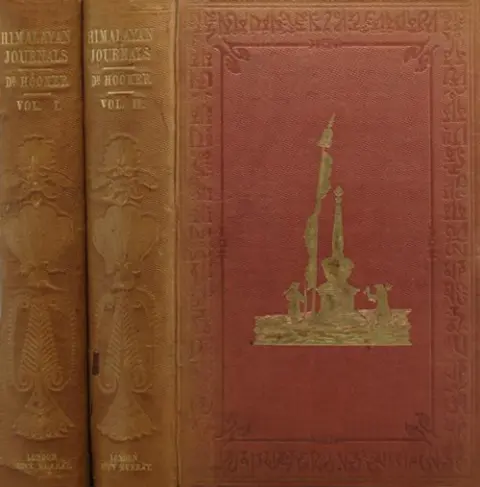
"Himalayan Journals — Complete" by Joseph Dalton Hooker is a travel and scientific exploration narrative written during the late 19th century. The work details Hooker's extensive travels through the Himalayan region, particularly Sikkim, Nepal, and the surrounding mountains, focusing on botany and geology. It serves as both a personal account of his adventures and an important scientific observation, providing insights into the flora, fauna, and cultures of the areas he explored. The opening of the book introduces Hooker's journey to India and outlines his initial explorations, starting with the Sunderbunds and moving towards the Himalayan foothills. He describes the geography, the challenges he faced while traveling, and his experiences at different camps. Hooker shares his observations of the vegetation and wildlife, the local cultures, and the geological formations he encounters. His keen interest in botany is evident as he meticulously records various plant species, along with their characteristics and uses, setting the stage for the detailed natural history that unfolds in the subsequent chapters.
Introduction adapted from the source catalogue; source summaries may be automatically generated.
Free to read · English · 270,303 words · No account needed
MAKE TIME FOR A GOOD BOOK
On by default. Untick to stop anonymous reading totals. Each page counts after 10 seconds in view. How this works.
Anonymous counting is on unless you have switched it off.
These, it will be seen, give a result which approximates to that of the sets I and II. Being deduced from observations at different exposures, the effects of these may be supposed to be eliminated. It is to be observed that the probable results of the addition of November and December’s observations, would be balanced by those of May and June, which are hot moist months.
IV.—Miscellaneous cold weather observations made at various elevations between 1000 and 17,000 feet, during my journey into east Nepal and Sikkim, in November to January 1848 and 1849. The equivalent to 1° Fahr. was deduced from the mean of all the observations at each station, and these being arranged in sets corresponding to their elevations, gave the following results.
Elevation Number
of Stations Number of
Observations Equivalent 1,000 to 4,000 ft.
4,000 to 8,000 ft.
8,000 to 12,000 ft.
12,000 to 17,000 ft. 27
52
20
14 111
197
84
54 1°=215 ft.
1°=315 ft.
1°=327 ft.
1°=377 ft. Sum 113 Sum 446 Mean 1°=308 ft.
The total number of comparative observations taken during that journey, amounted to 563, and the mean equivalent was 1°=303 feet, but I rejected many of the observations that were obviously unworthy of confidence.
V.—Miscellaneous observations (chiefly during the rainy season) taken during my journey into Sikkim and the frontier of Tibet, between May 2nd and December 25th, 1848. The observations were reduced as in the previous instance. The rains on this occasion were unusually protracted, and cannot be said to have ceased till mid-winter, which partly accounts for the very high temperatures.
Elevation Number
of Stations Number of
Observations Equivalent 1,000 to 4,000 ft.
4,000 to 8,000 ft.
8,000 to 12,000 ft.
12,000 to 17,000 ft. 10
21
18
29 45
283
343
219 1°=422 ft.
1°=336 ft.
1°=355 ft.
1°=417 ft. Sum 78 Sum 890 Mean 1°=383 ft.
The great elevation of the temperature in the lowest elevations is accounted for by the heating of the valleys wherein these observations were taken, and especially of the rocks on their floors. The increase with the elevation, of the three succeeding sets, arises from the fact that the loftier regions are far within the mountain region, and are less forest clad and more sunny than the outer Himalaya.
A considerable number of observations were taken during this journey at night, when none are recorded at Calcutta, but which are comparable with contemporaneous observations taken by Mr. Muller at Dorjiling. These being all taken during the three most rainy months, when the temperature varies but very little during the whole twenty-four hours, I expected satisfactory results, but they proved very irregular and anomalous.
The means were—
At 21 stations of greater elevation than Dorjiling 1°=348
ft.
At 17 stations lower in elevation 1°=447 ft.
VI.—Sixty-four contemporaneous observations at Jillapahar, 7,430 feet, and the bed of the Great Rungeet river, 818 feet; taken in January and February, give 1°=322 feet.
Your reading position is saved on this browser. Take it to another device with a library code. Reading pages adapt to text, rather than matching a printed edition.
Joseph Dalton Hooker & John Ball
Joseph Dalton Hooker
Joseph Dalton Hooker
BEHIND THE BOOK
This eBook is for the use of anyone anywhere in the United States and most other parts of the world at no cost and with almost no restrictions whatsoever. You may copy it, give it away or re-use it under the terms of the Project Gutenberg License included with this eBook or online at www.gutenberg.org. If you are not located in the United States, you will have to check the laws of the country where you are located before using this eBook. Read the source licence.
The original source file, including credits and licence, is retained by this library. Request an original-format copy at no charge. Please include the book title and Project Gutenberg identifier #6478.
KEEP YOUR CURIOSITY GOING
Wilfrid Scawen Blunt
Wilfrid Scawen Blunt

E. W. (Edgar Watson) Howe
Cécile Tormay

Moritz Busch
John L. Ransom