THE CLASSIC COLLECTION✦Journal of a tour in Marocco and the Great AtlasCLASSIC FREE BOOKS
Journal of a tour in Marocco and the Great Atlas
Joseph Dalton Hooker & John Ball
THE CLASSIC COLLECTION · 1854
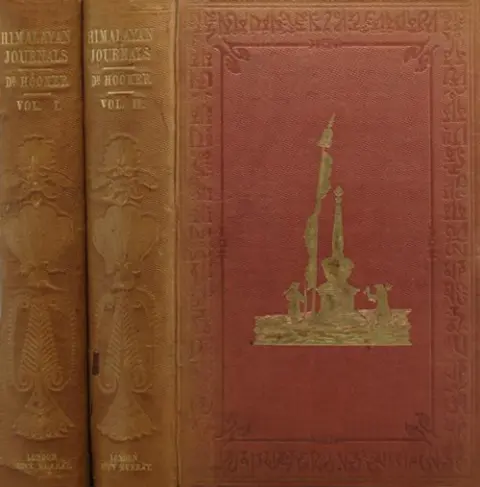
"Himalayan Journals — Complete" by Joseph Dalton Hooker is a travel and scientific exploration narrative written during the late 19th century. The work details Hooker's extensive travels through the Himalayan region, particularly Sikkim, Nepal, and the surrounding mountains, focusing on botany and geology. It serves as both a personal account of his adventures and an important scientific observation, providing insights into the flora, fauna, and cultures of the areas he explored. The opening of the book introduces Hooker's journey to India and outlines his initial explorations, starting with the Sunderbunds and moving towards the Himalayan foothills. He describes the geography, the challenges he faced while traveling, and his experiences at different camps. Hooker shares his observations of the vegetation and wildlife, the local cultures, and the geological formations he encounters. His keen interest in botany is evident as he meticulously records various plant species, along with their characteristics and uses, setting the stage for the detailed natural history that unfolds in the subsequent chapters.
Introduction adapted from the source catalogue; source summaries may be automatically generated.
Free to read · English · 270,303 words · No account needed
MAKE TIME FOR A GOOD BOOK
On by default. Untick to stop anonymous reading totals. Each page counts after 10 seconds in view. How this works.
Anonymous counting is on unless you have switched it off.
[355] These skirt a wood of prickly bamboo, in which occur fig, laurel, Aralia, Bœmeria, Smilax, Toddalia, wild cinnamon, and three kinds of oak.
Continuing northward from Moflong, the road, after five miles, dips into a very broad and shallow flat-floored valley, fully a mile across, which resembles a lake-bed: it is bounded by low hills, and is called “Lanten-tannia,” and is bare of aught but long grass and herbs; amongst these are the large groundsel (Senecio), Dipsacus, Ophelia, and Campanula. On its south flank the micaceous slates strike north-east, and dip north-west, and on the top repose beds, a foot in thickness, of angular water-worn gravel, indicating an ancient water-level, 400 feet above the floor of the valley. Other smaller lake-beds, in the lateral valleys, are equally evident.
A beautiful blue-flowered Clitoria creeps over the path, with the ground-raspberry of Dorjiling. From the top a sudden descent of 400 feet leads to another broad flat valley, called “Syong” (elevation, 5,725 feet), in which is a good bungalow, surrounded by hedges of Prinsepia utilis, a common north-west Himalayan plant, only found at 8000 feet in Sikkim. The valley is grassy, but otherwise bare. Beyond this the road passes over low rocky hills, wooded on their north or sheltered flanks only, dividing flat-floored valleys: a red sandy gneiss is the prevalent rock, but boulders of syenite are scattered about. Extensive moors (elevation, 6000 feet) succeed, covered with stunted pines, brake, and tufts of harsh grasses.[356]
[356] These are principally Andropogon and Brachypodium, amongst which grow yellow Corydalis, Thalictrum, Anemone, Parnassia, Prunella, strawberry, Eupatorium, Hypericum, willow, a Polygonum like Bistorta, Osmunda regalis and another species Lycopodium alpinum, a Senecio like Jacobæa, thistles, Gnaphalium, Gentians, Iris, Paris, Sanguisorba and Agrimonia.
Near the Dengship-oong (river), which flows in a narrow valley, is a low dome of gneiss altered by syenite. The prevalent dip is uniformly south-east, and the strike north-east; and detached boulders of syenite become more frequent, resting on a red gneiss, full of black garnets, till the descent to the valley of Myrung, one of the most beautiful spots in the Khasia, and a favourite resort, having an excellent bungalow which commands a superb view of the Himalaya: it is 5,650 feet above the sea, and is placed on the north flank of a very shallow marshy valley, two miles broad, and full of rice cultivation, as are the flat heads of all the little valleys that lead into it. There is a guard here of light infantry, and a little garden, boasting a gardener and some tea-plants, so that we had vegetables during our four visits to the place, on two of which occasions we stayed some days.
Your reading position is saved on this browser. Take it to another device with a library code. Reading pages adapt to text, rather than matching a printed edition.
Joseph Dalton Hooker & John Ball
Joseph Dalton Hooker
Joseph Dalton Hooker
BEHIND THE BOOK
This eBook is for the use of anyone anywhere in the United States and most other parts of the world at no cost and with almost no restrictions whatsoever. You may copy it, give it away or re-use it under the terms of the Project Gutenberg License included with this eBook or online at www.gutenberg.org. If you are not located in the United States, you will have to check the laws of the country where you are located before using this eBook. Read the source licence.
The original source file, including credits and licence, is retained by this library. Request an original-format copy at no charge. Please include the book title and Project Gutenberg identifier #6478.
KEEP YOUR CURIOSITY GOING
Wilfrid Scawen Blunt
Wilfrid Scawen Blunt

E. W. (Edgar Watson) Howe
Cécile Tormay

Moritz Busch
John L. Ransom