THE CLASSIC COLLECTION✦Journal of a tour in Marocco and the Great AtlasCLASSIC FREE BOOKS
Journal of a tour in Marocco and the Great Atlas
Joseph Dalton Hooker & John Ball
THE CLASSIC COLLECTION · 1854
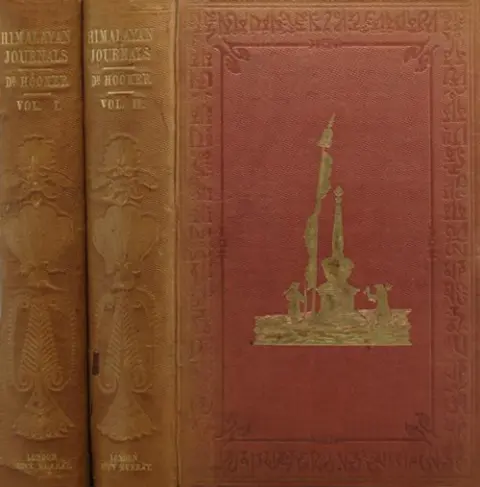
"Himalayan Journals — Complete" by Joseph Dalton Hooker is a travel and scientific exploration narrative written during the late 19th century. The work details Hooker's extensive travels through the Himalayan region, particularly Sikkim, Nepal, and the surrounding mountains, focusing on botany and geology. It serves as both a personal account of his adventures and an important scientific observation, providing insights into the flora, fauna, and cultures of the areas he explored. The opening of the book introduces Hooker's journey to India and outlines his initial explorations, starting with the Sunderbunds and moving towards the Himalayan foothills. He describes the geography, the challenges he faced while traveling, and his experiences at different camps. Hooker shares his observations of the vegetation and wildlife, the local cultures, and the geological formations he encounters. His keen interest in botany is evident as he meticulously records various plant species, along with their characteristics and uses, setting the stage for the detailed natural history that unfolds in the subsequent chapters.
Introduction adapted from the source catalogue; source summaries may be automatically generated.
Free to read · English · 270,303 words · No account needed
MAKE TIME FOR A GOOD BOOK
On by default. Untick to stop anonymous reading totals. Each page counts after 10 seconds in view. How this works.
Anonymous counting is on unless you have switched it off.
The mean temperature of Lamteng (about 50°) is that of the isothermal which passes through Britain in lat. 52°, and east Europe in lat. 48°, cutting the parallel of 45° in Siberia (due north of Lamteng itself), descending to lat. 42° on the east coast of Asia, ascending to lat. 48° on the west of America, and descending to that of New York in the United States. This mean temperature is considerably increased by descending to the bed of the Lachen at 8000 feet, and diminished by ascending Tukcham to 14,000 feet, which gives a range of 6000 feet of elevation, and 20° of mean temperature. But as the climate and vegetation become arctic at 12,000 feet, it will be as well to confine my observations to the flora of 7000 to 10,000 feet; of the mean temperature, namely, between 53° and 43°, the isothermal lines corresponding to which embrace, on the surface of the globe, at the level of the sea, a space varying in different meridians from three to twelve degrees of latitude.[155] At first sight it appears incredible that such a limited area, buried in the depths of the Himalaya, should present nearly all the types of the flora of the north temperate zone; not only, however, is this the case, but space is also found at Lamteng for the intercalation of types of a Malayan flora, otherwise wholly foreign to the north temperate region.
[155] On the west coast of Europe, where the distance between these isothermal lines is greatest, this belt extends almost from Stockholm and the Shetlands to Paris.
A few examples will show this. Amongst trees the Conifers are conspicuous at Lamteng, and all are of genera typical both of Europe and North America: namely, silver fir, spruce, larch, and juniper, besides the yew: there are also species of birch, alder, ash, apple, oak, willow, cherry, bird-cherry, mountain-ash, thorn, walnut, hazel, maple, poplar, ivy, holly, Andromeda, Rhamnus. Of bushes; rose, berberry, bramble, rhododendron, elder, cornel, willow, honeysuckle, currant, Spiræa, Viburnum, Cotoneaster, Hippophæ. Herbaceous plants[156] are far too numerous to be enumerated, as a list would include most of the common genera of European and North American plants.
[156] As an example, the ground about my tent was covered with grasses and sedges, amongst which grew primroses, thistles, speedwell, wild leeks, Arum, Convallaria, Callitriche, Oxalis, Ranunculus, Potentilla, Orchis, Chærophyllum, Galium, Paris, and Anagallis; besides cultivated weeds of shepherd’s-purse, dock, mustard, Mithridate cress, radish, turnip, Thlaspi arvense, and Poa annua.
Your reading position is saved on this browser. Take it to another device with a library code. Reading pages adapt to text, rather than matching a printed edition.
Joseph Dalton Hooker & John Ball
Joseph Dalton Hooker
Joseph Dalton Hooker
BEHIND THE BOOK
This eBook is for the use of anyone anywhere in the United States and most other parts of the world at no cost and with almost no restrictions whatsoever. You may copy it, give it away or re-use it under the terms of the Project Gutenberg License included with this eBook or online at www.gutenberg.org. If you are not located in the United States, you will have to check the laws of the country where you are located before using this eBook. Read the source licence.
The original source file, including credits and licence, is retained by this library. Request an original-format copy at no charge. Please include the book title and Project Gutenberg identifier #6478.
KEEP YOUR CURIOSITY GOING
Wilfrid Scawen Blunt
Wilfrid Scawen Blunt

E. W. (Edgar Watson) Howe
Cécile Tormay

Moritz Busch
John L. Ransom