THE CLASSIC COLLECTION✦Journal of a tour in Marocco and the Great AtlasCLASSIC FREE BOOKS
Journal of a tour in Marocco and the Great Atlas
Joseph Dalton Hooker & John Ball
THE CLASSIC COLLECTION · 1854
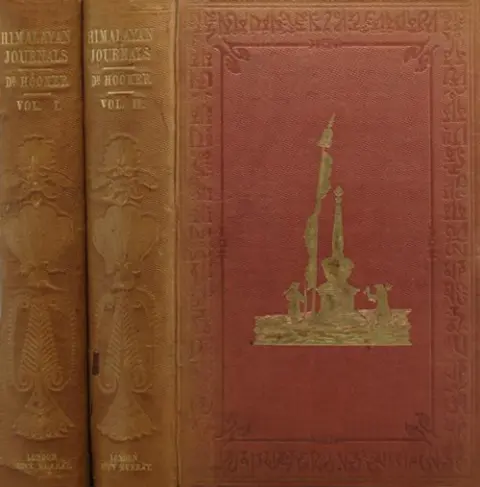
"Himalayan Journals — Complete" by Joseph Dalton Hooker is a travel and scientific exploration narrative written during the late 19th century. The work details Hooker's extensive travels through the Himalayan region, particularly Sikkim, Nepal, and the surrounding mountains, focusing on botany and geology. It serves as both a personal account of his adventures and an important scientific observation, providing insights into the flora, fauna, and cultures of the areas he explored. The opening of the book introduces Hooker's journey to India and outlines his initial explorations, starting with the Sunderbunds and moving towards the Himalayan foothills. He describes the geography, the challenges he faced while traveling, and his experiences at different camps. Hooker shares his observations of the vegetation and wildlife, the local cultures, and the geological formations he encounters. His keen interest in botany is evident as he meticulously records various plant species, along with their characteristics and uses, setting the stage for the detailed natural history that unfolds in the subsequent chapters.
Introduction adapted from the source catalogue; source summaries may be automatically generated.
Free to read · English · 270,303 words · No account needed
MAKE TIME FOR A GOOD BOOK
On by default. Untick to stop anonymous reading totals. Each page counts after 10 seconds in view. How this works.
Anonymous counting is on unless you have switched it off.
Again, near the hills, the features of interest are very numerous. The neighbouring mountains of Curruckpore, which are a portion of the Rajmahal and Paras-nath range, are peopled by tribes representing the earliest races of India, prior to the invasion of young Rama, prince of Oude, who, according to the legend, spread Brahminism with his conquests, and won the hand of King Jannuk’s daughter, Seeta, by bending her father’s bow. These people are called Coles, a middle-sized, strong, very dark, and black-haired race, with thick lips: they have no vocation but collecting iron from the soil, which occurs abundantly in nodules. They eat flesh, whether that of animals killed by themselves, or of those which have died a natural death, and mix with Hindoos, but not with Mussulmen. There are other tribes, vestiges of the Tamulian race, differing somewhat in their rites from these, and approaching, in their habits, more to Hindoos; but all are timorous and retiring.
The hill-rangers, or Bhagulpore-rangers, are all natives of the Rajmahal hills, and form a local corps maintained by the Company for the protection of the district. For many years these people were engaged in predatory excursions, which, owing to the nature of the country, were checked with great difficulty. The plan was therefore conceived, by an active magistrate in the district, of embodying a portion into a military force, for the protection of the country from invasions of their own tribes; and this scheme has answered perfectly.
To me the most interesting object in Bhagulpore was the Horticultural Gardens, whose origin and flourishing condition are due to the activity and enterprise of the late Major Napleton, commander of the hill-rangers. The site is good, consisting of fifteen acres, that were, four years ago, an indigo field, but form now a smiling garden. About fifty men are employed; and the number of seeds and vegetables annually distributed is very great. Of trees the most conspicuous are the tamarind, Tecoma jasminoides, Erythrina, Adansonia, Bombax, teak, banyan, peepul, Sissoo, Casuarina, Terminalia, Melia, Bauhinia. Of introduced species English and Chinese flat peaches (pruned to the centre to let the sun in), Mangos of various sorts, Eugenia Jambos, various Anonas, Litchi, Loquat and Longan, oranges, Sapodilla; apple, pear, both succeeding tolerably; various Cabool and Persian varieties of fruit-trees; figs, grapes, guava, apricots, and jujube. The grapes looked extremely well, but they require great skill and care in the management. They form a long covered walk, with a row of plantains on the W. side, to diminish the effects of the hot winds, but even with this screen, the fruit on that side are inferior to that on the opposite trellis. Easterly winds, again, being moist, blight these and other plants, by favouring the abundant increase of insects, and causing the leaves to curl and fall off; and against this evil there is no remedy. With a clear sky the mischief is not great; under a cloudy one the prevalence of such winds is fatal to the crop. The white ant sometimes attacks the stems, and is best checked by washing the roots with limewater, yellow arsenic, or tobacco-water. Numerous Cerealia, and the varieties of cotton, sugar-cane, etc. all thrive extremely well; so do many of our English vegetables. Cabbages, peas, and beans are much injured by the caterpillars of a Pontia, like our English “White;” raspberries, currants, and gooseberries will not grow at all.
Your reading position is saved on this browser. Take it to another device with a library code. Reading pages adapt to text, rather than matching a printed edition.
Joseph Dalton Hooker & John Ball
Joseph Dalton Hooker
Joseph Dalton Hooker
BEHIND THE BOOK
This eBook is for the use of anyone anywhere in the United States and most other parts of the world at no cost and with almost no restrictions whatsoever. You may copy it, give it away or re-use it under the terms of the Project Gutenberg License included with this eBook or online at www.gutenberg.org. If you are not located in the United States, you will have to check the laws of the country where you are located before using this eBook. Read the source licence.
The original source file, including credits and licence, is retained by this library. Request an original-format copy at no charge. Please include the book title and Project Gutenberg identifier #6478.
KEEP YOUR CURIOSITY GOING
Wilfrid Scawen Blunt
Wilfrid Scawen Blunt

E. W. (Edgar Watson) Howe
Cécile Tormay

Moritz Busch
John L. Ransom