THE CLASSIC COLLECTION✦When I was your ageCLASSIC FREE BOOKS
When I was your age
Laura Elizabeth Howe Richards
THE CLASSIC COLLECTION · 1895
"Hildegarde's Neighbors" by Laura Elizabeth Howe Richards is a delightful children's novel written in the late 19th century. The story centers around Hildegarde Grahame, a young girl who is excited about the arrival of new neighbors, the Merryweather family, next door. With a cast of endearing characters, including Hildegarde’s mother and her eccentric friend Colonel Ferrers, the narrative explores themes of friendship, curiosity, and the adventures that unfold as Hildegarde interacts with the lively Merryweather children. The opening of the novel introduces Hildegarde's joyous anticipation as she shares the news of the new family moving in next door with her mother, leading to a series of amusing and lighthearted exchanges. Hildegarde describes her first glimpse of the Merryweathers, including their amusingly named children, such as Obadiah and Toots. As the story unfolds, Hildegarde's keen observations reveal her eagerness to connect with her new neighbors, and her excitement hints at the friendships and adventures that await. The narrative sets the stage for a rich exploration of community and companionship as Hildegarde forms bonds with the Merryweather siblings, promising readers a charming tale full of youthful exuberance and the joys of neighborly relations.
Introduction adapted from the source catalogue; source summaries may be automatically generated.
Free to read · English · 41,289 words · No account needed
MAKE TIME FOR A GOOD BOOK
On by default. Untick to stop anonymous reading totals. Each page counts after 10 seconds in view. How this works.
Anonymous counting is on unless you have switched it off.
"Well? oh, bless you! no, dearie! She was terrible sick! that was why she died. Oh, my, yes! She had dyspepsy right along, suffered everything with it, yet 'twas croup that got her at last. Ah! there's never any child knows when croup 'll get her; girl NOR boy!"
Hildegarde began to feel as if she must scream, or stamp her foot, or do some other impossible thing.
"Mrs. Lankton," she said, gravely, "I am sure Auntie has the kettle on, and you will be the better for your tea, so will you not tell us as quickly as you can, please, about the game? The children are waiting, you see, to go on with their play."
"Jest what I was going to say, dear," cried Mrs. Lankton. "Let 'em play, I says, while they can, I says; for its soon enough they get the play squenched out of 'em, if you'll excuse the expression, Miss Henfeather."
At this apostrophe, delivered with mournful intensity, Bell retreated hastily behind a post of the veranda, and even Susan Aurora Bulger giggled faintly, with her apron in her mouth.
Hildegarde was silent, and tried the effect of gazing severely at the widow, apparently with some success, for after a pause of head-shaking, Mrs. Lankton continued:
"But as you was saying, dearie, about the game. Ye--es! Well, my grandmother, she was an anncient woman; some said she was ninety-seven, and more called it ninety-eight, but she didn't rightly know herself, bein' she had lost the family Bible. Burned up with the house it was, before she came from the Provinces, and some said it was because of starting a new fire in the cook-stove on Sunday; but I don't want to set in judgment, not on my own flesh and blood, I do not, Miss Grahame. And I remember as if it was this day of time, she settin' in her chair in the porch to our house, smokin' her pipe, if you'll excuse me ladies, bein' an anncient woman, and I HAVE heard great ladies took their pipes in them times, but so it is. And she says to me, 'Drusilly,' she says, 'Why don't you play with Salome?' and I says, ''Cause I ain't got nothin' to play.' And she says, 'Come here,' she says, 'and I'll learn ye a game,' she says. So I called Salome, and we two stood there, and Gram'ther she taught us 'The Highland Gates to Die.' Salome, she had been feedin' the hens, and when she come back she left the gate open, and they all got out and went and strayed into the woods, and my father got so mad we thought we should lose him, for sure. Purple he used to get when he was mad, same as a late cabbage, and an awful sight. Yes, children, be thankful if you're learned to keep your tempers. So that's all I know, Miss Grahame, my dear, and you're welcome as air to it; and I do believe I see Mis' Auntie lookin' out the kitching winder this minute, so if you'll excuse me, ladies, bein' I feel a goneness inside, and if I should faint away, how your blessed mother would feel!"
Your reading position is saved on this browser. Take it to another device with a library code. Reading pages adapt to text, rather than matching a printed edition.
Laura Elizabeth Howe Richards
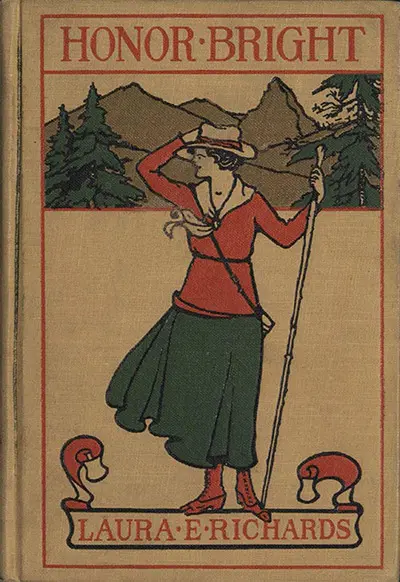
Laura Elizabeth Howe Richards
Laura Elizabeth Howe Richards
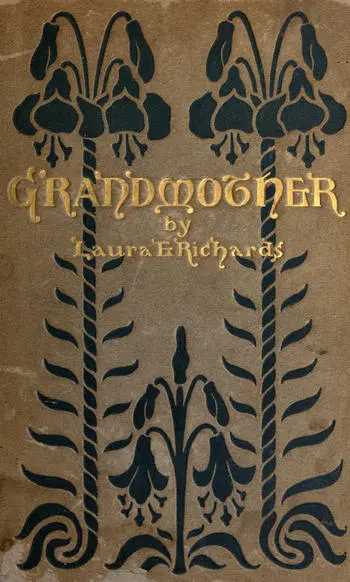
Laura Elizabeth Howe Richards
BEHIND THE BOOK
This eBook is for the use of anyone anywhere in the United States and most other parts of the world at no cost and with almost no restrictions whatsoever. You may copy it, give it away or re-use it under the terms of the Project Gutenberg License included with this eBook or online at www.gutenberg.org. If you are not located in the United States, you will have to check the laws of the country where you are located before using this eBook. Read the source licence.
The original source file, including credits and licence, is retained by this library. Request an original-format copy at no charge. Please include the book title and Project Gutenberg identifier #5259.
KEEP YOUR CURIOSITY GOING
Coulson Kernahan

Maurice Baring
Frances Wright
Cécile Tormay

Frederic Jesup Stimson

W. H. P. (William Henry Pope) Jarvis