THE CLASSIC COLLECTION✦A dead man’s diaryCLASSIC FREE BOOKS
A dead man’s diary
Coulson Kernahan
THE CLASSIC COLLECTION · 1902
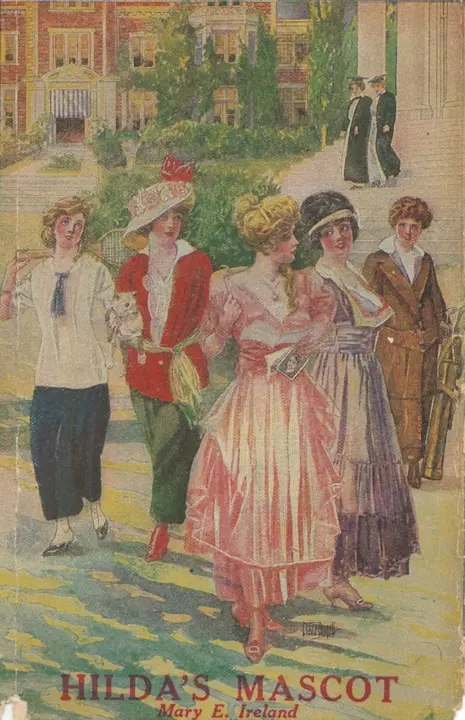
"Hilda's Mascot: A Tale of 'Maryland, My Maryland'" by Mary E. Ireland is a children's fiction narrative written in the early 20th century. The story follows Hilda, a young girl who navigates the challenges of life with her aunt, Mrs. Ashley, and her interactions with the world around her, all while grappling with themes of family, loss, and resilience. Central to the narrative are characters like Mrs. Ashley, who embodies care and compassion, highlighting the importance of familial bonds. The opening of the story introduces a somber and emotional journey as a man takes two children, Jerusha and Horace Flint, to an orphanage, revealing their untimely separation from their mother. The narrative immediately sets a tone of loss and uncertainty as the children face their new reality in the orphanage. Meanwhile, it hints at a deeper connection to Hilda’s life later on by exploring her relationships and the complexities of her upbringing and environment. The emotional gravity of the beginning lays the groundwork for exploring themes such as love, abandonment, and the search for belonging, making it a poignant read for young audiences.
Introduction adapted from the source catalogue; source summaries may be automatically generated.
Free to read · English · 57,107 words · No account needed
MAKE TIME FOR A GOOD BOOK
On by default. Untick to stop anonymous reading totals. Each page counts after 10 seconds in view. How this works.
Anonymous counting is on unless you have switched it off.
"Wait until you have seen my brother Fred," said Paul, a little confusedly. "Do not think me boastful, Cousin Hilda, but all agree that Fred is very handsome, and he is young."
"I suppose he looks like you," said Hilda, in all sincerity.
"Girls never see me when Fred is around. He seems to know exactly what
to say to interest them."
"And 'My Lady's Manor' is such a lovely place," resumed Hilda. "I wish you could have stayed even one day longer and visited there and at 'Friedenheim.' They are such beautiful places, and my friends are all so kind."
"They are indeed charming people. I was glad to meet them and would have enjoyed remaining, but, little cousin, I have something to tell you. Shall it be now?"
"Yes, now," echoed the girl eagerly.
"I told your Dorton friends that we would remain in Philadelphia until to-morrow with Mr. and Mrs. De Cormis, old friends of my father. A niece of Mr. De Cormis from Woodmont, a village near my home in Ohio, is visiting there, and I am glad to have you become acquainted."
"Is she a dear friend of yours?"
"Yes, the dearest."
"Did she come to Philadelphia with you?"
"No, she has been there several weeks. She has many friends there to visit, for she lived there all her life until the past four years, when she and her father came to Woodmont. Her father, Rev. Horace De Cormis, is pastor of our church and is one of the best of men."
"Will she go back to Ohio with us?"
"No, her visit is not yet completed. Her uncle, Mr. Robert De Cormis, and his family wish her to remain the winter with them, but she is a devoted daughter and is not willing to leave her father longer than a fortnight more. You may know that we were glad to meet again."
"You love each other, then?"
"Oh, little cousin, when you see her you will understand how impossible it would be not to love her! If nothing prevents, we expect to be married before another autumn."
"I am glad, Cousin Paul, and hope you will be very happy."
"Thank you, cousin; I am sure you wish it. I cannot fail being happy
with Lura De Cormis."
"What style of person is she, Cousin Paul?"
"She is faultlessly fair, has coal black hair and brilliant black eyes, lips like coral, perfect teeth, and her hands are small, white, and beautifully formed."
"She must be beautiful," commented Hilda. "I hope she will love me. Is it easy to make her acquaintance?"
Your reading position is saved on this browser. Take it to another device with a library code. Reading pages adapt to text, rather than matching a printed edition.
BEHIND THE BOOK
This eBook is for the use of anyone anywhere in the United States and most other parts of the world at no cost and with almost no restrictions whatsoever. You may copy it, give it away or re-use it under the terms of the Project Gutenberg License included with this eBook or online at www.gutenberg.org. If you are not located in the United States, you will have to check the laws of the country where you are located before using this eBook. Read the source licence.
The original source file, including credits and licence, is retained by this library. Request an original-format copy at no charge. Please include the book title and Project Gutenberg identifier #40620.
KEEP YOUR CURIOSITY GOING
Coulson Kernahan

Maurice Baring
Frances Wright
Cécile Tormay

Frederic Jesup Stimson

W. H. P. (William Henry Pope) Jarvis