THE CLASSIC COLLECTION✦A dead man’s diaryCLASSIC FREE BOOKS
A dead man’s diary
Coulson Kernahan
THE CLASSIC COLLECTION · 1902
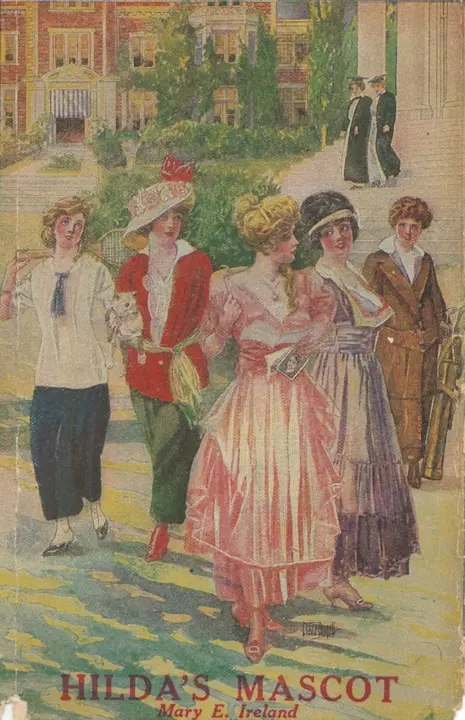
"Hilda's Mascot: A Tale of 'Maryland, My Maryland'" by Mary E. Ireland is a children's fiction narrative written in the early 20th century. The story follows Hilda, a young girl who navigates the challenges of life with her aunt, Mrs. Ashley, and her interactions with the world around her, all while grappling with themes of family, loss, and resilience. Central to the narrative are characters like Mrs. Ashley, who embodies care and compassion, highlighting the importance of familial bonds. The opening of the story introduces a somber and emotional journey as a man takes two children, Jerusha and Horace Flint, to an orphanage, revealing their untimely separation from their mother. The narrative immediately sets a tone of loss and uncertainty as the children face their new reality in the orphanage. Meanwhile, it hints at a deeper connection to Hilda’s life later on by exploring her relationships and the complexities of her upbringing and environment. The emotional gravity of the beginning lays the groundwork for exploring themes such as love, abandonment, and the search for belonging, making it a poignant read for young audiences.
Introduction adapted from the source catalogue; source summaries may be automatically generated.
Free to read · English · 57,107 words · No account needed
MAKE TIME FOR A GOOD BOOK
On by default. Untick to stop anonymous reading totals. Each page counts after 10 seconds in view. How this works.
Anonymous counting is on unless you have switched it off.
Before Cecil could make choice Uncle Andy broke into that melody so dear to his race--"Roll, Jordan, Roll," and Israel's deep, pathetic voice thrilled the hearts of the city boys as no other had done; no noted concert singer had tones so full and grand as issued from his powerful chest without effort or thought that he was making an impression upon his listeners.
"There is one thing that Gabe could do," remarked Kitty, when the last notes died away in perfect accord, "he could sing like a seraphim; that 'Roll, Jordan, Roll' was his favorite."
"Dat is so; dat is jis' so!" agreed Uncle Andy, whose feelings were softened by the melody, "and I'll tell yer what was passin' in my mind while we was singin'. I is gwine to write a letter to Gabe dis yer berry night. Roy, honey, bring de pen; Kitty, clar dat table; I's gwine ter write dis yer hour an' tell Gabe Websta ter gib up de rheumatiz an' go ter work."
"Oh, Uncle Andy, Gabe won't be in a hurry to get that letter; wait till
mornin'," said Kitty.
"No, now is de 'cepted time, Kitty. If de doctahs git to 'westigatin' it'll knock Gabe higher 'n a kite; he'll git well ob dat rheumatiz, an' be popped out 'n dat pore-house whar my letter will nebber jine him. No, sah! Dat letter has done got ter be writ dis yer ebenin'."
"To-morrow would be airly enough," said Kitty, preparing to arrange the table for the writing materials.
"You is allus puttin' off, Kitty. Dat is de way ol' Satan gits de souls ob sinners; dey help him dar ownselves by puttin' off. Git de writin' utenshils, Roy, honey."
While Roy was gone, Andy had the table rolled to his chair and was
ruminating over the prospective contents of the epistle when he
returned.
"How shall I commence it, Uncle Andy?" Roy asked.
"Dear Gabe," suggested Chloe.
"No, I is gwine ter say no sich thing!" said Andy irately, the softening influence of the music having lost its effect when he had reflected upon Gabe's delinquencies. "He's not 'dear Gabe' ter onybody but de pore-house and dem dat has him ter keep; mighty cheap Gabe in my mind."
"'Respected Gabe,' or 'Esteemed Gabe'" suggested Roy, with waiting pen
in hand.
"No, he is none ob dat! 'Lazy Gabe' is de only 'pendix dat fits him."
"But it would not look well to commence a letter that way," said Roy.
"No, honey, ol' Andy knows dat. Folks hab to be 'ceitful in dis yer wicked world. I suppect yer'll hab ter say, 'dear Gabe,'" he agreed regretfully.
Your reading position is saved on this browser. Take it to another device with a library code. Reading pages adapt to text, rather than matching a printed edition.
BEHIND THE BOOK
This eBook is for the use of anyone anywhere in the United States and most other parts of the world at no cost and with almost no restrictions whatsoever. You may copy it, give it away or re-use it under the terms of the Project Gutenberg License included with this eBook or online at www.gutenberg.org. If you are not located in the United States, you will have to check the laws of the country where you are located before using this eBook. Read the source licence.
The original source file, including credits and licence, is retained by this library. Request an original-format copy at no charge. Please include the book title and Project Gutenberg identifier #40620.
KEEP YOUR CURIOSITY GOING
Coulson Kernahan

Maurice Baring
Frances Wright
Cécile Tormay

Frederic Jesup Stimson

W. H. P. (William Henry Pope) Jarvis