THE CLASSIC COLLECTION✦A dead man’s diaryCLASSIC FREE BOOKS
A dead man’s diary
Coulson Kernahan
THE CLASSIC COLLECTION · 1902
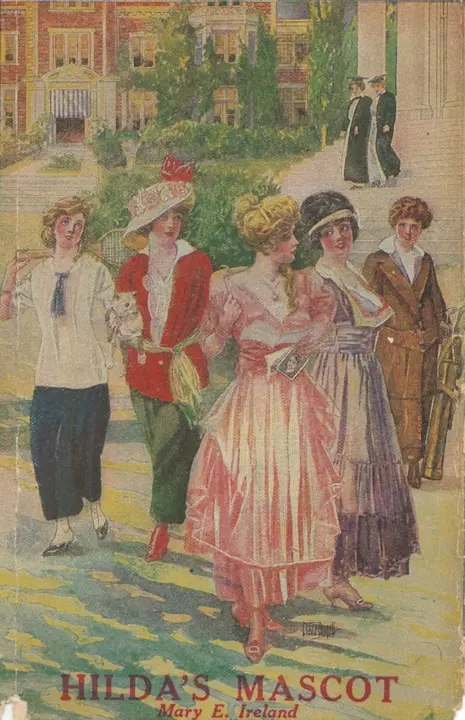
"Hilda's Mascot: A Tale of 'Maryland, My Maryland'" by Mary E. Ireland is a children's fiction narrative written in the early 20th century. The story follows Hilda, a young girl who navigates the challenges of life with her aunt, Mrs. Ashley, and her interactions with the world around her, all while grappling with themes of family, loss, and resilience. Central to the narrative are characters like Mrs. Ashley, who embodies care and compassion, highlighting the importance of familial bonds. The opening of the story introduces a somber and emotional journey as a man takes two children, Jerusha and Horace Flint, to an orphanage, revealing their untimely separation from their mother. The narrative immediately sets a tone of loss and uncertainty as the children face their new reality in the orphanage. Meanwhile, it hints at a deeper connection to Hilda’s life later on by exploring her relationships and the complexities of her upbringing and environment. The emotional gravity of the beginning lays the groundwork for exploring themes such as love, abandonment, and the search for belonging, making it a poignant read for young audiences.
Introduction adapted from the source catalogue; source summaries may be automatically generated.
Free to read · English · 57,107 words · No account needed
MAKE TIME FOR A GOOD BOOK
On by default. Untick to stop anonymous reading totals. Each page counts after 10 seconds in view. How this works.
Anonymous counting is on unless you have switched it off.
Mr. Farnsworth's first thought was that a caller had come to the library for a book, but seeing him sleeping was returning quietly without it. He was therefore more than surprised to see her, after gliding through the door, ascend swiftly the steps leading to the attic.
He arose and followed, keeping her in view until she reached a distant corner of the unfurnished back room at the end of the dwelling, when, like a shadow-picture, she disappeared.
Feeling bewildered, Mr. Farnsworth descended to his bed-room adjoining the library, bathed face and hands in cold water, arranged his attire, and then sat down to reflect.
He was not superstitious, but he feared that his conscience-stricken feelings had influenced his brain and he had imagined what was not there to see. Believing this, he joined the ladies in the parlor.
"You are not well, Reginald," said his wife anxiously, "you are looking very pale; I am afraid the sun was too hot for you."
"My husband has had several cases of prostration from heat in the last few days," remarked Mrs. Lattinger, "and one of the men came near losing his life from exposure to the sun."
"How was he affected?" asked Mr. Farnsworth.
"He was at first unconscious, then delirious, imagining he saw weird, spectral objects, causing him fright and anxiety."
Mr. Farnsworth breathed more freely upon hearing this. It was not a figment of the brain caused by an uneasy conscience as he had feared, but he had suffered a slight sunstroke, and, believing this, he became more tranquil.
Resolving not to expose himself to the heat of the sun more than necessary, he decided not to mention what he had seen to his wife, who was nervous, nor to the servants, who were superstitious.
The figure he had seen corresponded in every detail with the description of the late Mrs. Farnsworth, as given that evening to his wife by Mrs. Lattinger, and as it was the last thing he heard before dropping asleep it was not surprising that in his drowsy condition he should imagine he saw her.
"Lois," he said one evening, halting at the door of her cabin, "when is the best time to plant Lima beans?"
"When de sign is in de arms, 'kase you wants de vines to run up de poles and not bunch on de ground," she answered promptly.
"I mean the time in the month, Lois. I have no belief in signs."
"Culled folks is allus mighty keerful about de signs, and de keerfulest ones has de best gardens."
Your reading position is saved on this browser. Take it to another device with a library code. Reading pages adapt to text, rather than matching a printed edition.
BEHIND THE BOOK
This eBook is for the use of anyone anywhere in the United States and most other parts of the world at no cost and with almost no restrictions whatsoever. You may copy it, give it away or re-use it under the terms of the Project Gutenberg License included with this eBook or online at www.gutenberg.org. If you are not located in the United States, you will have to check the laws of the country where you are located before using this eBook. Read the source licence.
The original source file, including credits and licence, is retained by this library. Request an original-format copy at no charge. Please include the book title and Project Gutenberg identifier #40620.
KEEP YOUR CURIOSITY GOING
Coulson Kernahan

Maurice Baring
Frances Wright
Cécile Tormay

Frederic Jesup Stimson

W. H. P. (William Henry Pope) Jarvis