THE CLASSIC COLLECTION✦An outlaw’s diary: the CommuneCLASSIC FREE BOOKS
An outlaw’s diary: the Commune
Cécile Tormay
THE CLASSIC COLLECTION · 1924
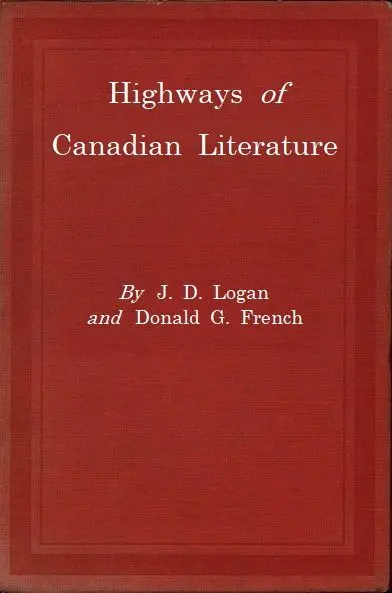
"Highways of Canadian Literature" by J. D. Logan and Donald G. French is a comprehensive historical survey written in the early 20th century. This work aims to provide an extensive overview of Canadian literature in English, tracing its development from the Puritan Migration in 1760 to the late 1920s. The book explores the social and spiritual contexts that influenced Canadian authors and highlights key literary movements and figures, distinguishing between different epochs in Canadian literary history. The opening of the work presents the necessity for a synoptic history of Canadian literature, noting the recent academic interest in this field and the lack of comprehensive resources to guide educators and readers. Logan emphasizes the importance of understanding how Canadian literature has developed in relation to its social, cultural, and historical backgrounds. He argues for a deeper appreciation of this literature, which, while still young, reflects a growing national consciousness and distinct literary identity. The early chapters set the stage for exploring the roots of Canadian literary expression, detailing the influences of various migrations and the foundational works that contribute to the early narrative of Canadian literature.
Introduction adapted from the source catalogue; source summaries may be automatically generated.
Free to read · English · 119,361 words · No account needed
MAKE TIME FOR A GOOD BOOK
On by default. Untick to stop anonymous reading totals. Each page counts after 10 seconds in view. How this works.
Anonymous counting is on unless you have switched it off.
In particular: Pauline Johnson has yet, by other Canadian poets, to be equalled as a lyrist of the passion and pathos of romantic love, and as an inventor of picturesque, veracious, vivid, beautiful, and compelling poetic figures and images. Her love poems are full of the most poignant passion and pathos. It would be easy to make a catalogue of a half hundred or more poetic figures and images which are unique in descriptive aptness or in emotional ‘tang.’
In short, the supreme spiritual and aesthetic qualities of Pauline Johnson’s poetry are its real sincerity, its naiveté of thought, its simplicity of structure, its lovely color images, its winning music, its passion, pathos, and womanly tenderness. But first place must be given to its dulcet and insinuating music and to its original and arresting poetic figures and images.
Pauline Johnson, taking the date engraved on the monument to her memory at Vancouver, was born in 1861. She died at Vancouver in 1912. She was the youngest child of a family of four born to the late G. H. M. Johnson (Onwononsyshon) of Brantford, Ontario, Head Chief of the Six Nations Indians, and his wife, Emily S. Howells, who was of English parentage and born at Brixton, England. Pauline Johnson (Tekahionwake) was born on her father’s estate, which is on the Reserve apportioned the Mohawk Tribe by the Canadian government. It must, therefore, pique the imagination to know that Pauline Johnson was of pure Indian and pure English descent, but that though she travelled from coast to coast in Canada and the United States and twice to England, her freedom of movement was ‘privileged’ and she was always, wherever she went, a ‘ward’ of the Canadian government.
In Pauline Johnson’s case there are nice, though not recondite, problems in literary psychology and interpretive criticism. For instance: Was Pauline Johnson’s genius Indian, or English? Was it inherited, or was she a ‘born’ poet, or how else may her gifts and tastes be explained? The poet herself always insisted, with considerable pride, on her Indian origin. Some critics, reasoning by quasi-inductions, abetted her in this belief. Yet, so far as her genius is concerned, the only one of her Indian ancestors who had anything like literary gifts was her grandfather, ‘The Mohawk Warbler,’ and his gifts were those of the ‘tongue’ in compelling eloquence rather than aesthetic sensibility and the power of expressing in words the beauty and the music in Nature. On the other hand, Pauline Johnson’s English ancestors were a family who possessed distinct literary tendencies and habits. The most distinguished member of the branches of that family was W. D. Howells, the American novelist, poet, and essayist. It is most probable that she inherited her literary gifts from her English ancestors. For in Flint and Feather—her complete poems—there is not one concept, or bit of color, or rhythm, or anything else, that may be described as specifically Indian. Rather it is all British or Universal. We do find in her poems Indian themes, protests against British ruthlessness in governmental treatment of the Indian, and the celebration of Indian valor and love. But these are human utterances. Moreover, of the ninety poems in Flint and Feather, only eight concern the Indian, and these only on the side of episodes which formed good material for romantic story-telling in verse. In these fine ballads Pauline Johnson became indeed the ‘Voice’ of her inarticulate Indian fellows, but the voice itself was that of a woman cultured in the forms and music of English poetry. Pauline Johnson’s loyalty to the Indian side of her ancestry, and her pride in it, were admirable; but, if heredity is to be accepted as a real cause of genius, her taste for literature, and her bent towards literary expression, must have come from her mother’s side. For her mother was both a cultured and a romantically-minded woman. If, however, we are to grant the poet any gift from her Indian ancestry, we must remember her brilliant career as a reciter or dramatic reader. If she inherited this dramatic gift, then she got it from her eloquent grandfather, ‘The Mohawk Warbler.’ Though she used it conspicuously in her dramatic readings, the gift is also observable in the vividly graphic qualities, and in the emotional intensity, of her story-telling ballads.
Your reading position is saved on this browser. Take it to another device with a library code. Reading pages adapt to text, rather than matching a printed edition.
BEHIND THE BOOK
This eBook is for the use of anyone anywhere in the United States and most other parts of the world at no cost and with almost no restrictions whatsoever. You may copy it, give it away or re-use it under the terms of the Project Gutenberg License included with this eBook or online at www.gutenberg.org. If you are not located in the United States, you will have to check the laws of the country where you are located before using this eBook. Read the source licence.
The original source file, including credits and licence, is retained by this library. Request an original-format copy at no charge. Please include the book title and Project Gutenberg identifier #65557.
KEEP YOUR CURIOSITY GOING
Cécile Tormay

Moritz Busch
John L. Ransom
Frances Wright
Cécile Tormay

Mabel Potter Daggett