THE CLASSIC COLLECTION✦An American tragedy, v. 2CLASSIC FREE BOOKS
An American tragedy, v. 2
Theodore Dreiser
THE CLASSIC COLLECTION · 1920
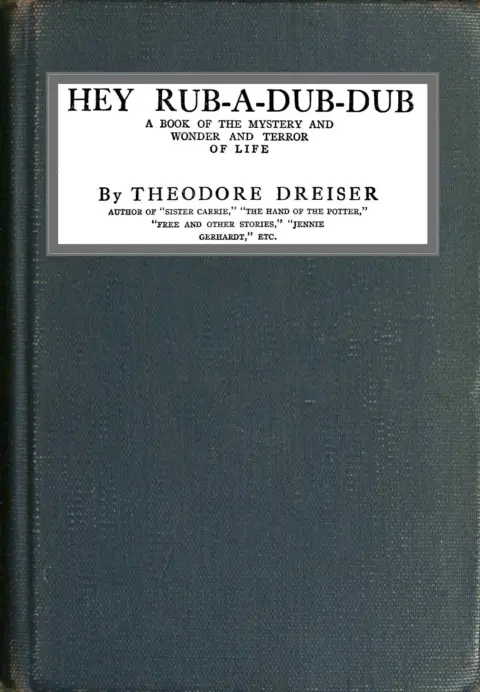
"Hey Rub-a-dub-dub: A Book of the Mystery and Wonder and Terror of Life" by Theodore Dreiser is a collection of reflective essays written in the early 20th century. The book delves into the complexities of human existence, exploring themes of poverty, morality, and societal contradictions as seen through the eyes of a contemplative narrator. The narrative voice grapples with personal inadequacies and observations of those around him, particularly focusing on the dissonance between aspiration and reality in American life. The opening of the book introduces the narrator, who reflects on his life at the age of forty, living in a shabby neighborhood across the river from New York City. He describes his struggles with poverty, his attempts at being a writer, and his natural curiosity about the world, which leads him to question the societal values he observes. As he looks out over the city, he feels a mix of envy and confusion regarding those who thrive materially while he appears stagnant. Through a series of anecdotes about his neighbors and his inner musings, the narrator sets the stage for deeper explorations of life’s moral complexities, social injustices, and the pursuit of meaning in a seemingly indifferent universe.
Introduction adapted from the source catalogue; source summaries may be automatically generated.
Free to read · English · 100,855 words · No account needed
MAKE TIME FOR A GOOD BOOK
On by default. Untick to stop anonymous reading totals. Each page counts after 10 seconds in view. How this works.
Anonymous counting is on unless you have switched it off.
The truth is all good things are gifts, a voice, strength of body, vigor of mind, vision, the power to lead, as in war, any art, beauty, charm. This is not to say that these things may not be technically improved, and are, but this is the business with which mediocrity is chiefly concerning itself. I know that the world, where it lacks the strength to think on the subject, thinks differently, but this is mere nonsense and without import.
The man of personality or destiny realizes the guidance, enmity or favor of not necessarily higher, we will say, but different powers. (I am not for saints, guardian angels, Buddhas, Christs, perfect gods all.) He realizes all too keenly the element of chance, luck, unpropitious as well as propitious hours. Sometimes, in spite of himself and to his wonder, he notes that his affairs prosper. “There is a tide--” At other times (and who has not realized this?), try as he will, he had better lay aside all effort and disappear. Fortune will have none of him. The furies hover over his path. Harpies beset him. Go where he will, there will be elements to annoy him, if no more than an ill wind to blow his cap away or to cast dust into his eyes. He, above all others, knows that time and chance happen to all men.
But it is so easy to cite the old-time virtues of honesty, stability, truthfulness, fair-dealing, etc., as proving character, its value, and the power of any one, however weak or defective, personally to achieve it. But always, in spite of the advocates of simple and normal and moral things as proving in themselves genius and worth, there is something more--magnetism, for instance, a thing not necessarily or solely a part of these other so-called virtues, and strength, assurance, courage, generous or the reverse. These are not things of ethical import necessarily, but they make for success just the same. Observe that youth admires color, flare, pugnacity, brute courage and daring; middle age, knowledge of sorts, aggressiveness, endurance, success; old age, wisdom, generosity, humility, etc. How many of the former are ethical? In the quiet halls of learning or reflection certain of the tabulated virtues may be extolled, but to whom does the world pay attention, to whom has it paid attention? Darius, Artaxerxes, Alexander, Cæsar, Hannibal, Attila, Alaric, Peter the Hermit, Napoleon, the Kaiser; possessing what of all these virtues? Cæsar kind, patient, honest, truthful? Napoleon the same? Antony the same? Attila the same? Not even the popes, the preachers, the founders of religion were so. Always craft, force, diplomacy; but little of the sacrificial media so extolled and commended to the rank and file in order to keep them at rest.
Your reading position is saved on this browser. Take it to another device with a library code. Reading pages adapt to text, rather than matching a printed edition.
Theodore Dreiser
Theodore Dreiser
Theodore Dreiser
Theodore Dreiser
BEHIND THE BOOK
This eBook is for the use of anyone anywhere in the United States and most other parts of the world at no cost and with almost no restrictions whatsoever. You may copy it, give it away or re-use it under the terms of the Project Gutenberg License included with this eBook or online at www.gutenberg.org. If you are not located in the United States, you will have to check the laws of the country where you are located before using this eBook. Read the source licence.
The original source file, including credits and licence, is retained by this library. Request an original-format copy at no charge. Please include the book title and Project Gutenberg identifier #67059.
KEEP YOUR CURIOSITY GOING

David Patterson (Spirit) Hatch

David Patterson (Spirit) Hatch

David Patterson (Spirit) Hatch

Ralph Waldo Emerson

Maurice Baring

Oscar Wilde & James McNeill Whistler