THE CLASSIC COLLECTION✦An American tragedy, v. 2CLASSIC FREE BOOKS
An American tragedy, v. 2
Theodore Dreiser
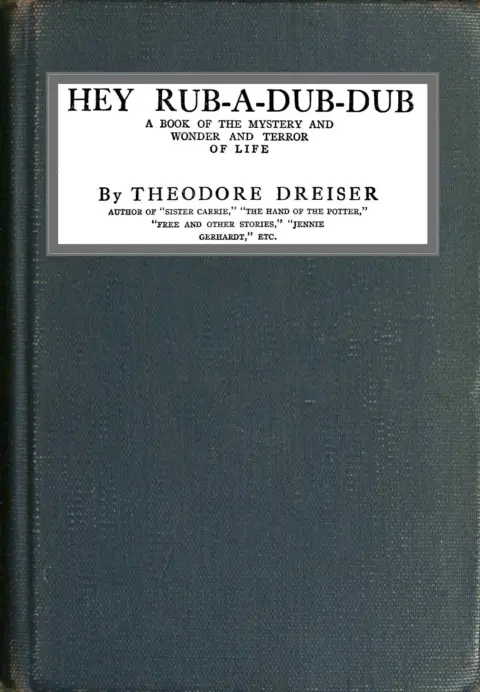
THE CLASSIC COLLECTION · 1920
"Hey Rub-a-dub-dub: A Book of the Mystery and Wonder and Terror of Life" by Theodore Dreiser is a collection of reflective essays written in the early 20th century. The book delves into the complexities of human existence, exploring themes of poverty, morality, and societal contradictions as seen through the eyes of a contemplative narrator. The narrative voice grapples with personal inadequacies and observations of those around him, particularly focusing on the dissonance between aspiration and reality in American life. The opening of the book introduces the narrator, who reflects on his life at the age of forty, living in a shabby neighborhood across the river from New York City. He describes his struggles with poverty, his attempts at being a writer, and his natural curiosity about the world, which leads him to question the societal values he observes. As he looks out over the city, he feels a mix of envy and confusion regarding those who thrive materially while he appears stagnant. Through a series of anecdotes about his neighbors and his inner musings, the narrator sets the stage for deeper explorations of life’s moral complexities, social injustices, and the pursuit of meaning in a seemingly indifferent universe.
Introduction adapted from the source catalogue; source summaries may be automatically generated.
Free to read · English · 100,855 words · No account needed
MAKE TIME FOR A GOOD BOOK
On by default. Untick to stop anonymous reading totals. Each page counts after 10 seconds in view. How this works.
Anonymous counting is on unless you have switched it off.
(10) In Ives vs. South Buffalo Ry. Co. (94 N. E. R. 431), a case in which a railroad employee, crippled for life while at work and without “contributory negligence,” sued for recompense, the New York Court of Appeals unanimously decided that the law under which the suit was brought was unconstitutional. The judges admitted the injustice, since the man was helpless, but held the Constitution responsible.
... One might thus go forward for pages. I merely cite these in order to present a few definite instances. The truth is that while the average American imagines he is better looked after and more free here than he would be elsewhere, it is more a matter of thought than anything else. As to his daily earning and living capacity, while it is true that he gets more pay he also pays more for what he buys. A rising scale of wages has so regularly been accompanied by a lowering of the purchasing power of the dollar that he has not been much comforted by higher wages. In fact, the National Department of Labor (February, 1919), after studying family budgets in various cities of the country, announced that the then exorbitant cost of necessities bore heaviest on incomes of one thousand dollars or less, although five per cent of the population controlled ninety-five per cent of the wealth of the nation. And one should further note the rising Protection policy of a hundred years, under which the trusts flourished without any notable increase of wages to the local consumer, and the local consumer paid uniformly higher prices than those paid by foreigners for the same grade of goods, often the very same goods made here and shipped abroad. This protection explains the American multi-millionaire; also the American beggar and his slum. It also explains the profiteer. If the average American has had a little more of food and clothes than the men of some other countries, he has also been confronted by the very irritating spectacle of thousands upon thousands who have so much more than he has or can get. He has been made to appear as poor as any churchmouse anywhere, and, worst of all, his woes get but small attention from those who, financially able to control his only medium of expression, the newspapers, insist upon telling him that he is well and happy. If any one should doubt this, let him consult, for one thing, the report of the Federal Trade Commission appointed by Congress (Report handed down June, 1918), wherein it was charged and proved that large exactions and safe profiteering permitted more than one giant concern to double, treble, even quintuple, its capitalization and still earn from 100 to 227 per cent in one instance. Coal, valued at five cents a ton in the ground, was being sold for twenty-two dollars a ton in New York--not over two hundred and fifty miles away. Milk was shoved up rapidly from seven to seventeen-and-one-half cents a quart, and with no interference on the part of any one and no effort to pool the wasteful competition and duplication of systems which, on the other hand, were offered as an excuse for the necessity of the more than 100 per cent increase. Wheat, potatoes, meat, oil, sugar rose in proportion. There was no corresponding increase in the wages, save to unionized labor (which was the only form of labor in a position to demand a just share, and which constituted but ten per cent of all employed). And these had to indulge in three hundred and sixty-seven strikes in the first three years of the war to effect even so much as a twenty per cent increase. (I am quoting figures furnished by the United States Bureau of Labor.) When complaint was made, one enthusiastic retort on the part of a corporation press was that the natural law of supply and demand must be allowed to work, that interference with exhorbitant prices meant curtailment of production at the source. The poor producer, robbed of his just right to high prices under a strenuous demand, would become discouraged and quit! On the other hand, the producer was constantly complaining that he was getting little more than before, while the rapidly increasing cost of labor was cited as proving the need of a from 100 to a 1000 per cent increase on everything--shoes, clothes, food, rent.
Your reading position is saved on this browser. Take it to another device with a library code. Reading pages adapt to text, rather than matching a printed edition.
Theodore Dreiser
Theodore Dreiser
Theodore Dreiser
Theodore Dreiser
BEHIND THE BOOK
This eBook is for the use of anyone anywhere in the United States and most other parts of the world at no cost and with almost no restrictions whatsoever. You may copy it, give it away or re-use it under the terms of the Project Gutenberg License included with this eBook or online at www.gutenberg.org. If you are not located in the United States, you will have to check the laws of the country where you are located before using this eBook. Read the source licence.
The original source file, including credits and licence, is retained by this library. Request an original-format copy at no charge. Please include the book title and Project Gutenberg identifier #67059.
KEEP YOUR CURIOSITY GOING

David Patterson (Spirit) Hatch

David Patterson (Spirit) Hatch

David Patterson (Spirit) Hatch

Ralph Waldo Emerson

Maurice Baring

Oscar Wilde & James McNeill Whistler