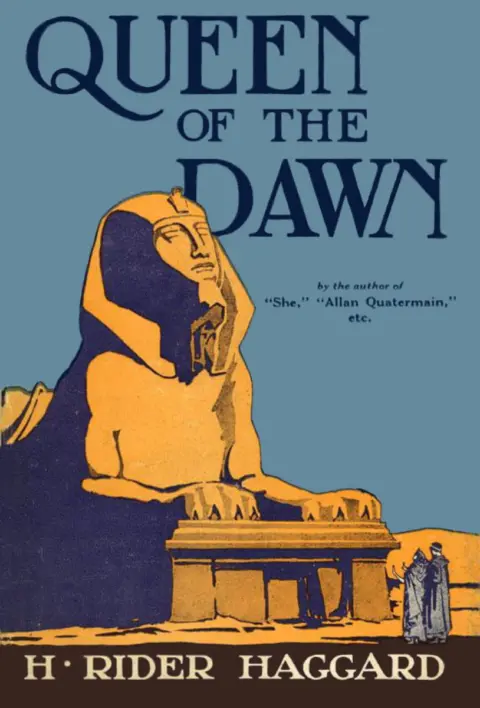
Queen of the Dawn: A Love Tale of Old Egypt
H. Rider (Henry Rider) Haggard
THE CLASSIC COLLECTION · 1923
Heu-Heu, or The Monster by H. Rider Haggard is a novel written in the early 20th century. It plunges Allan Quatermain into a supernatural-tinged African adventure sparked by a terrifying cave painting of an ape-like “Monster-god” and the call of a hidden people guarded by legend and fear. With his crafty companion Hans and the enigmatic wizard Zikali, Quatermain is drawn toward a lost land, forbidden rituals, and a threat that blurs the line between myth and reality. The opening of the novel finds Allan Quatermain, prompted by friends at his Yorkshire home, recounting an episode that begins on the Drakensberg slopes when a colossal storm forces his wagon party—himself, Hans, and two Zulu hands—into a vast cave. There, after a perilous crawl past a death-chasm full of ancient bones, moonlight reveals a Bushman painting of a monstrous, half-human figure called Heu-Heu. Haunted by the image, Quatermain treks into Zululand, witnesses a grim royal execution at Nongela Rock, and reaches Zikali in the Black Kloof. The wizard conjures a fiery vision of the same creature, offers replacement oxen, and unfolds a legend: a cruel northern ruler slain by his people returns as Heu-Heu to haunt a volcano-ringed land, abduct women, and sire the savage Heuheua; in that hidden country, a rare “Tree of Visions” grows—its leaves the key to Zikali’s magic and the bait that sets Quatermain’s road toward Heu-Heu, and possibly diamonds and ivory.
Introduction adapted from the source catalogue; source summaries may be automatically generated.
Free to read · English · 82,555 words · No account needed
MAKE TIME FOR A GOOD BOOK
On by default. Untick to stop anonymous reading totals. Each page counts after 10 seconds in view. How this works.
Anonymous counting is on unless you have switched it off.
“Well by most of the people, but not well by the priests of Heu-Heu, if they think he comes to harm the god, and certainly not well by the Hairy Folk who live in the forest, who are called the Children of the god. With these he must be prepared to war, though the prophecy says that he will conquer all of them.”
“Is there plenty to eat in your country, and is there tobacco, and something better than water to drink, Long Baas?”
“There is plenty of all these things. There is wealth of every kind, O Counsellor of the White Lord, and all of them shall be his and yours, though,” he added with meaning, “those who have to deal with the priests of the god and the Hairy Folk would do well to drink water, lest they should be found asleep.”
“Have you guns there?” Hans asked, pointing to my rifle.
“No, our weapons are swords and spears, and the Hairy Folk shoot with
arrows from bows.”
Hans ceased from his questions and began to yawn as though he were
tired, as he did so, staring up at the sky where some vultures were
wheeling.
“Baas,” he said, “how many vultures do you see up there? Is
it seven or eight? I have not counted them but I think there are
seven.”
“No, Hans, there are eight; one, the highest, was hid behind a
cloud.”
“You are quite sure that there are eight, Baas?”
“Quite,” I answered angrily. “Why do you ask such silly questions when you can count for yourself?”
Hans yawned again and said, “Then we will go with this fine, hook-nosed Baas to the country of Heu-Heu. That is settled.”
“What the deuce do you mean, Hans? What on earth has the number of vultures got to do with the matter?”
“Everything, Baas. You see, the burden of this choice was too heavy for my shoulders, so I lifted my eyes and put up a prayer to your Reverend Father to help me, and in doing so saw the vultures. Then your Reverend Father in the heaven above seemed to say to me, ‘If there are an even number of vultures, Hans, then go; if an odd number, then stop where you are. But, Hans, do not count the vultures. Make my son, the Baas Allan, count them, for then he will not be able to grumble at you if things turn out badly whether you go or whether you stay behind, and say that you counted wrong or cheated.’ And now, Baas, I have had enough of this, and should like to return to our outspan and examine those new oxen.”
Your reading position is saved on this browser. Take it to another device with a library code. Reading pages adapt to text, rather than matching a printed edition.
H. Rider (Henry Rider) Haggard
H. Rider (Henry Rider) Haggard
H. Rider (Henry Rider) Haggard
H. Rider (Henry Rider) Haggard
BEHIND THE BOOK
This eBook is for the use of anyone anywhere in the United States and most other parts of the world at no cost and with almost no restrictions whatsoever. You may copy it, give it away or re-use it under the terms of the Project Gutenberg License included with this eBook or online at www.gutenberg.org. If you are not located in the United States, you will have to check the laws of the country where you are located before using this eBook. Read the source licence.
The original source file, including credits and licence, is retained by this library. Request an original-format copy at no charge. Please include the book title and Project Gutenberg identifier #76643.
KEEP YOUR CURIOSITY GOING
Coulson Kernahan

Maurice Baring
Frances Wright
Cécile Tormay
Francis Greenleaf Allinson & Anne C. E. (Anne Crosby Emery) Allinson

Frederic Jesup Stimson