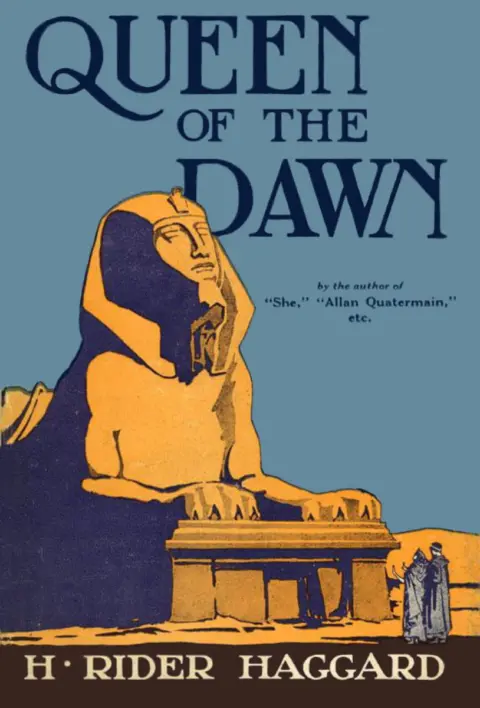
Queen of the Dawn: A Love Tale of Old Egypt
H. Rider (Henry Rider) Haggard
THE CLASSIC COLLECTION · 1923
Heu-Heu, or The Monster by H. Rider Haggard is a novel written in the early 20th century. It plunges Allan Quatermain into a supernatural-tinged African adventure sparked by a terrifying cave painting of an ape-like “Monster-god” and the call of a hidden people guarded by legend and fear. With his crafty companion Hans and the enigmatic wizard Zikali, Quatermain is drawn toward a lost land, forbidden rituals, and a threat that blurs the line between myth and reality. The opening of the novel finds Allan Quatermain, prompted by friends at his Yorkshire home, recounting an episode that begins on the Drakensberg slopes when a colossal storm forces his wagon party—himself, Hans, and two Zulu hands—into a vast cave. There, after a perilous crawl past a death-chasm full of ancient bones, moonlight reveals a Bushman painting of a monstrous, half-human figure called Heu-Heu. Haunted by the image, Quatermain treks into Zululand, witnesses a grim royal execution at Nongela Rock, and reaches Zikali in the Black Kloof. The wizard conjures a fiery vision of the same creature, offers replacement oxen, and unfolds a legend: a cruel northern ruler slain by his people returns as Heu-Heu to haunt a volcano-ringed land, abduct women, and sire the savage Heuheua; in that hidden country, a rare “Tree of Visions” grows—its leaves the key to Zikali’s magic and the bait that sets Quatermain’s road toward Heu-Heu, and possibly diamonds and ivory.
Introduction adapted from the source catalogue; source summaries may be automatically generated.
Free to read · English · 82,555 words · No account needed
MAKE TIME FOR A GOOD BOOK
On by default. Untick to stop anonymous reading totals. Each page counts after 10 seconds in view. How this works.
Anonymous counting is on unless you have switched it off.
“Yes,” I answered. “She annoyed the Lord-of-the-Fire with her attentions, so he slew her, as was right and proper. I cut off the finger of another who wished to shake hands with me when I had told him to go away.”
“But how did he slay her, Lord?”
Now I may explain that there was one inhabitant of this place that greeted us with no cordiality at all, namely a large and particularly ferocious dog, that all this while had been growling round us and finally had got hold of Hans’s coat, which it held between its teeth, still growling.
“Scheet! Hans, scheet een dood!” (“Shoot! Hans, shoot him dead!”) I whispered, and Hans, who was always quick to catch an idea, put his hand into his pocket where he kept his pistol, and pressing the muzzle against the brute’s head, fired through the cloth, with the result that this dog went wherever bad dogs go.
Then there was consternation. Indeed, one of the priests fell down with fear and the others turned tail, all of them except Dacha, who stood his ground.
“A little of the magic fire!” I remarked airily, “and there is plenty more where that came from,” at the same time, as though by accident, slapping Hans’s pocket, which I saw was smouldering. “And now, noble Dacha, it is setting in wet and we are hungry. Be pleased to give us shelter and food.”
“Certainly, Lord, certainly!” he exclaimed, and started off with us, keeping me well between himself and Hans, while the others, who had returned, followed with the dead dog.
Presently, recovering from his fear, he asked me whether the Lady Sabeela had said anything more about him.
“Only one thing,” I answered: “that it was a pity that a maiden should be obliged to marry a god when there were such men as you in the world.”
Here I stopped and watched the effect of my shot out of the corner of
my eye.
His coarse but handsome face grew cunning, and he smacked his lips.
“Yes, Lord, yes,” he said hurriedly. “But who knows? Things are not always what they seem, Lord, and I have noted that sometimes the faithful servant tithes the master’s offering.”
“By Jingo! I’ve got it!” thought I to myself. “You, my friend, are Heu-Heu, or at any rate his business part.” But aloud, glancing at the redoubtable Hans, I only remarked something to the effect that Dacha’s powers of observation were keen and that, like the Lord-of-the-Fire himself, as he said truly, things were not always what they seemed.
Your reading position is saved on this browser. Take it to another device with a library code. Reading pages adapt to text, rather than matching a printed edition.
H. Rider (Henry Rider) Haggard
H. Rider (Henry Rider) Haggard
H. Rider (Henry Rider) Haggard
H. Rider (Henry Rider) Haggard
BEHIND THE BOOK
This eBook is for the use of anyone anywhere in the United States and most other parts of the world at no cost and with almost no restrictions whatsoever. You may copy it, give it away or re-use it under the terms of the Project Gutenberg License included with this eBook or online at www.gutenberg.org. If you are not located in the United States, you will have to check the laws of the country where you are located before using this eBook. Read the source licence.
The original source file, including credits and licence, is retained by this library. Request an original-format copy at no charge. Please include the book title and Project Gutenberg identifier #76643.
KEEP YOUR CURIOSITY GOING
Coulson Kernahan

Maurice Baring
Frances Wright
Cécile Tormay
Francis Greenleaf Allinson & Anne C. E. (Anne Crosby Emery) Allinson

Frederic Jesup Stimson