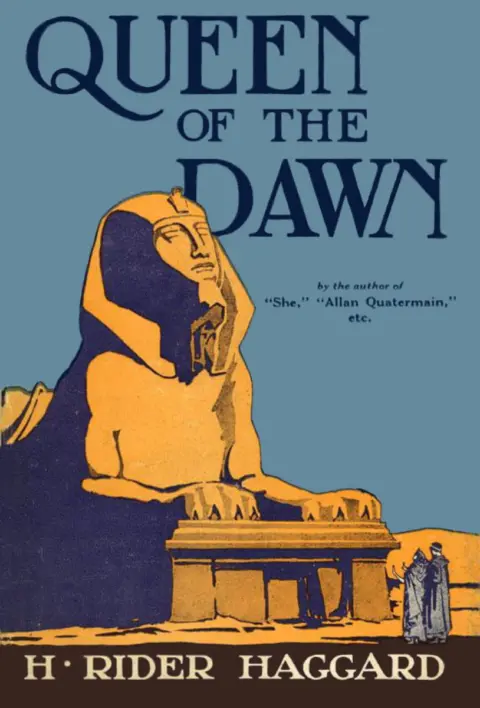
Queen of the Dawn: A Love Tale of Old Egypt
H. Rider (Henry Rider) Haggard
THE CLASSIC COLLECTION · 1923
Heu-Heu, or The Monster by H. Rider Haggard is a novel written in the early 20th century. It plunges Allan Quatermain into a supernatural-tinged African adventure sparked by a terrifying cave painting of an ape-like “Monster-god” and the call of a hidden people guarded by legend and fear. With his crafty companion Hans and the enigmatic wizard Zikali, Quatermain is drawn toward a lost land, forbidden rituals, and a threat that blurs the line between myth and reality. The opening of the novel finds Allan Quatermain, prompted by friends at his Yorkshire home, recounting an episode that begins on the Drakensberg slopes when a colossal storm forces his wagon party—himself, Hans, and two Zulu hands—into a vast cave. There, after a perilous crawl past a death-chasm full of ancient bones, moonlight reveals a Bushman painting of a monstrous, half-human figure called Heu-Heu. Haunted by the image, Quatermain treks into Zululand, witnesses a grim royal execution at Nongela Rock, and reaches Zikali in the Black Kloof. The wizard conjures a fiery vision of the same creature, offers replacement oxen, and unfolds a legend: a cruel northern ruler slain by his people returns as Heu-Heu to haunt a volcano-ringed land, abduct women, and sire the savage Heuheua; in that hidden country, a rare “Tree of Visions” grows—its leaves the key to Zikali’s magic and the bait that sets Quatermain’s road toward Heu-Heu, and possibly diamonds and ivory.
Introduction adapted from the source catalogue; source summaries may be automatically generated.
Free to read · English · 82,555 words · No account needed
MAKE TIME FOR A GOOD BOOK
On by default. Untick to stop anonymous reading totals. Each page counts after 10 seconds in view. How this works.
Anonymous counting is on unless you have switched it off.
Speechless with amazement, we emerged from that death chamber and wandered about the place. Here and there we found the bodies of others who had perished in the great catastrophe and once came across an arm projecting from a mass of lava, which seemed to show that many more were buried underneath. Also we found a number of fossilized goats in a kraal. What a place to dig in! I thought to myself. Given some spades, picks, and blasting-powder, what might one not find in these ruins?
All the relics of a past civilization, perhaps—its inscriptions, its jewellery, the statues of its gods; even, perhaps, its domestic furniture buried beneath the lava and the dust, though probably this had rotted. Here, certainly, was another Pompeii, and perhaps beneath that another Herculaneum.
Whilst I mused thus over glories passed away and wondered when they had passed, Hans dug me in the ribs and, in his horrible Boer Dutch, ejaculated a single word, “Kek!” which, as perhaps you know, means “Look!” at the same time nodding towards the lake.
I did look, and saw our canoe paddling for all it was worth, going “hell for leather,” as my old father used to say, towards the Walloo shore.
“Now why is it doing that?” I asked.
“I expect because something is behind it, Baas,” he replied with resignation, then sat down on a rock, pulled out his pipe, filled it, and lit a match.
As usual, Hans was right, for presently from round the curve of the island there appeared two other canoes, very large canoes, rowing after ours with great energy and determination, and, as I guessed, with malignant intent.
“I think those priests have seen our boat and mean to catch it, if they can,” remarked Hans, spitting reflectively, “though as Issicore has got a long start, perhaps they won’t. And now, Baas, what are we to do? We can’t live here with dead men, and stone goat is not good to eat.”
I considered the situation, and my heart sank into my boots, for the position seemed desperate. A moment before I had been filled with enthusiasm over this ruined city and its fossilized remains. Now I hated the very thought of them, and wished that they were at the bottom of the lake. Thus do circumstances alter cases and our poor variable human moods. Then an idea came to me, and I said boldly,
“Do! Why, there is only one thing to do. We must go to call on Heu-Heu,
or his priests.”
Your reading position is saved on this browser. Take it to another device with a library code. Reading pages adapt to text, rather than matching a printed edition.
H. Rider (Henry Rider) Haggard
H. Rider (Henry Rider) Haggard
H. Rider (Henry Rider) Haggard
H. Rider (Henry Rider) Haggard
BEHIND THE BOOK
This eBook is for the use of anyone anywhere in the United States and most other parts of the world at no cost and with almost no restrictions whatsoever. You may copy it, give it away or re-use it under the terms of the Project Gutenberg License included with this eBook or online at www.gutenberg.org. If you are not located in the United States, you will have to check the laws of the country where you are located before using this eBook. Read the source licence.
The original source file, including credits and licence, is retained by this library. Request an original-format copy at no charge. Please include the book title and Project Gutenberg identifier #76643.
KEEP YOUR CURIOSITY GOING
Coulson Kernahan

Maurice Baring
Frances Wright
Cécile Tormay
Francis Greenleaf Allinson & Anne C. E. (Anne Crosby Emery) Allinson

Frederic Jesup Stimson