Poems of Progress
Lizzie Doten
THE CLASSIC COLLECTION · 1858
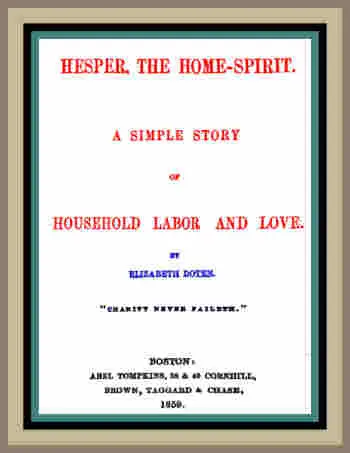
"Hesper, the Home-Spirit: A Simple Story of Household Labor and Love" by Lizzie Doten is a fictional work written in the mid-19th century. The narrative centers around Hesper, a compassionate young girl who bears many responsibilities in her family, including caring for her ill mother and assisting her siblings while navigating the challenges of their humble lives. The story emphasizes themes of love, duty, and the unseen heroism of those engaged in household labor. The beginning of the story introduces us to Mr. Byers, an elderly man who brings a letter to Aunt Nyna, a Quaker lady living at Locust Cottage. This letter is eagerly awaited as it is from her son, Harry. As Mr. Byers converses with Aunt Nyna, we learn about her deep affection for her family and her worries about Harry. Soon after, Hesper makes her entrance, revealing the struggles she faces in her daily life, which include concerns for her father’s painful injury and the overall well-being of her family. As the opening unfolds, we see hints of Hesper's selflessness and the simple yet profound acts of care she performs for her loved ones, setting the stage for a story steeped in domestic love and the trials of everyday existence.
Introduction adapted from the source catalogue; source summaries may be automatically generated.
Free to read · English · 55,482 words · No account needed
MAKE TIME FOR A GOOD BOOK
On by default. Untick to stop anonymous reading totals. Each page counts after 10 seconds in view. How this works.
Anonymous counting is on unless you have switched it off.
“Get your hat, my boy,” said he, “and go to walk with me. My heart is full and I want to relieve it.”
Accordingly Mose complied with his request, and they turned their steps towards the sea shore. As they seated themselves on an unfinished spar, Mr. Byers asked if the ship in which Mose was to sail would touch at Canton.
“Yes, I believe so,” replied Mose, “at some time in the course of the voyage, for we are to be gone two years or more, and shall visit several ports.”
“Well, then,” resumed Mr. Byers, “doubtless you will meet with Harry Nyna, and I want you, Mose, to take a sharp observation of that young man, for if I can trust anything to my knowledge of human nature, I should say he was exceedingly progressive.”
“Progressive!” repeated Mose. “Well, why not?”
“Ay, let me tell you, I think a young man is altogether too progressive, when, at the age of seventeen or eighteen, he smokes his cigar in public, drinks brandy behind the barn-door, and plays cards on the hay-mow.”
“What!” said Mose, in astonishment.
“Ay, that’s a fact; and his mother--dear good lady,--never suspected it. She’s just like all the rest of the women--Lord bless ‘em! So good themselves they think everybody else is, and whoever they love, is next kin to perfection.”
“Harry is a good-hearted boy, though” said Mose thoughtfully.
“As good as a ripe October peach with a doubled kernelled pit in it, and generous as summer sunshine. But that is the great difficulty with him. He is too generous to say no, and goes in for a jolly time whenever he can have one. Nevertheless, I love him with all his faults, and really feel a fatherly solicitude for him. Not on his mother’s account, however. O, no, Mose! no! It’s purely for his own sake, although I think Mrs. Dorothy a most excellent woman, and should I ever think of marrying again, I would certainly give her the preference. But, then, that isn’t what I came here to talk about. Mose,” resumed the old man, after a few moment’s silence, “you are to be gone a long time, and perhaps I may never see you again, and possibly I may be dead when you come back.”
“O, I don’t think so,” said Mose.
“Nor I either,” continued Mr. Byers. “I only said possibly, and as I would like to be remembered, I have concluded to give you this;” so saying, he drew a monstrous old silver watch from his pocket, and laid it in the hand of his young friend.
Your reading position is saved on this browser. Take it to another device with a library code. Reading pages adapt to text, rather than matching a printed edition.
Lizzie Doten
BEHIND THE BOOK
This eBook is for the use of anyone anywhere in the United States and most other parts of the world at no cost and with almost no restrictions whatsoever. You may copy it, give it away or re-use it under the terms of the Project Gutenberg License included with this eBook or online at www.gutenberg.org. If you are not located in the United States, you will have to check the laws of the country where you are located before using this eBook. Read the source licence.
The original source file, including credits and licence, is retained by this library. Request an original-format copy at no charge. Please include the book title and Project Gutenberg identifier #47483.
KEEP YOUR CURIOSITY GOING
Coulson Kernahan

Maurice Baring
Frances Wright
Cécile Tormay

Frederic Jesup Stimson

W. H. P. (William Henry Pope) Jarvis