THE CLASSIC COLLECTION✦An outlaw’s diary: the CommuneCLASSIC FREE BOOKS
An outlaw’s diary: the Commune
Cécile Tormay
THE CLASSIC COLLECTION · 1922
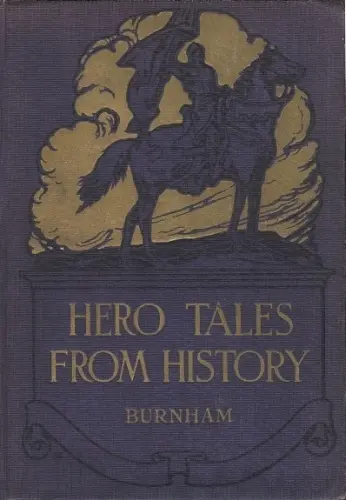
"HERO TALES FROM HISTORY" by Smith Burnham is a collection of historical narratives written in the early 20th century. The work aims to introduce children to significant figures from history through engaging stories that emphasize virtues such as courage, honor, and justice. It features a variety of heroes from different time periods, providing vivid portraits that serve to inspire young readers. At the start of the book, the author sets forth a preface explaining the purpose behind these stories, which is to cultivate a love for history in children through compelling tales of notable individuals. The opening portion introduces some key figures, such as Moses, David, and Homer, detailing their incredible feats and contributions. Each narrative is crafted to be accessible and engaging for young minds, emphasizing action and highlight moral lessons without overt didacticism. The objective is to transform historical figures into relatable and inspiring characters, making history come alive for its young audience.
Introduction adapted from the source catalogue; source summaries may be automatically generated.
Free to read · English · 101,949 words · No account needed
MAKE TIME FOR A GOOD BOOK
On by default. Untick to stop anonymous reading totals. Each page counts after 10 seconds in view. How this works.
Anonymous counting is on unless you have switched it off.
Some of the Indian tribes of the Great Northwest were so delighted with “Hiawatha” that they voted to make the poet one of their great chiefs; and after Longfellow himself had gone to the “Happy Hunting Grounds” across the River of Death, the Indians went through a formal service making the poet’s daughter Alice a girl chief.
It must have been because he was so fond of children that Longfellow became known as the “Children’s Poet.” In the hall of quaint old Craigie House, which became the poet’s home, stood the stately “Old Clock on the Stairs,” solemnly ticking: “Forever, never! Never, forever!” In the early morning the spacious rooms were made bright with the merry laughter of Longfellow’s three little daughters, running down to spend an hour with their kindly, white-haired poet father. Of this he wrote in a poem named “The Children’s Hour”:
“From my study I see in the lamplight,
Descending the broad hall stair,
Grave Alice, and laughing Allegra,
And Edith with golden hair.”
Longfellow’s last poem was about “The Bells of San Blas,” which appeared in print just a few days before he died. The close of this--the last poetry he ever wrote--were these three lines:
“Out of the shadow of night
The world rolls into light--
It is daybreak everywhere.”
āte, sen*ate, râre, căt, loc*al, fär, åsk, pårade; scēne, *event, ĕdge, nov*el, refḛr; rîght, sĭn; cōld, *obey, côrd, stŏp, c*ompare; ūnit, *unite, bûrn, cŭt, foc*us, menü; bōōt, fŏŏt; f=ou=nd; b=oi=l; fuṅction; =ch=ase; =g=ood; =j=oy; then, =th=ick; hw = wh as in when; zh = z as in azure; kh = ch as in loch.
Aaron (ā´r*on), 3
Aboukir (å-bōō-kēr´) Bay, 75
Achilles (å-kĭl´ēz), 12
Acre (ä´kêr), (see Akka)
Africa (ăf´rĭ-kå), 32
Akka (ä´kå), 49
Albany (ôl´bå-nĭ), 118
Alciun (*al´sĭ-ŭn), 33
Alden (ôl´dĕn), John, 162
Alexander (ăl´´ĕg-zăn´dĕr) the Great, 20-24;
conquers Persia, 22
Alexandria (ăl´´ĕg-zăn´drĭ-å), 24
Alfred (ăl´frĕd), King, 37, 41
Alfred the Great, (see Alfred, King)
Alps (ălps) Mountains, 69
Annapolis (ă-nåp´*o-lĭs), 342
“Apology of Socrates,” 19
Arden (är´dĕn), Mary, 58
“Ashland,” 325
Asia Minor (ā´shå mī´nḛr), 26
Athens (ăth´ĕnz), 15
Aztecs (ăz´tĕks), 90
Baltimore (bôl´tĭ-mōr), (See Calvert, George)
Barton (bär´tŭn), Clara, 358-364
Battle Hill, 44
Beacon Hill, 174
Blackstone, William, 173
Bon Homme Richard (b*o-n*om rē´´-shär´), 212
Boone (bōōn), Daniel, 232-240
Boulogne (bōō-lŏn´; Fr. bōō´´lō´ṅy), 36
Your reading position is saved on this browser. Take it to another device with a library code. Reading pages adapt to text, rather than matching a printed edition.
BEHIND THE BOOK
This eBook is for the use of anyone anywhere in the United States and most other parts of the world at no cost and with almost no restrictions whatsoever. You may copy it, give it away or re-use it under the terms of the Project Gutenberg License included with this eBook or online at www.gutenberg.org. If you are not located in the United States, you will have to check the laws of the country where you are located before using this eBook. Read the source licence.
The original source file, including credits and licence, is retained by this library. Request an original-format copy at no charge. Please include the book title and Project Gutenberg identifier #49356.
KEEP YOUR CURIOSITY GOING
Cécile Tormay

Moritz Busch
John L. Ransom
Frances Wright
Cécile Tormay

Mabel Potter Daggett