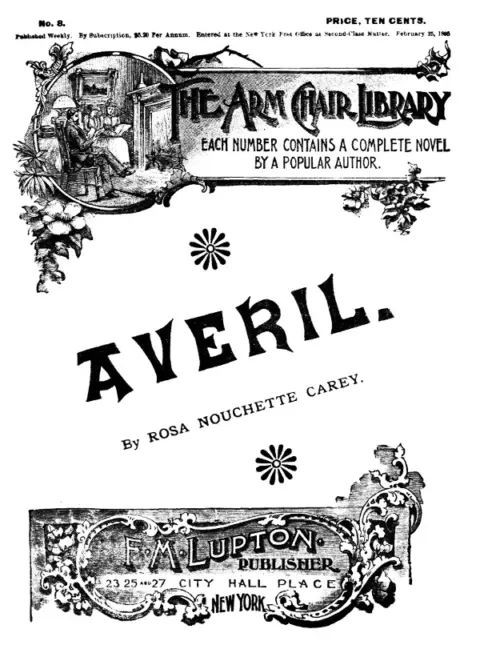
Averil
Rosa Nouchette Carey
THE CLASSIC COLLECTION · 1898
"Heriot's Choice: A Tale" by Rosa Nouchette Carey is a novel written in the late 19th century. The story centers around Mildred Lambert, a woman who, after a long period of caregiving for her ailing mother, is called upon to help her brother Arnold after the death of his wife. The narrative explores themes of duty, family bonds, and the emotional turmoil associated with loss as Mildred transitions from her solitary life into a dynamic family environment. The opening of the book introduces Mildred as she contemplates her stagnant existence and the responsibilities that await her in her brother's home. Following the death of her mother and her sister-in-law, Mildred feels the weight of her past life and considers whether she will be able to fulfill her new role successfully. In her brother's letters, she sees a call to action and the potential for rekindling her own sense of purpose. The narrative also introduces her new charge, Polly, Dr. Heriot's ward, hinting at the complexity of relationships and the adjustments both characters must make as they navigate their new paths in life.
Introduction adapted from the source catalogue; source summaries may be automatically generated.
Free to read · English · 182,790 words · No account needed
MAKE TIME FOR A GOOD BOOK
On by default. Untick to stop anonymous reading totals. Each page counts after 10 seconds in view. How this works.
Anonymous counting is on unless you have switched it off.
'Yes, that long level of green to our left is where the celebrated Brough fair is held. The country people use it as a date, "last Brough Hill," as they say--the word "Brough" comes from "Brugh," a fortification. My father has written a very clever paper on the origin of the names of places; it is really very interesting.'
'Some of the names are so quaint--"Smardale," for example.'
'Let me see, that has a Danish termination, and means Butter-dale--"dale" from "dal," a valley; Garsdale, grass-dale; Sleddale, from "slet," plain, the open level plain or dale, and so on. I recollect my father told us that "Kirkby," on the contrary, is always of Christian origin, as "Kirkby Stephen," and "Kirkby Kendal;" but perhaps you are not fond of etymology, Aunt Milly.'
'On the contrary, it is rather a favourite study of mine; go on, Richard. I want to know how Kirkby Stephen got its name.'
'I must quote my father again, then. He thinks the victorious Danes found a kirk with houses near it, and called the place Kirkby, and they afterwards learnt that the church was dedicated to St. Stephen, the proto-martyr, and then added his name to distinguish it from the other Kirkbys.'
'It must have been rather a different church, Richard.'
'I see I must go on quoting. He says, "We can almost picture to ourselves that low, narrow, quaint old church, with its rude walls and thatched roof." But, Aunt Milly, we must be thinking of returning, if we are to call on the Trelawnys. By the bye, what do you think of them?'
'Of Mr. Trelawny, you mean, for I certainly did not exchange three words
with his daughter.'
'I noticed she was very silent; she generally is when he is present. What a pity it is they do not understand each other better.'
He seemed waiting for her to speak, but Mildred, who was taking a last lingering look at the ruin, was slow to respond.
'He seems very masterful,' she said at last when they had entered the pony-carriage, and were driving homewards.
'Yes, and what is worse, so narrow in his views. He is very kind to me, and I get on with him tolerably well,' continued Richard, modestly; 'but I can understand the repressing influence under which she lives.'
'It seems so strange for a father not to understand his daughter.'
Your reading position is saved on this browser. Take it to another device with a library code. Reading pages adapt to text, rather than matching a printed edition.
Rosa Nouchette Carey
Rosa Nouchette Carey
Rosa Nouchette Carey
Rosa Nouchette Carey
BEHIND THE BOOK
This eBook is for the use of anyone anywhere in the United States and most other parts of the world at no cost and with almost no restrictions whatsoever. You may copy it, give it away or re-use it under the terms of the Project Gutenberg License included with this eBook or online at www.gutenberg.org. If you are not located in the United States, you will have to check the laws of the country where you are located before using this eBook. Read the source licence.
The original source file, including credits and licence, is retained by this library. Request an original-format copy at no charge. Please include the book title and Project Gutenberg identifier #35901.
KEEP YOUR CURIOSITY GOING
Coulson Kernahan

Maurice Baring
Frances Wright
Cécile Tormay

Frederic Jesup Stimson

W. H. P. (William Henry Pope) Jarvis