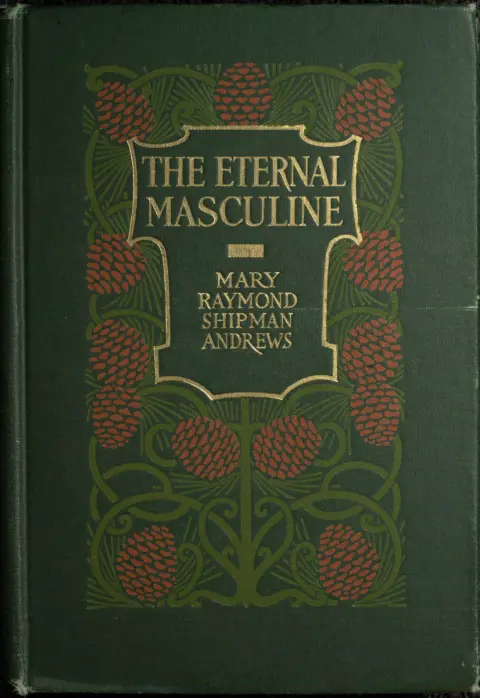
The eternal masculine
Mary Raymond Shipman Andrews
THE CLASSIC COLLECTION · 1918
"Her Country" by Mary Raymond Shipman Andrews is a novel written during the early 20th century, specifically around the time of World War I. The story revolves around themes of patriotism, ambition, and personal sacrifice as it follows the life of Honor Mannering, a young girl aspiring to become a successful singer while grappling with the realities of her family's financial struggles and the call to serve her country. In the narrative, Honor Mannering is determined to make money through her vocal talents, believing her voice can alleviate her family's financial woes. As the United States enters the war, her perspective gradually shifts from seeking personal success to embracing a sense of duty toward her nation, especially influenced by her brother Eric, who aspires to help the war effort through his speeches. The climax occurs when Honor finds herself on stage to replace a famous singer who cannot perform, and she delivers a resonant rendition of patriotic songs that inspires a crowd to support the Liberty Loan campaign. Ultimately, the book captures Honor's transformation from self-interest to a profound sense of responsibility for her country, blending personal ambition with the collective aspirations of a nation at war.
Introduction adapted from the source catalogue; source summaries may be automatically generated.
Free to read · English · 10,500 words · No account needed
MAKE TIME FOR A GOOD BOOK
On by default. Untick to stop anonymous reading totals. Each page counts after 10 seconds in view. How this works.
Anonymous counting is on unless you have switched it off.
“Dr. Thomas go to the devil. That voice--who is it?”
“Little Honor Mannering, next door. It’s a fine voice--yet----”
“Exactly,” McIvor caught him up. “Something lacking. But a great music machine, the throat that’s doing that peaches and cream. I want her to sing for me. I want to see what’s the trouble--why that voice isn’t a miracle. Can you get her to----”
Barron was looking into the sunlight of his drive. “Here she comes,” he
said.
The white, tall, thin figure was moving, facile of movement as the voice, up the broad gravel; the shallow basket, rioting color, swept casually back and forth in the girl’s hand. Barron went down the steps.
“For Mr. McIvor,” she called, swinging the mass of reds and pinks at him as she came. “I wish they were better. They’re all we have, but they’re only common roses.”
“The sweetest kind,” said Barron, and the girl stood gazing at him, her eyes shining with the romance of bringing flowers to a hero.
“When’s he coming?” she demanded. “I’m going to stand in our garden and sing and sing till he asks me to do ‘Carmen’ for him. Do tell him to, Mr. Barron. When’s he coming?”
“He’s here,” some one spoke from the gallery, back of the flower-boxes. The girl stood rooted. “And ‘Carmen’ has been sung by worse voices. Seldom better.”
“Oh,” groaned Barron, “he ought not to be stirred up; come and see him, then, but don’t stay over a minute.”
The girl came, breathless, shy a bit, but blissful.
“To-morrow morning, then, you’ll sing for him,” said Barron three minutes later. “And now go away, my dear, for he mustn’t get tired.”
In the Barron drawing-room, while McIvor’s secretary played an accompaniment, the girl stood next morning and sang.
McIvor lay outside among his pillows and stared at the tossing pink veil clothing the broken lattice. The girl sang as confidently as any bird in a tree, taking the difficult changes and the trying high notes without any effort. Her voice was astonishing in its power. McIvor looked at her as she came smiling through the door.
“You’d do for a church organ,” he said. “Where does all that noise come from, you wisp of a child? Turn sideways.” She whirled, laughing. “I see. You fooled me. You’ve got the deep chest of a prima donna. Healthy, aren’t you?”
She nodded. “As strong as my brother. Never ill since measles. I can run up-hill and not get winded.”
“You’re fit,” said McIvor. The girl looked at him, waited.
Your reading position is saved on this browser. Take it to another device with a library code. Reading pages adapt to text, rather than matching a printed edition.
Mary Raymond Shipman Andrews

Mary Raymond Shipman Andrews
Mary Raymond Shipman Andrews
Mary Raymond Shipman Andrews
BEHIND THE BOOK
This eBook is for the use of anyone anywhere in the United States and most other parts of the world at no cost and with almost no restrictions whatsoever. You may copy it, give it away or re-use it under the terms of the Project Gutenberg License included with this eBook or online at www.gutenberg.org. If you are not located in the United States, you will have to check the laws of the country where you are located before using this eBook. Read the source licence.
The original source file, including credits and licence, is retained by this library. Request an original-format copy at no charge. Please include the book title and Project Gutenberg identifier #71078.
KEEP YOUR CURIOSITY GOING
Coulson Kernahan

Maurice Baring
Frances Wright
Cécile Tormay

Frederic Jesup Stimson

W. H. P. (William Henry Pope) Jarvis