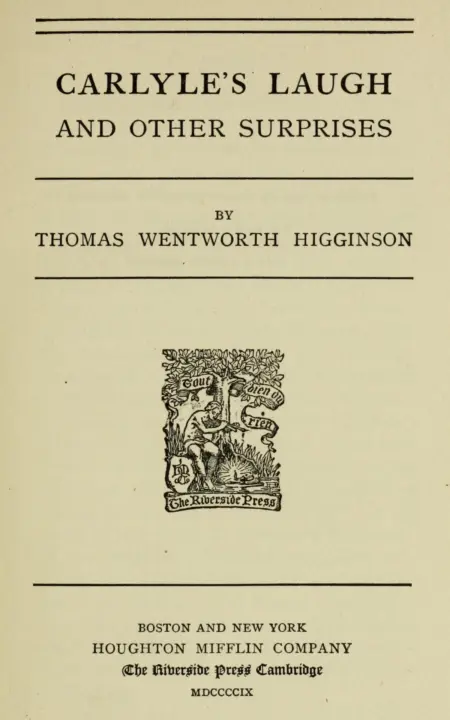
Carlyle’s laugh, and other surprises
Thomas Wentworth Higginson
THE CLASSIC COLLECTION · 1902
"HENRY WADSWORTH LONGFELLOW" by Thomas Wentworth Higginson is a biographical account written in the early 20th century as part of the "American Men of Letters" series. The book delves into the life and works of the renowned American poet Henry Wadsworth Longfellow, exploring his background, influences, and literary contributions. It offers insights into Longfellow's early years, his academic journey, and the events that shaped his famed career, including his interactions with influential literary circles. The opening of the memoir provides a tribute to Longfellow's significant impact on American literature, noting his status as a leading poet of his time and his widespread fame. Higginson introduces Longfellow's life, beginning with reflections on his importance among contemporaries and the "breach" left by his death. The author hints at the transformative periods of Longfellow's life, highlighting his childhood in Maine, early education, and the relationships that informed his growth as a poet. This sets the stage for a detailed exploration of Longfellow's literary pursuits, including his ambition to establish a distinctly American literature. The chapter promises a rich narrative of Longfellow’s evolution, showcasing both his personal and professional experiences.
Introduction adapted from the source catalogue; source summaries may be automatically generated.
Free to read · English · 70,326 words · No account needed
MAKE TIME FOR A GOOD BOOK
On by default. Untick to stop anonymous reading totals. Each page counts after 10 seconds in view. How this works.
Anonymous counting is on unless you have switched it off.
His first aim was Sweden, but he spent a few weeks in London, where he met, among others, Carlyle. So little has hitherto been recorded of this part of Longfellow's life or of his early married life in any way, that I am glad to be able to describe it from the original letters of the young wife, which are now in my possession, and are addressed mainly to Mrs. Longfellow, her mother-in-law. She seems to have enjoyed her travelling experiences very thoroughly, and writes in one case, "We are generally taken for French ... and I am always believed to be Henry's sister. They say to me, 'What a resemblance between your brother and self!'"
Sunday afternoon, May 31, 1835.
MY DEAR MOTHER,--I wrote you a very few lines, in great haste, in Henry's letter to his Father, acknowledging the receipt of your kind letter. I hope that you will write us as often as your many cares will permit, & be assured that even a few lines will always be welcomed with delight by your absent children. We have passed our time very delightfully in London. The only difficulty is--there is so much to be seen & so little time to see it in. We have, however, seen many of the principal points. Last Monday we passed very delightfully at Shirley Park, near the little village of Croydon. The ride is through a very beautiful country. We passed several gipsy encampments, in the most picturesque situations. Shirley Park is a truly delightful place. The house, which is a very fine one, is placed on a beautiful spot, & there are fine views from all sides of it. Mrs. Skinner, the lady of the place, is a very agreeable amiable lady--She took us all over the grounds in her carriage, & was very kind & attentive to us. Her house is thronged with visitors, the great, the fashionable, & the literati all pay their court to her. She is a great admirer of Willis's, & thinks his writings superior to Irving's!--On Wednesday we visited the National Gallery, the finest collection of old paintings in the city. We saw while we were there, the Queen pass into the city, attended by the horse-guards in their beautiful uniforms. Five or six carriages passed with a coachman & two footmen to each, lost almost in the quantity of gold lace which covered them. Last of all came her Majesty's carriage with two coachmen & four footmen in the same magnificent livery. Thursday was the king's birth day. The drawing room was the most splendid one that had ever been seen--so Willis says. In the eve'g there was a grand illumination. About ten Henry and Mr. Frazer went out to see it. The crowd was so immense, that it was with the greatest difficulty they made their way home. Four women from St. Giles's armed with large clubs pointed with iron, passed through the crowd striking in all directions. We took a carriage & drove to see the illuminations. It was after eleven & the crowd had nearly dispersed. There were brilliant crowns & a variety of pretty devices formed with coloured lamps & some very fine gas ones. I suspect however there was very little true rejoicing in all this show & splendour. The Queen is very unpopular among the people. Friday morn'g--Willis called. He had been to breakfast with the beautiful Mrs. Wadsworth, & was on his way, to breakfast at 3 in the aft. with the Duchess of St. Albans. Mrs. Wadsworth, from Genesseo, was a Philadelphia lady & has been greatly admired on the continent & here. She returns in a few days to America. Yesterday morning Mr. Barnard a young lawyer from Connecticut called upon me. He arrived but a month before us, & takes much the same route as we do, though a more extensive one. He will be in Stockholm in the course of the summer. Mr. Carlyle of Craigenputtock was soon after announced, & passed an half hour with us much to our delight. He has very unpolished manners, & broad Scottish accent, but such fine language & beautiful thoughts that it is truly delightful to listen to him. Perhaps you have read some of his articles in the Edinburgh Review. He invited us to take tea with him at Chelsea, where they now reside. We were as much charmed with Mrs. C[arlyle] as with her husband. She is a lovely woman with very simple & pleasing manners. She is also very talented & accomplished, & how delightful it is to see such modesty combined with such power to please. On Tuesday we visit Chantrey's study with them. This morning Mr. Bentham, a nephew of Jeremy's, called, & invited us to dine with them on Wednesday--We may see the great potentate appear. Henry is petitioning for room to write, & saying that I must retire, but I must tell you my dreams. A few nights since I heard Samuel [Longfellow] preach for Dr. Nichols. Last night I dreamt I was with my father & sisters, telling them of all I had seen. I only went to America to make a call & tell you all we had safely arrived, & was to return immediately. You will give very much love to all for me. They must all write me, & their letters shall be answered as speedily as possible. We leave here the last of this week. I shall leave letters to be sent by the first opportunity. George & Ann must not forget us.
Your reading position is saved on this browser. Take it to another device with a library code. Reading pages adapt to text, rather than matching a printed edition.
Thomas Wentworth Higginson
Thomas Wentworth Higginson
Thomas Wentworth Higginson
Thomas Wentworth Higginson
BEHIND THE BOOK
This eBook is for the use of anyone anywhere in the United States and most other parts of the world at no cost and with almost no restrictions whatsoever. You may copy it, give it away or re-use it under the terms of the Project Gutenberg License included with this eBook or online at www.gutenberg.org. If you are not located in the United States, you will have to check the laws of the country where you are located before using this eBook. Read the source licence.
The original source file, including credits and licence, is retained by this library. Request an original-format copy at no charge. Please include the book title and Project Gutenberg identifier #33402.
KEEP YOUR CURIOSITY GOING

Charles G. (Charles Griffith) Ross
Hannah Webster Foster

Emily Lawless
Edwin Hamlin Carr

Charles De Lano Hine
Andrew Ure