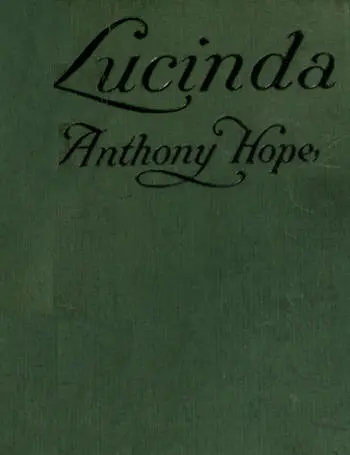
Lucinda
Anthony Hope
THE CLASSIC COLLECTION · 1907
"Helena's Path" by Anthony Hope is a novel written in the early 20th century. The book follows Ambrose, Lord Lynborough, an unconventional nobleman who has returned to his ancestral estate after a series of erratic adventures. With a unique blend of humor and drama, the story revolves around his clashes with the Marchesa di San Servolo, the owner of the neighboring estate, as they become embroiled in a territorial dispute over a path leading to the beach. The beginning of "Helena's Path" introduces us to Lord Lynborough, whose disdain for societal norms propels him into a life of oddity, flouting authority and convention at every turn. As he navigates his return to Scarsmoor Castle, we meet a cast of characters, including his loyal friend Leonard Stabb, and the feisty Marchesa, who has locked a path frequently used by Lynborough and his family. The tension escalates when Lynborough insists on re-opening the path to access his beach for bathing, leading to a battle of wits and wills as the Marchesa staunchly defends her claim over the path. The opening sets the stage for a delightful clash of personalities and interests, teasing the reader with the promise of both romance and conflict ahead.
Introduction adapted from the source catalogue; source summaries may be automatically generated.
Free to read · English · 30,240 words · No account needed
MAKE TIME FOR A GOOD BOOK
On by default. Untick to stop anonymous reading totals. Each page counts after 10 seconds in view. How this works.
Anonymous counting is on unless you have switched it off.
The men began to bandy stories of Lynborough from one table to the other. Wenman knew the London gossip, Stillford the local traditions: but neither had seen the hero of their tales for many years. The anecdotes delighted Norah Mountliffey, and caused Miss Gilletson's hands to fly up in horror. Nevertheless it was Miss Gilletson who said, "Perhaps we shall see him at church to-day."
"Not likely!" Stillford opined. "And--er--is anybody going?"
The pause which habitually follows this question ensued upon it now. Neither the Marchesa nor Lady Norah would go--they were both of the Old Church. Miss Dufaure was unlikely to go, by reason of fatigue. Miss Gilletson would, of course, go, so would Colonel Wenman--but that was so well known that they didn't speak.
"Any ladies with Lynborough's party, I wonder!" Captain Irons hazarded. "I think I'll go! Stillford, you ought to go to church--family solicitor and all that, eh?"
A message suddenly arrived from Miss Dufaure, to say that she felt better and proposed to attend church--could she be sent?
"The carriage is going anyhow," said Miss Gilletson a trifle stiffly.
"Yes, I suppose I ought," Stillford agreed. "We'll drive there and walk
back?"
"Right you are!" said the Captain.
By following the party from Nab Grange to Fillby parish church, a partial idea of the locality would be gained; but perhaps it is better to face the complete task at once. Idle tales suit idle readers; a history such as this may legitimately demand from those who study it some degree of mental application.
If, then, the traveler lands from the North Sea (which is the only sea he can land from) he will find himself on a sandy beach, dipping rapidly to deep water and well adapted for bathing. As he stands facing inland, the sands stretch in a long line southerly on his left; on his right rises the bold bluff of Sandy Nab with its swelling outline, its grass-covered dunes, and its sparse firs; directly in front of him, abutting on the beach, is the high wall inclosing the Grange property; a gate in the middle gives access to the grounds. The Grange faces south, and lies in the shelter of Sandy Nab. In front of it are pleasure-grounds, then a sunk fence, then spacious meadow-lands. The property is about a mile and a half (rather more than less) in length, to half-a-mile in breadth. Besides the Grange there is a small farmhouse, or bailiff's house, in the southwest corner of the estate. On the north the boundary consists of moorlands, to the east (as has been seen) of the beach, to the west and south of a public road. At the end of the Grange walls this road turns to the right, inland, and passes by Fillby village; it then develops into the highroad to Easthorpe with its market, shops, and station, ten miles away. Instead, however, of pursuing this longer route, the traveler from the Grange grounds may reach Fillby and Easthorpe sooner by crossing the road on the west, and traversing the Scarsmoor Castle property, across which runs a broad carriage road, open to the public. He will first--after entering Lord Lynborough's gates--pass over a bridge which spans a little river, often nearly dry, but liable to be suddenly flooded by a rainfall in the hills. Thus he enters a beautiful demesne, rich in wood and undergrowth, in hill and valley, in pleasant rides and winding drives. The Castle itself--an ancient gray building, square and massive, stands on an eminence in the northwest extremity of the property; the ground drops rapidly in front of it, and it commands a view of Nab Grange and the sea beyond, being in its turn easily visible from either of these points. The road above mentioned, on leaving Lynborough's park, runs across the moors in a southwesterly line to Fillby, a little village of some three hundred souls. All around and behind this, stretching to Easthorpe, are great rolling moors, rich in beauty as in opportunities for sport, yet cutting off the little settlement of village, Castle, and Grange from the outer world by an isolation more complete than the mere distance would in these days seem to entail. The church, two or three little shops, and one policeman, sum up Fillby's resources: anything more, for soul's comfort, for body's supply or protection, must come across the moors from Easthorpe.
Your reading position is saved on this browser. Take it to another device with a library code. Reading pages adapt to text, rather than matching a printed edition.
Anthony Hope

Anthony Hope
Anthony Hope
Anthony Hope
BEHIND THE BOOK
This eBook is for the use of anyone anywhere in the United States and most other parts of the world at no cost and with almost no restrictions whatsoever. You may copy it, give it away or re-use it under the terms of the Project Gutenberg License included with this eBook or online at www.gutenberg.org. If you are not located in the United States, you will have to check the laws of the country where you are located before using this eBook. Read the source licence.
The original source file, including credits and licence, is retained by this library. Request an original-format copy at no charge. Please include the book title and Project Gutenberg identifier #36876.
KEEP YOUR CURIOSITY GOING
Coulson Kernahan

Maurice Baring
Frances Wright
Cécile Tormay

Frederic Jesup Stimson

W. H. P. (William Henry Pope) Jarvis