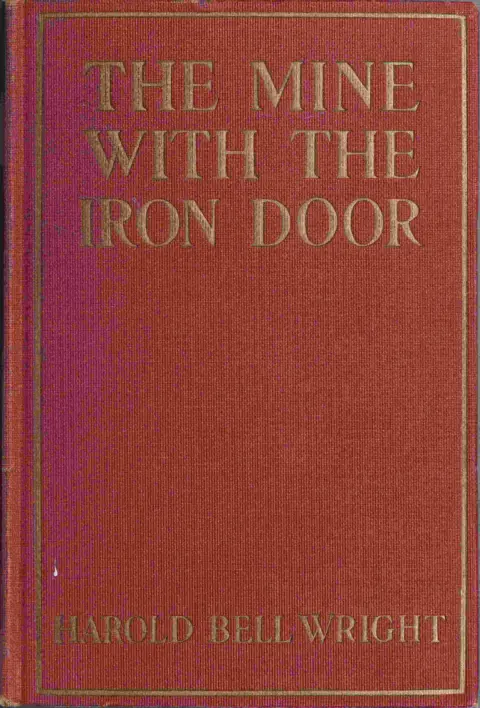
The Mine with the Iron Door
Harold Bell Wright
THE CLASSIC COLLECTION · 1921
"Helen of the Old House" by Harold Bell Wright is a novel written in the early 20th century. The story is set in the small manufacturing city of Millsburgh and revolves around the lives of its inhabitants, focusing on the contrast between the wealthy Mill owner Adam Ward and the struggling working-class families in the community. The characters, particularly Adam's daughter Helen and the children Bobby and Maggie Whaley, navigate themes of class struggle, happiness, and social responsibility against the backdrop of an industrialized society. The beginning of the novel introduces two children, Bobby and Maggie Whaley, who live in a poor community overshadowed by the Mill owned by Adam Ward. As they explore their environment, they come across a peculiar figure known as the Interpreter, who resides in a small hut on a cliff overlooking the Mill. The children, drawn by curiosity and the hope of adventure, climb to meet the Interpreter and are welcomed into his world filled with stories and kindness. Their initial joy is contrasted sharply with their subsequent encounter with Adam Ward, who harshly confronts them, revealing the depth of class divides and animosity that permeates their lives. The story sets the stage for deeper explorations of personal connections, societal roles, and the quest for happiness amidst adversity.
Introduction adapted from the source catalogue; source summaries may be automatically generated.
Free to read · English · 89,607 words · No account needed
MAKE TIME FOR A GOOD BOOK
On by default. Untick to stop anonymous reading totals. Each page counts after 10 seconds in view. How this works.
Anonymous counting is on unless you have switched it off.
Two bright tears rolled down the thin, dirty cheeks of the little girl's tired face, and she turned to look away over the dirty Flats, the smoke-grimed mills, and the golden fields of grain in the sunshiny valley, to something that she seemed to see in the far distant sky.
With a quick movement the Interpreter again hid his useless limbs.
"And now don't you think you might tell me about yourselves? What is
your name, my boy?"
"I'm Bobby Whaley," answered the lad. "She's my sister, Maggie."
"Oh, yes," said the Interpreter. "Your father is Sam Whaley. He works
in the Mill."
"Uh-huh, some of the time he works--when there ain't no strikes ner
nothin'."
The Interpreter, with his eyes on that dark cloud that hung above the forest of grim stacks, appeared to attach rather more importance to Bobby's reply than the lad's simple words would justify.
Then, looking gravely at Sam Whaley's son, he said, "And you will work in the Mill, too, I suppose, when you grow up?"
"I dunno," returned the boy. "I ain't much stuck on work. An' dad, he says it don't git yer nothin', nohow."
"I see," mused the Interpreter, and he seemed to see much more than lay on the surface of the child's characteristic expression.
The little girl was still gazing wistfully at the faraway line of
hills.
As if struck by a sudden thought, the Interpreter asked, "Your father is working now, though, isn't he?"
"Uh-huh, just now he is."
"I suppose then you are not hungry."
At this wee Maggie turned quickly from contemplating the distant horizon to consider the possible meaning in the man's remark.
For a moment the children looked at each other. Then, as a grin of anticipation spread itself over his freckled face, the boy exclaimed, "Hungry! Gosh! Mister Interpreter, we're allus hungry!"
For the first time the little girl spoke, in a thin, piping voice, "Skinny an' Chuck, they said yer give 'em cookies. Didn't they, Bobby?"
"Uh-huh," agreed Bobby, hopefully.
The man in the wheel chair laughed. "If you go into the house and look in the bottom part of that cupboard near the kitchen door you will find a big jar and--"
But Bobby and Maggie had disappeared.
The children had found the jar in the cupboard and, with their hands and their mouths filled with cookies, were gazing at each other in unbelieving wonder when the sound of a step on the bare floor of the kitchen startled them. One look through the open doorway and they fled with headlong haste back to the porch, where they unhesitatingly sought refuge behind their friend ha the wheel chair.
Your reading position is saved on this browser. Take it to another device with a library code. Reading pages adapt to text, rather than matching a printed edition.
Harold Bell Wright
Harold Bell Wright
Harold Bell Wright
Harold Bell Wright
BEHIND THE BOOK
This eBook is for the use of anyone anywhere in the United States and most other parts of the world at no cost and with almost no restrictions whatsoever. You may copy it, give it away or re-use it under the terms of the Project Gutenberg License included with this eBook or online at www.gutenberg.org. If you are not located in the United States, you will have to check the laws of the country where you are located before using this eBook. Read the source licence.
The original source file, including credits and licence, is retained by this library. Request an original-format copy at no charge. Please include the book title and Project Gutenberg identifier #9410.
KEEP YOUR CURIOSITY GOING
Coulson Kernahan

Maurice Baring
Frances Wright
Cécile Tormay

Frederic Jesup Stimson

W. H. P. (William Henry Pope) Jarvis