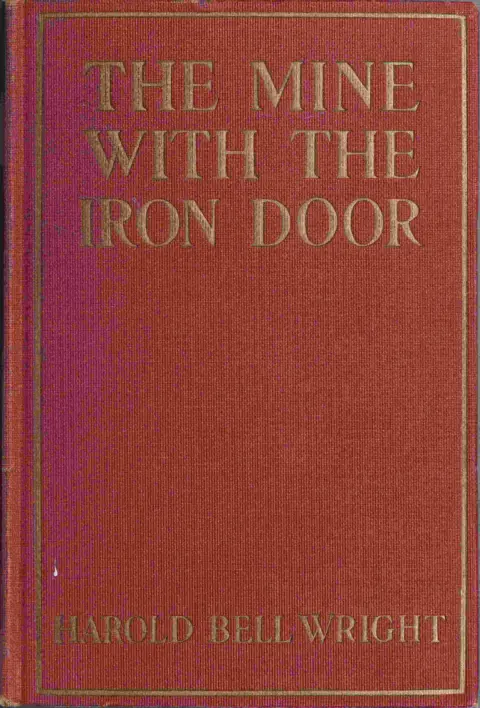
The Mine with the Iron Door
Harold Bell Wright
THE CLASSIC COLLECTION · 1921
"Helen of the Old House" by Harold Bell Wright is a novel written in the early 20th century. The story is set in the small manufacturing city of Millsburgh and revolves around the lives of its inhabitants, focusing on the contrast between the wealthy Mill owner Adam Ward and the struggling working-class families in the community. The characters, particularly Adam's daughter Helen and the children Bobby and Maggie Whaley, navigate themes of class struggle, happiness, and social responsibility against the backdrop of an industrialized society. The beginning of the novel introduces two children, Bobby and Maggie Whaley, who live in a poor community overshadowed by the Mill owned by Adam Ward. As they explore their environment, they come across a peculiar figure known as the Interpreter, who resides in a small hut on a cliff overlooking the Mill. The children, drawn by curiosity and the hope of adventure, climb to meet the Interpreter and are welcomed into his world filled with stories and kindness. Their initial joy is contrasted sharply with their subsequent encounter with Adam Ward, who harshly confronts them, revealing the depth of class divides and animosity that permeates their lives. The story sets the stage for deeper explorations of personal connections, societal roles, and the quest for happiness amidst adversity.
Introduction adapted from the source catalogue; source summaries may be automatically generated.
Free to read · English · 89,607 words · No account needed
MAKE TIME FOR A GOOD BOOK
On by default. Untick to stop anonymous reading totals. Each page counts after 10 seconds in view. How this works.
Anonymous counting is on unless you have switched it off.
Helen had not consciously followed the children. Indeed, her mind was so occupied with her own troubled thoughts that she had forgotten the little victims of her father's insane cruelty. To avoid meeting her mother, as she fled from the scene of her father's madness, she had taken a course that led her toward the entrance to the estate. With the one thought of escaping from the invisible presence of that hidden thing, she had left the grounds and followed the quiet old road.
When the storm of her grief had calmed a little, the young woman raised her head and saw Sam Whaley's dirty, ill-kept children gazing at her with wondering sympathy. It is not too much to say that Helen Ward was more embarrassed than she would have been had she found herself thus suddenly in the presence of royalty. "I am sorry you were frightened," she said, hesitatingly. "I can't believe that he really would have hurt you."
"Huh," grunted Bobby. "I'm darned glad we was outside of that there
fence."
Maggie's big eyes were eloquent with compassion. "Did--did he scare
yer, too?"
Helen held back her tears with an effort. "Yes, dear, he frightened me,
too--dreadfully."
With shy friendliness, little Maggie drew closer. "Is he--is he sure
'nuff, yer father?"
"Yes," returned Helen, "he is my father."
"Gee!" ejaculated Bobby. "An' is he always like that?"
"Oh, no, indeed," returned Helen, quickly. "Father is really kind and good, but he--he is sick now and not wholly himself, you see."
"Huh," said Bobby. "He didn't act very sick to me. What's ailin' him?"
Helen answered slowly, "I--we don't just know what it is. The doctors say it is a nervous trouble."
"An' does he--does he ever whip yer?" asked Maggie.
In spite of the pain in her heart, Helen smiled. "No--never."
"Our dad gits mad, too, sometimes," said Bobby. "But, gee! he ain't never like that. Dad, he wouldn't care if somebody just looked into our yard. We wasn't a-hurtin' nothin'--just a-lookin'--that's all. Yer can't hurt nothin' just a-lookin', can yer?"
"I am sorry," said Helen.
"Be yer happy?" asked Maggie, suddenly, with disconcerting directness.
"Why!" replied Helen, "I--What makes you ask such a funny question?"
Maggie was too much embarrassed at her own boldness to answer, and
Bobby came to her rescue.
"She wants to know because the Interpreter, he tole us about a princess what lived in a castle an' wasn't happy 'til the fairy told her how to find the jewel of happiness; an' Mag, here, she thinks it's you."
"And where did the princess find the jewel of happiness?" asked Helen.
Your reading position is saved on this browser. Take it to another device with a library code. Reading pages adapt to text, rather than matching a printed edition.
Harold Bell Wright
Harold Bell Wright
Harold Bell Wright
Harold Bell Wright
BEHIND THE BOOK
This eBook is for the use of anyone anywhere in the United States and most other parts of the world at no cost and with almost no restrictions whatsoever. You may copy it, give it away or re-use it under the terms of the Project Gutenberg License included with this eBook or online at www.gutenberg.org. If you are not located in the United States, you will have to check the laws of the country where you are located before using this eBook. Read the source licence.
The original source file, including credits and licence, is retained by this library. Request an original-format copy at no charge. Please include the book title and Project Gutenberg identifier #9410.
KEEP YOUR CURIOSITY GOING
Coulson Kernahan

Maurice Baring
Frances Wright
Cécile Tormay

Frederic Jesup Stimson

W. H. P. (William Henry Pope) Jarvis