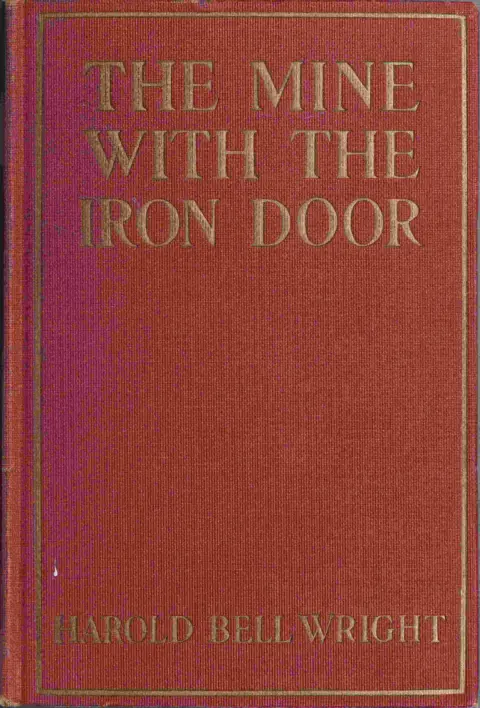
The Mine with the Iron Door
Harold Bell Wright
THE CLASSIC COLLECTION · 1921
"Helen of the Old House" by Harold Bell Wright is a novel written in the early 20th century. The story is set in the small manufacturing city of Millsburgh and revolves around the lives of its inhabitants, focusing on the contrast between the wealthy Mill owner Adam Ward and the struggling working-class families in the community. The characters, particularly Adam's daughter Helen and the children Bobby and Maggie Whaley, navigate themes of class struggle, happiness, and social responsibility against the backdrop of an industrialized society. The beginning of the novel introduces two children, Bobby and Maggie Whaley, who live in a poor community overshadowed by the Mill owned by Adam Ward. As they explore their environment, they come across a peculiar figure known as the Interpreter, who resides in a small hut on a cliff overlooking the Mill. The children, drawn by curiosity and the hope of adventure, climb to meet the Interpreter and are welcomed into his world filled with stories and kindness. Their initial joy is contrasted sharply with their subsequent encounter with Adam Ward, who harshly confronts them, revealing the depth of class divides and animosity that permeates their lives. The story sets the stage for deeper explorations of personal connections, societal roles, and the quest for happiness amidst adversity.
Introduction adapted from the source catalogue; source summaries may be automatically generated.
Free to read · English · 89,607 words · No account needed
MAKE TIME FOR A GOOD BOOK
On by default. Untick to stop anonymous reading totals. Each page counts after 10 seconds in view. How this works.
Anonymous counting is on unless you have switched it off.
Bobby thought that she had discovered her mistake in coming to the wrong place. But the next moment she was coming closer, and he heard, "Bobby, is that really you! You poor child, have you been ill?"
"I ain't been sick, if that's what yer mean," returned the boy. "Mag is, though. She's worse to-day."
His manner was sullenly defiant, as if the warmly dressed stranger had in some way revealed herself as his enemy.
"Don't you know me, Bobby?"
"Not with yer face covered up like that, I don't."
She laughed nervously and raised her veil.
"Huh, it's you, is it? Funny--Mag's been a-talkin' about her princess lady all afternoon. What yer doin' here?"
Before this hollow-cheeked skeleton of a boy Helen Ward felt strangely like one who, conscious of guilt, is brought suddenly into the presence of a stern judge.
"Why, Bobby," she faltered, "I--I came to see you and Maggie--I was at the Interpreter's this afternoon and he told me--I mean something he said made me want to come."
"The Interpreter, he's all right," said the boy. "So's Mary Martin."
"Aren't you just a little glad to see me, Bobby?"
The boy did not seem to hear. "Funny the way Mag talks about yer all the time. She's purty sick all right. Peterson's baby, it died."
"Can't we go into the house and see Maggie? You must be nearly frozen standing out here in the cold."
"Huh, I'm used to freezin'--I guess yer can come on in though--if yer want to. Mebbe Mag 'd like to see yer."
He pushed open the door, and she followed him into the ghastly barrenness of the place that he knew as home.
Never before had the daughter of Adam Ward viewed such naked, cruel poverty. She shuddered with the horror of it. It was so unreal--so unbelievable.
A small, rusty cookstove with no fire--a rude table with no cloth--a rickety cupboard with its shelves bare save for a few dishes--two broken-backed chairs--that was all. No, it was not all--on a window ledge, beneath a bundle of rags that filled the opening left by a broken pane, was a small earthen flowerpot holding a single scraggly slip of geranium.
Helen seemed to hear again the Interpreter saying, "A girl with true
instincts for the best things of life and a capacity for great
happiness."
At Bobby's call, Mrs. Whaley came from another room.
The boy did not even attempt an introduction but stood sullenly aside, waiting developments, and the mother in her pitiful distress evidently failed to identify their visitor when Helen introduced herself.
Your reading position is saved on this browser. Take it to another device with a library code. Reading pages adapt to text, rather than matching a printed edition.
Harold Bell Wright
Harold Bell Wright
Harold Bell Wright
Harold Bell Wright
BEHIND THE BOOK
This eBook is for the use of anyone anywhere in the United States and most other parts of the world at no cost and with almost no restrictions whatsoever. You may copy it, give it away or re-use it under the terms of the Project Gutenberg License included with this eBook or online at www.gutenberg.org. If you are not located in the United States, you will have to check the laws of the country where you are located before using this eBook. Read the source licence.
The original source file, including credits and licence, is retained by this library. Request an original-format copy at no charge. Please include the book title and Project Gutenberg identifier #9410.
KEEP YOUR CURIOSITY GOING
Coulson Kernahan

Maurice Baring
Frances Wright
Cécile Tormay

Frederic Jesup Stimson

W. H. P. (William Henry Pope) Jarvis